More than 10,000 Starlink satellites currently orbit the Earth. We see them crawling across dark skies, no matter how remote our location, and streaking through images from research telescopes.
SpaceX recently announced that it wants to launch one million more of these satellites as orbital data centres for AI computing power.
A few years ago, we wrote a paper predicting what the night sky would look like with 65,000 satellites from four planned megaconstellations: SpaceX’s Starlink, Amazon’s Kuiper (now Leo), the U.K.’s OneWeb and China’s Guowang. We calibrated our models to observations of real Starlink satellites and came up with a startling prediction: One in 15 visible points in the night sky would be a satellite, not a star.
A million satellites would be so much worse.
The human eye can see fewer than 4,500 stars in an unpolluted night sky. If we permit SpaceX to launch these satellites, we will see more satellites than stars — for large portions of the night and the year, throughout the world. This will severely damage the night sky for everyone on Earth.
SpaceX’s proposal also completely fails to account for atmospheric pollution, collision risk or how to develop the technology needed to disperse waste heat from orbital data centres.
Predicting the night sky
SpaceX has filed its million-satellite proposal to the United States Federal Communications Commission (FCC) and has only provided bare-bones information about these new satellites so far.
We do know that the proposed constellation will have satellites in much higher orbits, making them visible for longer periods of the night.
We decided to build an updated simulation, using the website of astrophysicist Jonathan McDowell. This includes a set of orbits consistent with the limited information in SpaceX’s filing.
We used the observed brightness of Starlink satellites as a reference, scaling the brightness model by considering size jumps between Starlink V1, V2 and predictions for V3, and assuming even higher complexity and power requirements.
There are many factors we don’t know anything about, so there is some uncertainty in the brightness we predict.
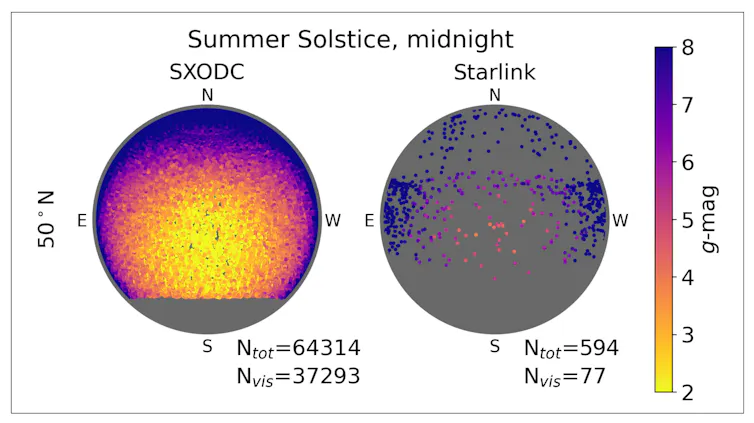
In the figure above, each grey circle shows a simulation of the full night sky, as seen from latitude 50 degrees north at midnight on the summer solstice.
The left circle shows the night sky with SpaceX’s orbital data centres (SXODC), and the right shows the night sky with 42,000 Starlink satellites for comparison.
The coloured points show the positions and brightness of satellites in the sky, with blue the faintest and yellow the brightest. Below each all-sky simulation we list the number of sunlit satellites in the sky (Ntot) and the number of naked-eye visible satellites (Nvis), with tens of thousands predicted for SXODC.
Each of our simulations shows there will be more visible satellites than stars for large portions of the night and the year.
It is hard to overstate this: Should a million new satellites be launched, in the orbits and with the sizes proposed, the stars we are able to see at night would be completely overwhelmed by artificial satellites — throughout the world.
This does not even account for additional large satellite system proposals filed to the International Telecommunication Union (ITU) in recent years by numerous national governments.
A satellite crematorium
SpaceX’s proposal is that these new satellites will operate as orbital data centres.
Data centres on the ground are drawing increasing criticism for the huge amounts of water and electricity they use. In an impressive feat of greenwashing, SpaceX suggests that launching data centres into orbit is better for the environment. This is only true if you ignore all the consequences of satellite launch, orbital operations and re-entry.
We can already measure atmospheric pollution from “re-entries,” when satellites fall back to Earth. We know that multiple satellites are falling every day and that if they do not fully burn up on re-entry, debris falls on the ground with risk for injury and death.
Increasing densities of satellites also drive up collision risks in orbit. And using the atmosphere as a satellite crematorium is changing the atmosphere in ways we don’t yet understand.
Practically, it is not at all clear whether the proposed orbital data centres are feasible any time soon. To operate data centres in orbit, they would need to disperse huge amounts of waste heat. Despite the greenwashing, this is actually very hard to do in space as they would have to manage the intense radiation from the sun, while cooling the satellite by radiation.
SpaceX should know this well: one of the first brightness mitigations they tested for Starlink was “darksat,” a Starlink satellite they effectively just painted black. The satellite overheated and the electronics fried.
A slap in the face for astronomers
SpaceX has done a lot of engineering work to make its Starlink satellites fainter. They are still too bright for research astronomy, but thanks to new coatings, their brightness has not increased dramatically even as SpaceX has launched larger and larger satellites.
SpaceX’s proposal for one million AI data centre satellites with enormous power requirements does not include any discussion of the co-ordination agreement for dark and quiet skies required by the FCC.
It feels like a slap in the face after many astronomers have spent years working with SpaceX on ways to mitigate their Starlink megaconstellation and save the night sky.
Orbital space is a finite resource
The SpaceX filing does not include exact orbits, the size or shape of satellites or the casualty risk from de-orbiting (other than a vague promise that it won’t exceed 0.01 per cent per satellite). It doesn’t even include any information on how the company plans to develop the technology that does not currently exist but is needed to make this plan work.
Despite how shockingly little information SpaceX provided, the FCC accepted SpaceX’s filing and opened the comment period within four days. Astronomers and dark sky advocates worldwide scrambled to write and submit comments in the short four weeks that the comment period was open.
The scientific process is slow and careful and it often takes months or years to publish a peer-reviewed result. Companies like SpaceX have stated repeatedly that their method is to “move fast and break things.” They are now close to breaking the atmosphere, the night sky and anything on the ground or in space that their satellites and rockets fall on or crash into.
Earth’s orbital space is a finite resource. There is an evolving set of international guidelines for operating in outer space, grounded in a set of high-level international rules. Yet, those rules and guidelines are inadequate.
One corporation based in one country should not be allowed to ruin orbit, the night sky, and the atmosphere for everyone else in the world.