

Market Justice vs. Egalitarianism: The Role of the Alpha Parameter in Economic Equilibrium
Table of Links
Abstract and 1. Introduction
-
A free and fair economy: definition, existence and uniqueness
2.1 A free economy
2.2 A free and fair economy
-
Equilibrium existence in a free and fair economy
3.1 A free and fair economy as a strategic form game
3.2 Existence of an equilibrium
-
Equilibrium efficiency in a free and fair economy
-
A free economy with social justice and inclusion
5.1 Equilibrium existence and efficiency in a free economy with social justice
5.2 Choosing a reference point to achieve equilibrium efficiency
-
Some applications
6.1 Teamwork: surplus distribution in a firm
6.2 Contagion and self-enforcing lockdown in a networked economy
6.3 Bias in academic publishing
6.4 Exchange economies
-
Contributions to the closely related literature
-
Conclusion and References
Appendix
5.1 Equilibrium existence and efficiency in a free economy with social justice
In what follows, we study the existence of equilibrium in an α-free economy with social justice. As defined in Section 3.1, a free economy with social justice admits an equilibrium if the strategic form game derived from that economy possesses a pure strategy Nash equilibrium. A meritocratic planner will choose a higher α when allocating resources since talents and merits have more value in such a society. An egalitarian planner will put a higher weight on equal distribution. It follows that a choice of α reveals a trade-off between market justice and egalitarianism. The good news is that there exists a self-enforcing social contract irrespective of the size of α. We have the result hereunder.
\ 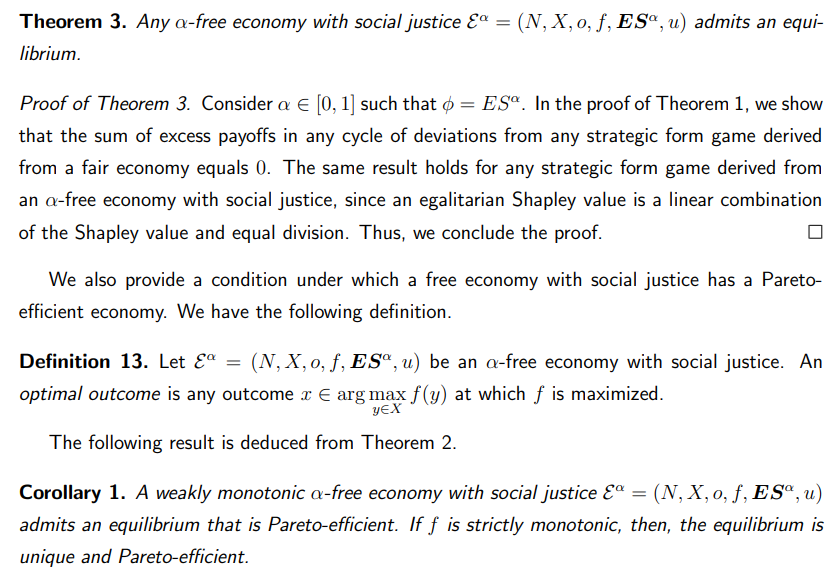
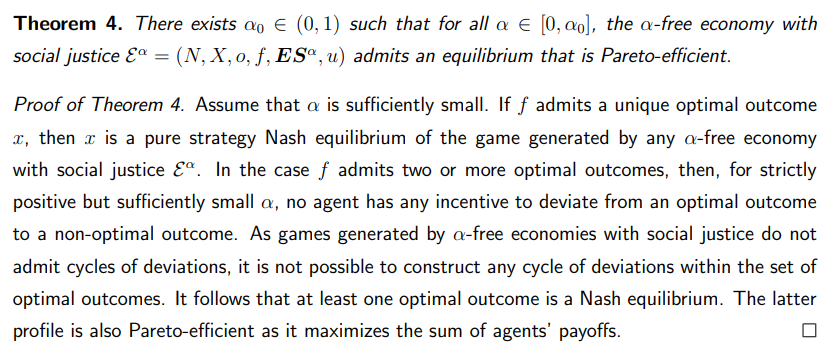
\ The proof of Corollary 1 is similar to that of Theorem 2. Next, we provide an additional result about Pareto-efficiency of equilibria in a free economy with social justice.
\ 
\ 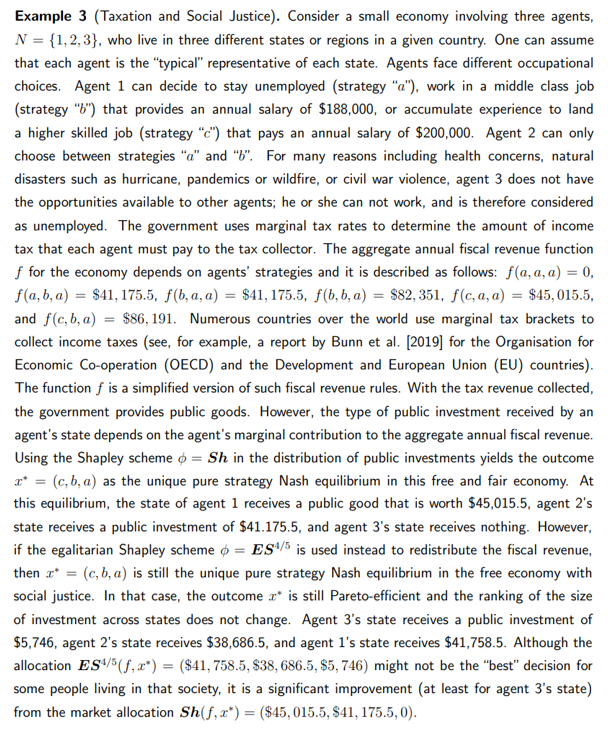
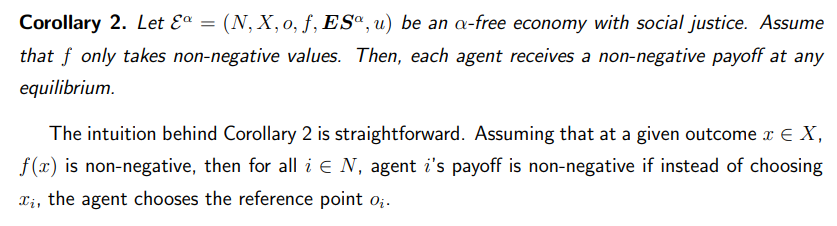
\ Using Theorem 4, we deduce the following corollary.
\ 
\
:::info Authors:
(1) Ghislain H. Demeze-Jouatsa, Center for Mathematical Economics, University of Bielefeld (demeze jouatsa@uni-bielefeld.de);
(2) Roland Pongou, Department of Economics, University of Ottawa (rpongou@uottawa.ca);
(3) Jean-Baptiste Tondji, Department of Economics and Finance, The University of Texas Rio Grande Valley (jeanbaptiste.tondji@utrgv.edu).
:::
:::info This paper is available on arxiv under CC BY 4.0 DEED license.
:::
\


You May Also Like

Iran’s army chief warns of ‘total destruction’ for ground invasion

Metaplanet Stock Passes MARA to Become Third-Largest BTC Holder — Stock Slips Anyway




