TLDR The Nasdaq Composite dropped 2.4% on Thursday, falling over 10% from its October 29 record high, confirming a correction The selloff is driven by uncertaintyTLDR The Nasdaq Composite dropped 2.4% on Thursday, falling over 10% from its October 29 record high, confirming a correction The selloff is driven by uncertainty

Nasdaq Falls Into Correction as Iran War Uncertainty Rattles Tech Stocks and Markets

2026/03/27 23:46
3 min read
For feedback or concerns regarding this content, please contact us at crypto.news@mexc.com

TLDR

  • The Nasdaq Composite dropped 2.4% on Thursday, falling over 10% from its October 29 record high, confirming a correction
  • The selloff is driven by uncertainty over the U.S.-Israeli war with Iran and fears of rising oil prices and inflation
  • Gas prices in the U.S. hit $3.98, up $1.00 in just one month
  • Meta Platforms dropped 8% after two court verdicts found it liable for harm to young users
  • Nvidia, Alphabet, and Tesla all fell between 3.4% and 4.2% on Thursday

The Nasdaq Composite is officially in correction territory. The index dropped 2.4% on Thursday, putting it nearly 11% below its record-high close from October 29, 2025. This is the first time the Nasdaq has confirmed a correction in a year.
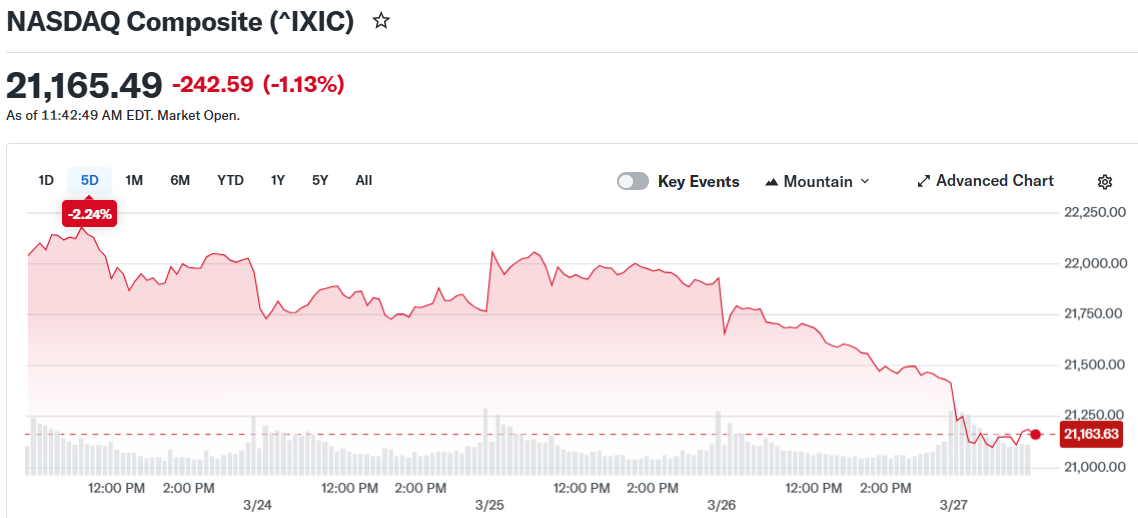
NASDAQ Composite (^IXIC)

The drop marks the index’s worst decline since April 2025, when President Trump’s “Liberation Day” tariff announcement sent global markets falling.

The Nasdaq is now down nearly 8% in 2026 and sits at its lowest point since early September 2025.

The main driver of the selloff is ongoing uncertainty around the U.S. and Israeli war with Iran. Investors are unsure how long the conflict will last and what it means for the global economy.

A Seeking Alpha community poll found most subscribers expect the operation to last up to three months. The White House has suggested a four-to-six week timeline. The gap between those estimates is adding to market nervousness.

Energy prices are rising fast. The average U.S. gas price is now $3.98 per gallon, up $1.00 from just one month ago. Seasonal demand is expected to push prices higher as spring begins.

Analysts say the energy shock could push inflation higher, or it could reduce consumer demand enough to slow the economy. The outcome depends heavily on how long the conflict continues.

Tech Stocks Take the Hit

Tech stocks have been hit hard. Nvidia fell 4.2%, Alphabet dropped 3.4%, and Tesla lost 3.6%. The Roundhill Magnificent Seven ETF dropped 3.3% and is now down 17% since the Nasdaq’s October peak.

Investors are also questioning whether massive AI spending by companies like Microsoft, Alphabet, and Amazon is paying off fast enough. The concern is that heavy infrastructure investment has not yet translated into meaningful revenue growth.

Meta Adds to the Pressure

Meta Platforms was one of the biggest drags on the index Thursday, falling 8%. Two court verdicts found Meta liable for harm to young users, raising fears the company may need to overhaul its advertising model.

The losses across Big Tech are amplified because these stocks now make up a large share of both the Nasdaq and the S&P 500. A pullback in any of them hits the broader index hard.

Jim Carroll, senior wealth adviser at Ballast Rock Private Wealth, described the market’s back-and-forth moves as enough to “make people seasick.”

The Nasdaq fell nearly 23% from its 2024 high before recovering through October 2025. Investors are now watching whether this correction follows a similar path, or deepens further.

The post Nasdaq Falls Into Correction as Iran War Uncertainty Rattles Tech Stocks and Markets appeared first on CoinCentral.


Market Opportunity
Union Logo
Union Price(UNION)
$0.0006056
$0.0006056$0.0006056
+10.77%
USD
Union (UNION) Live Price Chart
Disclaimer: The articles reposted on this site are sourced from public platforms and are provided for informational purposes only. They do not necessarily reflect the views of MEXC. All rights remain with the original authors. If you believe any content infringes on third-party rights, please contact crypto.news@mexc.com for removal. MEXC makes no guarantees regarding the accuracy, completeness, or timeliness of the content and is not responsible for any actions taken based on the information provided. The content does not constitute financial, legal, or other professional advice, nor should it be considered a recommendation or endorsement by MEXC.

You May Also Like

Coinbase Urges Treasury to Clarify GENIUS Act Implementation

Coinbase Urges Treasury to Clarify GENIUS Act Implementation

The post Coinbase Urges Treasury to Clarify GENIUS Act Implementation appeared on BitcoinEthereumNews.com. Coinbase has called on the U.S. Treasury Department to provide clearer guidance on the implementation of the GENIUS Act, warning that excessive regulation could undermine innovation and weaken the country’s position as a global leader in digital finance. Source: Coinbase In an official statement, Coinbase’s Director of Policy, Faryar Shirzad, said that new rules should “ensure the competitiveness of U.S. stablecoins and create conditions for their global adoption as a payment instrument.” The exchange cautioned the Treasury against introducing restrictions not explicitly outlined in the law, urging policymakers to focus on innovation rather than limitation. Coinbase’s Recommendations for the GENIUS Framework In its response, Coinbase proposed several key adjustments to the regulatory framework. It suggested that non-financial software developers, blockchain validators, and open protocols be excluded from GENIUS compliance requirements. The company also argued that the ban on interest payments should apply only to stablecoin issuers, not to exchanges or intermediaries offering bonus programs or loyalty rewards. Coinbase emphasized that rewards from third parties should not be considered a violation, warning that a broad definition of “interest” could distort the intent of the legislation. The firm additionally proposed that payment stablecoins be treated as cash equivalents for accounting and tax purposes — a move it said would “reflect their real-world use as stable digital currencies.” The GENIUS Act and Its Impact Signed into law in July 2025, the GENIUS Act marked the first comprehensive federal regulation of the U.S. stablecoin market. The law requires that all stablecoins be fully backed by liquid assets, mandates annual audits for issuers, and sets rules for foreign-issued tokens operating in the U.S. market. Coinbase urged regulators to uphold Congress’s original intent, emphasizing that effective policy should allow innovation to grow within the framework of the law, not in defiance of it. Not all lawmakers…
Share
BitcoinEthereumNews2025/11/07 02:16
Q2 Market Insights: Bitcoin regains dominance in risk-averse environment, ETFs remain critical to market structure


Q2 Market Insights: Bitcoin regains dominance in risk-averse environment, ETFs remain critical to market structure

The market will show a downward trend in the short term, and then rebound and set new highs in the second half of the year.
Share
PANews2025/04/28 19:40
Critical USDT0 Response to Drift Hack Exposes Stark Contrast in Stablecoin Security Protocols

Critical USDT0 Response to Drift Hack Exposes Stark Contrast in Stablecoin Security Protocols

BitcoinWorld Critical USDT0 Response to Drift Hack Exposes Stark Contrast in Stablecoin Security Protocols In a decisive security move that highlights evolving
Share
bitcoinworld2026/04/02 17:15

$30,000 in PRL + 15,000 USDT

$30,000 in PRL + 15,000 USDT$30,000 in PRL + 15,000 USDT

Deposit & trade PRL to boost your rewards!

