Bitfinex: Fragile Market Conditions Test Bitcoin’s Long-Term Bullish Potential

Bitfinex has released its latest crypto market analysis, highlighting that Bitcoin’s structural role as a scarce, non-sovereign asset remains intact, as well as the long-term bullish potential. However, short-term price movements are being constrained by weakening demand, institutional de-risking, and broader macroeconomic pressures, creating a fragile, range-bound market.
According to the report, Bitcoin’s recent trading activity illustrates a tension between its inherent resilience and declining immediate demand. Attempts to break above the $72,000 range were unsuccessful, followed by a swift retracement, suggesting that recent gains were largely driven by short-term liquidations rather than sustained spot buying. As prices return toward the monthly open, the lack of follow-through demand has reinforced a delicate, range-bound structure.
Institutional flows have shifted notably in recent weeks. After a period of strong accumulation in early March, ETF flows turned sharply negative, producing some of the largest single-day outflows from IBIT. This indicates active de-risking by institutional investors rather than passive portfolio rotation, removing a key support for Bitcoin prices.
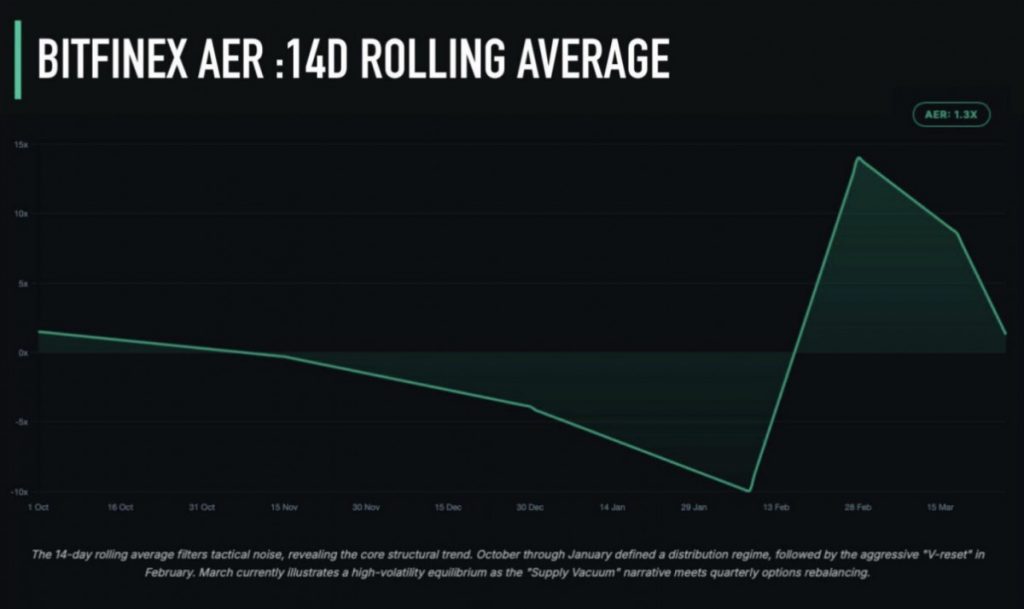
On-chain metrics confirm this change. The Absorption-to-Emissions Ratio (AER) has dropped from a speculative peak above 5x to approximately 1.3x, signaling that demand now only marginally exceeds new supply. The market has transitioned from aggressive accumulation to a fragile equilibrium, where even modest outflows could trigger supply-driven declines.
Macro Pressures And Structural Resilience
Despite short-term weakness, Bitcoin’s fundamental characteristics remain intact. Its status as a non-sovereign, supply-constrained asset continues to underpin its long-term thesis, which is expected to play out over quarters rather than in immediate market reactions. Current macroeconomic conditions are adding pressure in the near term.
Rising energy costs and geopolitical tensions have dampened consumer confidence, with US Consumer Sentiment falling to 53.3, while inflation expectations rise and growth risks persist. The labour market remains resilient but shows signs of gradual softening, reinforcing a “higher-for-longer” monetary policy stance as central banks balance inflation against slowing demand.
These macroeconomic dynamics are influencing broader asset allocation. Traditional safe havens such as gold have weakened under the dual pressures of rising yields and a stronger US dollar, as liquidity considerations take precedence over static hedges. At the same time, digital assets are gaining structural traction, with institutional adoption accelerating in areas such as stablecoins, payments infrastructure, and tokenization.
This signals a longer-term transformation in how capital is stored and transferred. Corporate strategies are evolving alongside these shifts. Marathon Digital Holdings’ $1.1 billion Bitcoin sale to reduce debt reflects a move away from passive holding strategies toward active treasury management, with Bitcoin increasingly treated as a liquid balance sheet asset.
The development of digital infrastructure continues to advance. Institutions like the NYSE are moving toward 24/7 tokenized securities markets, pointing to a future where traditional financial systems are more deeply integrated with blockchain technology. Regulatory frameworks are also adapting to these changes.
Overall, Bitcoin appears to be navigating two contrasting forces: a structurally bullish trend reflecting the transformation of financial systems and short-term bearish pressures driven by macroeconomic conditions. How this tension resolves is expected to determine the next major move in the market.
The post Bitfinex: Fragile Market Conditions Test Bitcoin’s Long-Term Bullish Potential appeared first on Metaverse Post.
You May Also Like

Ripple Moves Closer to Bank Approval as US Banking Rule Starts April 1

Official USA Token: Born in the U.S.A. (U.S.A.) Is a Fully Decentralized Solana Token With 348 Million Supply