Author: hitesh.eth , Crypto KOL Compiled by Felix, PANews This article delves into Bittensor, explaining why it is not a decentralized OpenAI, but rather a decentralized AI economy; it also explains how dTAO reshapes incentive mechanism design, how subnet economies work, and why TAO represents a cultural resistance to centralized AI. What changed after dTAO? Many may be wondering what Bittensor is trying to achieve. Is it trying to create a decentralized OpenAI, or is there something deeper at play? In fact, the crypto community generally believed that it could be a decentralized OpenAI, but confusion arose when it removed subnet restrictions and introduced the dTAO (which also involved subnet tokens) to make it more competitive. This shift was crucial because it shifted the network's reward distribution from centralized voting by a small number of validators to a fully market-driven system. The introduction of dynamic TAOs (dTAOs) fundamentally changed the ecosystem's operating mechanisms. The allocation of daily TAO issuance shifted entirely from the root validator (Subnet 0, which critics called an oligarchic voting system) to the market price of each subnet's alpha token. Each mining subnet received its own alpha (α) token and its own automated market maker (AMM) pool. This enabled each subnet to develop an independent, capital-driven economy. Staking shifted from delegating TAOs to a single validator (Subnet 0 staking) to purchasing and staking subnet-specific alpha tokens (α). Stakers now bear market risk but can directly influence resource allocation. The previously rigid 50/50 reward split between miners and validators evolved to the current 41/41/18 split to better fund subnet owners (18%) and encourage continued innovation in the subnet's core incentive mechanisms. Grand Vision Today, Bittensor competes with centralized AI development and distribution platforms, providing developers with the infrastructure to build diverse AI use cases across various industries. This is crucial to understanding Bittensor's total addressable market (TAM). While companies like OpenAI compete in the multi-billion dollar immediate market, selling finished AI products like subscriptions or API access, Bittensor targets the multi-trillion dollar market for the entire AI value chain—including computing infrastructure, data validation, model training, and the peer-reviewed intelligence layer. If successful, Bittensor, as the foundational, permissionless platform for all decentralized AI, will have a TAM far exceeding that of any single proprietary AI company. Bittensor is developing and deploying diverse AI models, building a coordination engine for a distributed and decentralized AI ecosystem while simultaneously incentivizing the provision of funding and computing resources to achieve the highest levels of quality, efficiency, and trust in outcomes across decentralized AI projects for diverse use cases. This is more like building a decentralized AI value chain in which anyone can participate with capital, knowledge, and computing power. Bittensor is for everyone, not just the 0.000001% of the world who can participate in OpenAI. Bittensor's overall vision is to build a neural internet. Over the past four years, Bittensor has built a loyal community that brings together top VCs like DCG, crypto researchers like Sami Kasab, and many talented people who work every day to advance this vision. They create content, do podcasts, develop products, and are starting a movement. Bittensor has also built a subnet ecosystem, with approximately 126 subnets currently active. The current cost of a subnet is approximately 1,600 TAOs ($640,000 USD), and this cost is dynamic and will change based on the frequency of new subnet registrations. After a few months of suspension, new subnet registrations are now open again. Grayscale, founded in 2013 by Barry Silbert, one of the earliest Bitcoin pioneers, aimed to attract institutional investors to Bitcoin. Now, Grayscale is creating a similar fund for subnet tokens. The fund, called the Yuma Subnet Composite Fund, will invest in the top subnet tokens by market capitalization. Subnet Tokens Subnet tokens are currently one of the most overlooked assets on crypto Twitter. 99% of users are completely unaware of this space. The core concept behind subnet token prices is that they are denominated in TAO, rather than simply pegged, and are determined by the liquidity ratio in their automated market maker (AMM) pools. The higher the value of a subnet token relative to TAO, the more it is issued. More issuance attracts more miners to host and run AI models and provide computing resources. Miners compete to optimize the output of subnet models, and better results lead to higher prices. More precisely, better service attracts more staking demand, which drives up prices, ensuring the overall output quality of AI models used in different subnets for different use cases. Validators ensure that miners maintain quality. Their job is to verify the miners' work and assign a score to it. Based on this score, the miners receive issuance from the subnet. Approximately 7,200 TAOs are issued daily, and this number will be halved over the next two months, with the first Bittensor halving event in December. This means there's currently intense competition within the mining ecosystem for the highest returns. Most miners will stick to mining on the best-performing subnets, and if they mine on top subnets, the price of those subnet tokens will rise accordingly. Increased mining demand driven by high issuance always leads to higher subnet token prices. Initial demand for mining on a subnet often comes from speculation about the use case it's building, the team behind it, its track record, and the backing of a major corporation. Currently, the top subnet tokens with the highest issuance volume include Chutes, Ridges, and Gradient. Some of these subnets are also venture-backed. For example, Gradient is building the AI Trains platform. It was built by Rayon Labs, which also operates Chutes, the leading subnet by issuance volume. Many of these subnets are collaborating with each other to exchange services. For example, Ridges is a Chutes client; Sportstensor is building AI models for sports betting and prediction; and there are subnets like OpenKaito, which powers Kaito's InfoFi Pioneer. Taofi is also part of Bittensor. They have launched a DEX that allows you to easily bridge and exchange subnet tokens from the Base network. Trust TAO If you're asking which subnet tokens will attract demand, you need to track the growth of the subnet token's price relative to TAO. The more growth you see over different timeframes, the higher the demand. Then, you need to look at the ADR (alpha distribution ratio). It should be less than 1, as token withdrawals are now permitted. The worst-performing subnets are withdrawn weekly. If the ADR ratio is above 1, the community may lose a portion of the value of the TAO collateral staked to acquire that token due to the liquidation discount upon withdrawal. You can also track staking pools for different subnets. The more TAO is staked to acquire subnet tokens, the more likely the price will rise. Therefore, the value of subnet tokens depends largely on how long they can maintain high issuance. If they maintain high issuance and the businesses surrounding the subnet generate revenue from the services and products they provide, the price of the subnet token is likely to continue to rise. The overall market capitalization growth surrounding the subnet will directly drive TAO price increases. However, it's recommended to stay away from things you don't understand. Subnet tokens aren't like your average altcoin or junk coin. They require a deeper logical understanding, so if you believe in their vision, invest in TAO. TAO isn't meant to be traded, but rather a cultural symbol against AI centralization. The question isn’t whether decentralized AI will exist, but who will own it. Bittensor has made its choice, and others will too. Related Reading: Bittensor Subnet Investment Guide: Seizing the Next AI TrendAuthor: hitesh.eth , Crypto KOL Compiled by Felix, PANews This article delves into Bittensor, explaining why it is not a decentralized OpenAI, but rather a decentralized AI economy; it also explains how dTAO reshapes incentive mechanism design, how subnet economies work, and why TAO represents a cultural resistance to centralized AI. What changed after dTAO? Many may be wondering what Bittensor is trying to achieve. Is it trying to create a decentralized OpenAI, or is there something deeper at play? In fact, the crypto community generally believed that it could be a decentralized OpenAI, but confusion arose when it removed subnet restrictions and introduced the dTAO (which also involved subnet tokens) to make it more competitive. This shift was crucial because it shifted the network's reward distribution from centralized voting by a small number of validators to a fully market-driven system. The introduction of dynamic TAOs (dTAOs) fundamentally changed the ecosystem's operating mechanisms. The allocation of daily TAO issuance shifted entirely from the root validator (Subnet 0, which critics called an oligarchic voting system) to the market price of each subnet's alpha token. Each mining subnet received its own alpha (α) token and its own automated market maker (AMM) pool. This enabled each subnet to develop an independent, capital-driven economy. Staking shifted from delegating TAOs to a single validator (Subnet 0 staking) to purchasing and staking subnet-specific alpha tokens (α). Stakers now bear market risk but can directly influence resource allocation. The previously rigid 50/50 reward split between miners and validators evolved to the current 41/41/18 split to better fund subnet owners (18%) and encourage continued innovation in the subnet's core incentive mechanisms. Grand Vision Today, Bittensor competes with centralized AI development and distribution platforms, providing developers with the infrastructure to build diverse AI use cases across various industries. This is crucial to understanding Bittensor's total addressable market (TAM). While companies like OpenAI compete in the multi-billion dollar immediate market, selling finished AI products like subscriptions or API access, Bittensor targets the multi-trillion dollar market for the entire AI value chain—including computing infrastructure, data validation, model training, and the peer-reviewed intelligence layer. If successful, Bittensor, as the foundational, permissionless platform for all decentralized AI, will have a TAM far exceeding that of any single proprietary AI company. Bittensor is developing and deploying diverse AI models, building a coordination engine for a distributed and decentralized AI ecosystem while simultaneously incentivizing the provision of funding and computing resources to achieve the highest levels of quality, efficiency, and trust in outcomes across decentralized AI projects for diverse use cases. This is more like building a decentralized AI value chain in which anyone can participate with capital, knowledge, and computing power. Bittensor is for everyone, not just the 0.000001% of the world who can participate in OpenAI. Bittensor's overall vision is to build a neural internet. Over the past four years, Bittensor has built a loyal community that brings together top VCs like DCG, crypto researchers like Sami Kasab, and many talented people who work every day to advance this vision. They create content, do podcasts, develop products, and are starting a movement. Bittensor has also built a subnet ecosystem, with approximately 126 subnets currently active. The current cost of a subnet is approximately 1,600 TAOs ($640,000 USD), and this cost is dynamic and will change based on the frequency of new subnet registrations. After a few months of suspension, new subnet registrations are now open again. Grayscale, founded in 2013 by Barry Silbert, one of the earliest Bitcoin pioneers, aimed to attract institutional investors to Bitcoin. Now, Grayscale is creating a similar fund for subnet tokens. The fund, called the Yuma Subnet Composite Fund, will invest in the top subnet tokens by market capitalization. Subnet Tokens Subnet tokens are currently one of the most overlooked assets on crypto Twitter. 99% of users are completely unaware of this space. The core concept behind subnet token prices is that they are denominated in TAO, rather than simply pegged, and are determined by the liquidity ratio in their automated market maker (AMM) pools. The higher the value of a subnet token relative to TAO, the more it is issued. More issuance attracts more miners to host and run AI models and provide computing resources. Miners compete to optimize the output of subnet models, and better results lead to higher prices. More precisely, better service attracts more staking demand, which drives up prices, ensuring the overall output quality of AI models used in different subnets for different use cases. Validators ensure that miners maintain quality. Their job is to verify the miners' work and assign a score to it. Based on this score, the miners receive issuance from the subnet. Approximately 7,200 TAOs are issued daily, and this number will be halved over the next two months, with the first Bittensor halving event in December. This means there's currently intense competition within the mining ecosystem for the highest returns. Most miners will stick to mining on the best-performing subnets, and if they mine on top subnets, the price of those subnet tokens will rise accordingly. Increased mining demand driven by high issuance always leads to higher subnet token prices. Initial demand for mining on a subnet often comes from speculation about the use case it's building, the team behind it, its track record, and the backing of a major corporation. Currently, the top subnet tokens with the highest issuance volume include Chutes, Ridges, and Gradient. Some of these subnets are also venture-backed. For example, Gradient is building the AI Trains platform. It was built by Rayon Labs, which also operates Chutes, the leading subnet by issuance volume. Many of these subnets are collaborating with each other to exchange services. For example, Ridges is a Chutes client; Sportstensor is building AI models for sports betting and prediction; and there are subnets like OpenKaito, which powers Kaito's InfoFi Pioneer. Taofi is also part of Bittensor. They have launched a DEX that allows you to easily bridge and exchange subnet tokens from the Base network. Trust TAO If you're asking which subnet tokens will attract demand, you need to track the growth of the subnet token's price relative to TAO. The more growth you see over different timeframes, the higher the demand. Then, you need to look at the ADR (alpha distribution ratio). It should be less than 1, as token withdrawals are now permitted. The worst-performing subnets are withdrawn weekly. If the ADR ratio is above 1, the community may lose a portion of the value of the TAO collateral staked to acquire that token due to the liquidation discount upon withdrawal. You can also track staking pools for different subnets. The more TAO is staked to acquire subnet tokens, the more likely the price will rise. Therefore, the value of subnet tokens depends largely on how long they can maintain high issuance. If they maintain high issuance and the businesses surrounding the subnet generate revenue from the services and products they provide, the price of the subnet token is likely to continue to rise. The overall market capitalization growth surrounding the subnet will directly drive TAO price increases. However, it's recommended to stay away from things you don't understand. Subnet tokens aren't like your average altcoin or junk coin. They require a deeper logical understanding, so if you believe in their vision, invest in TAO. TAO isn't meant to be traded, but rather a cultural symbol against AI centralization. The question isn’t whether decentralized AI will exist, but who will own it. Bittensor has made its choice, and others will too. Related Reading: Bittensor Subnet Investment Guide: Seizing the Next AI Trend

Bittensor (TAO) Explained: A Trillion-Dollar Market Opportunity

2025/10/14 10:56

Author: hitesh.eth , Crypto KOL

Compiled by Felix, PANews

This article delves into Bittensor, explaining why it is not a decentralized OpenAI, but rather a decentralized AI economy; it also explains how dTAO reshapes incentive mechanism design, how subnet economies work, and why TAO represents a cultural resistance to centralized AI.

What changed after dTAO?

Many may be wondering what Bittensor is trying to achieve. Is it trying to create a decentralized OpenAI, or is there something deeper at play? In fact, the crypto community generally believed that it could be a decentralized OpenAI, but confusion arose when it removed subnet restrictions and introduced the dTAO (which also involved subnet tokens) to make it more competitive. This shift was crucial because it shifted the network's reward distribution from centralized voting by a small number of validators to a fully market-driven system.

The introduction of dynamic TAOs (dTAOs) fundamentally changed the ecosystem's operating mechanisms. The allocation of daily TAO issuance shifted entirely from the root validator (Subnet 0, which critics called an oligarchic voting system) to the market price of each subnet's alpha token. Each mining subnet received its own alpha (α) token and its own automated market maker (AMM) pool. This enabled each subnet to develop an independent, capital-driven economy. Staking shifted from delegating TAOs to a single validator (Subnet 0 staking) to purchasing and staking subnet-specific alpha tokens (α). Stakers now bear market risk but can directly influence resource allocation. The previously rigid 50/50 reward split between miners and validators evolved to the current 41/41/18 split to better fund subnet owners (18%) and encourage continued innovation in the subnet's core incentive mechanisms.

Grand Vision

Today, Bittensor competes with centralized AI development and distribution platforms, providing developers with the infrastructure to build diverse AI use cases across various industries. This is crucial to understanding Bittensor's total addressable market (TAM). While companies like OpenAI compete in the multi-billion dollar immediate market, selling finished AI products like subscriptions or API access, Bittensor targets the multi-trillion dollar market for the entire AI value chain—including computing infrastructure, data validation, model training, and the peer-reviewed intelligence layer.

If successful, Bittensor, as the foundational, permissionless platform for all decentralized AI, will have a TAM far exceeding that of any single proprietary AI company. Bittensor is developing and deploying diverse AI models, building a coordination engine for a distributed and decentralized AI ecosystem while simultaneously incentivizing the provision of funding and computing resources to achieve the highest levels of quality, efficiency, and trust in outcomes across decentralized AI projects for diverse use cases. This is more like building a decentralized AI value chain in which anyone can participate with capital, knowledge, and computing power.

Bittensor is for everyone, not just the 0.000001% of the world who can participate in OpenAI.

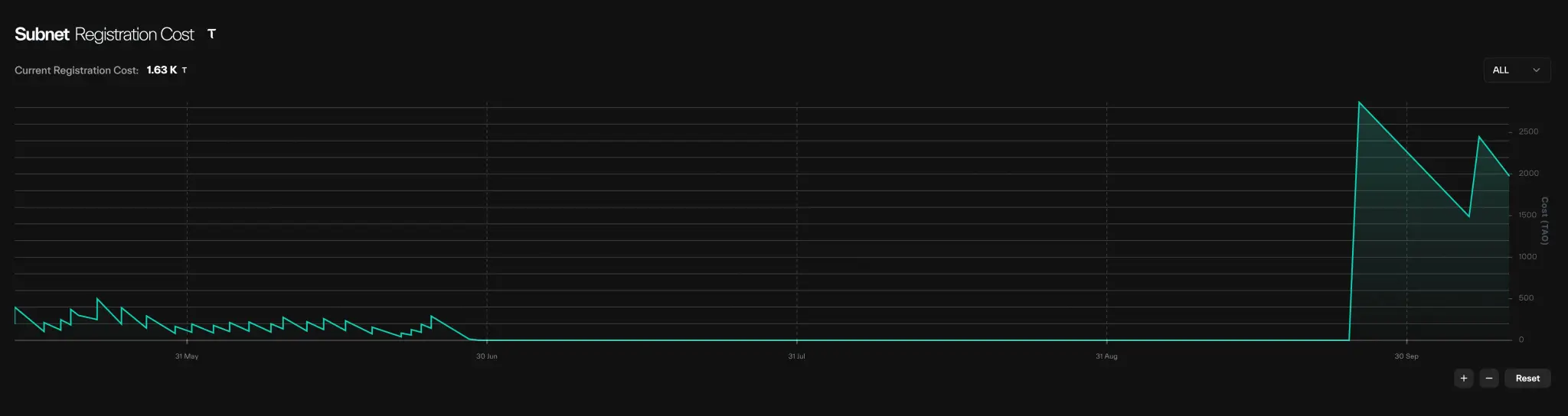
Bittensor's overall vision is to build a neural internet. Over the past four years, Bittensor has built a loyal community that brings together top VCs like DCG, crypto researchers like Sami Kasab, and many talented people who work every day to advance this vision. They create content, do podcasts, develop products, and are starting a movement. Bittensor has also built a subnet ecosystem, with approximately 126 subnets currently active. The current cost of a subnet is approximately 1,600 TAOs ($640,000 USD), and this cost is dynamic and will change based on the frequency of new subnet registrations. After a few months of suspension, new subnet registrations are now open again.

Grayscale, founded in 2013 by Barry Silbert, one of the earliest Bitcoin pioneers, aimed to attract institutional investors to Bitcoin. Now, Grayscale is creating a similar fund for subnet tokens. The fund, called the Yuma Subnet Composite Fund, will invest in the top subnet tokens by market capitalization.

Subnet Tokens

Subnet tokens are currently one of the most overlooked assets on crypto Twitter. 99% of users are completely unaware of this space. The core concept behind subnet token prices is that they are denominated in TAO, rather than simply pegged, and are determined by the liquidity ratio in their automated market maker (AMM) pools. The higher the value of a subnet token relative to TAO, the more it is issued. More issuance attracts more miners to host and run AI models and provide computing resources. Miners compete to optimize the output of subnet models, and better results lead to higher prices. More precisely, better service attracts more staking demand, which drives up prices, ensuring the overall output quality of AI models used in different subnets for different use cases. Validators ensure that miners maintain quality.

Their job is to verify the miners' work and assign a score to it. Based on this score, the miners receive issuance from the subnet. Approximately 7,200 TAOs are issued daily, and this number will be halved over the next two months, with the first Bittensor halving event in December.
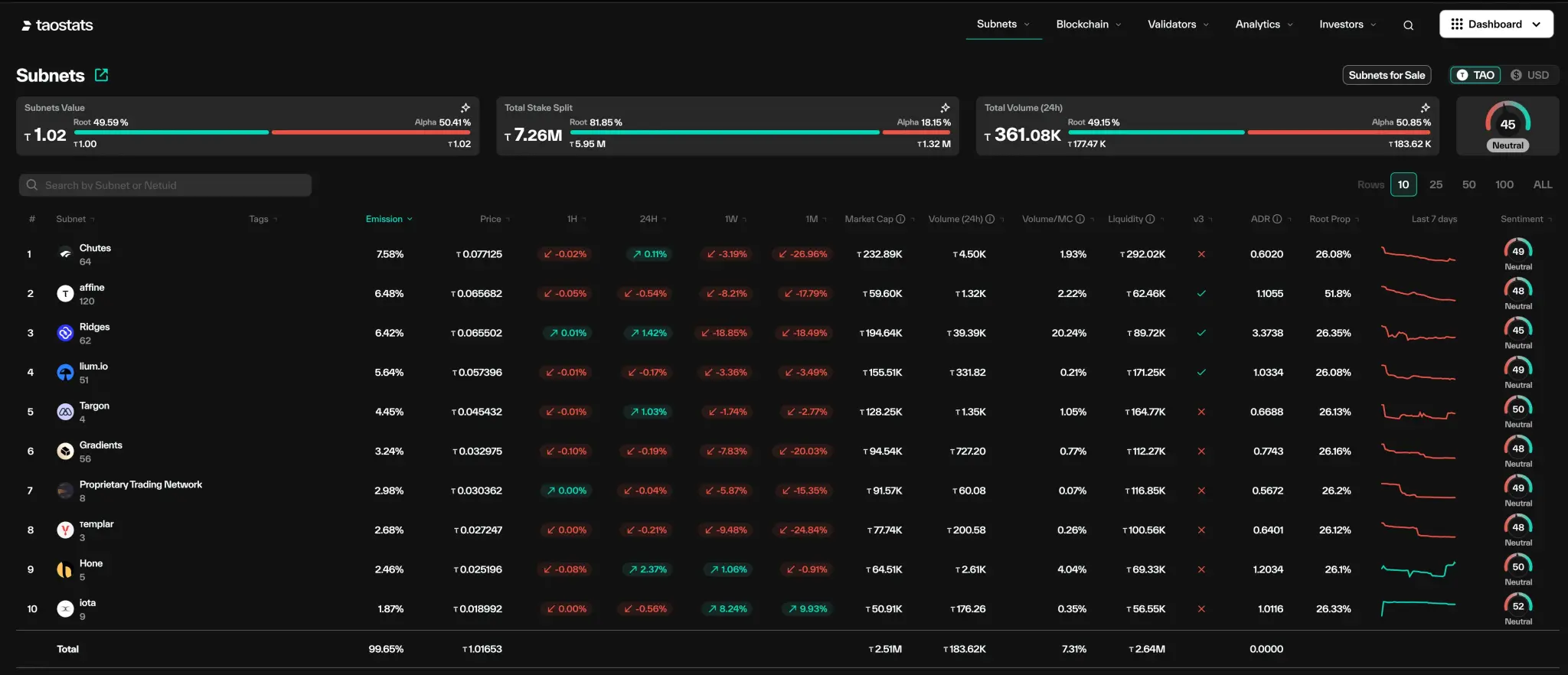
This means there's currently intense competition within the mining ecosystem for the highest returns. Most miners will stick to mining on the best-performing subnets, and if they mine on top subnets, the price of those subnet tokens will rise accordingly. Increased mining demand driven by high issuance always leads to higher subnet token prices. Initial demand for mining on a subnet often comes from speculation about the use case it's building, the team behind it, its track record, and the backing of a major corporation.

Currently, the top subnet tokens with the highest issuance volume include Chutes, Ridges, and Gradient. Some of these subnets are also venture-backed. For example, Gradient is building the AI Trains platform. It was built by Rayon Labs, which also operates Chutes, the leading subnet by issuance volume. Many of these subnets are collaborating with each other to exchange services. For example, Ridges is a Chutes client; Sportstensor is building AI models for sports betting and prediction; and there are subnets like OpenKaito, which powers Kaito's InfoFi Pioneer. Taofi is also part of Bittensor. They have launched a DEX that allows you to easily bridge and exchange subnet tokens from the Base network.

Trust TAO

If you're asking which subnet tokens will attract demand, you need to track the growth of the subnet token's price relative to TAO. The more growth you see over different timeframes, the higher the demand. Then, you need to look at the ADR (alpha distribution ratio). It should be less than 1, as token withdrawals are now permitted. The worst-performing subnets are withdrawn weekly. If the ADR ratio is above 1, the community may lose a portion of the value of the TAO collateral staked to acquire that token due to the liquidation discount upon withdrawal.
You can also track staking pools for different subnets. The more TAO is staked to acquire subnet tokens, the more likely the price will rise. Therefore, the value of subnet tokens depends largely on how long they can maintain high issuance. If they maintain high issuance and the businesses surrounding the subnet generate revenue from the services and products they provide, the price of the subnet token is likely to continue to rise. The overall market capitalization growth surrounding the subnet will directly drive TAO price increases.

However, it's recommended to stay away from things you don't understand. Subnet tokens aren't like your average altcoin or junk coin. They require a deeper logical understanding, so if you believe in their vision, invest in TAO. TAO isn't meant to be traded, but rather a cultural symbol against AI centralization.

The question isn’t whether decentralized AI will exist, but who will own it. Bittensor has made its choice, and others will too.

Related Reading: Bittensor Subnet Investment Guide: Seizing the Next AI Trend

Market Opportunity
Bittensor Logo
Bittensor Price(TAO)
$284.78
$284.78$284.78
-0.33%
USD
Bittensor (TAO) Live Price Chart
Disclaimer: The articles reposted on this site are sourced from public platforms and are provided for informational purposes only. They do not necessarily reflect the views of MEXC. All rights remain with the original authors. If you believe any content infringes on third-party rights, please contact service@support.mexc.com for removal. MEXC makes no guarantees regarding the accuracy, completeness, or timeliness of the content and is not responsible for any actions taken based on the information provided. The content does not constitute financial, legal, or other professional advice, nor should it be considered a recommendation or endorsement by MEXC.

You May Also Like

Is Doge Losing Steam As Traders Choose Pepeto For The Best Crypto Investment?

Is Doge Losing Steam As Traders Choose Pepeto For The Best Crypto Investment?

The post Is Doge Losing Steam As Traders Choose Pepeto For The Best Crypto Investment? appeared on BitcoinEthereumNews.com. Crypto News 17 September 2025 | 17:39 Is dogecoin really fading? As traders hunt the best crypto to buy now and weigh 2025 picks, Dogecoin (DOGE) still owns the meme coin spotlight, yet upside looks capped, today’s Dogecoin price prediction says as much. Attention is shifting to projects that blend culture with real on-chain tools. Buyers searching “best crypto to buy now” want shipped products, audits, and transparent tokenomics. That frames the true matchup: dogecoin vs. Pepeto. Enter Pepeto (PEPETO), an Ethereum-based memecoin with working rails: PepetoSwap, a zero-fee DEX, plus Pepeto Bridge for smooth cross-chain moves. By fusing story with tools people can use now, and speaking directly to crypto presale 2025 demand, Pepeto puts utility, clarity, and distribution in front. In a market where legacy meme coin leaders risk drifting on sentiment, Pepeto’s execution gives it a real seat in the “best crypto to buy now” debate. First, a quick look at why dogecoin may be losing altitude. Dogecoin Price Prediction: Is Doge Really Fading? Remember when dogecoin made crypto feel simple? In 2013, DOGE turned a meme into money and a loose forum into a movement. A decade on, the nonstop momentum has cooled; the backdrop is different, and the market is far more selective. With DOGE circling ~$0.268, the tape reads bearish-to-neutral for the next few weeks: hold the $0.26 shelf on daily closes and expect choppy range-trading toward $0.29–$0.30 where rallies keep stalling; lose $0.26 decisively and momentum often bleeds into $0.245 with risk of a deeper probe toward $0.22–$0.21; reclaim $0.30 on a clean daily close and the downside bias is likely neutralized, opening room for a squeeze into the low-$0.30s. Source: CoinMarketcap / TradingView Beyond the dogecoin price prediction, DOGE still centers on payments and lacks native smart contracts; ZK-proof verification is proposed,…
Share
BitcoinEthereumNews2025/09/18 00:14
Trouble for US Crypto Reform?

Trouble for US Crypto Reform?

The post Trouble for US Crypto Reform? appeared on BitcoinEthereumNews.com. The US Senate has delayed a critical step on the Digital Asset Market Structure CLARITY
Share
BitcoinEthereumNews2026/01/13 07:43
Wormhole launches reserve tying protocol revenue to token

Wormhole launches reserve tying protocol revenue to token

The post Wormhole launches reserve tying protocol revenue to token appeared on BitcoinEthereumNews.com. Wormhole is changing how its W token works by creating a new reserve designed to hold value for the long term. Announced on Wednesday, the Wormhole Reserve will collect onchain and offchain revenues and other value generated across the protocol and its applications (including Portal) and accumulate them into W, locking the tokens within the reserve. The reserve is part of a broader update called W 2.0. Other changes include a 4% targeted base yield for tokenholders who stake and take part in governance. While staking rewards will vary, Wormhole said active users of ecosystem apps can earn boosted yields through features like Portal Earn. The team stressed that no new tokens are being minted; rewards come from existing supply and protocol revenues, keeping the cap fixed at 10 billion. Wormhole is also overhauling its token release schedule. Instead of releasing large amounts of W at once under the old “cliff” model, the network will shift to steady, bi-weekly unlocks starting October 3, 2025. The aim is to avoid sharp periods of selling pressure and create a more predictable environment for investors. Lockups for some groups, including validators and investors, will extend an additional six months, until October 2028. Core contributor tokens remain under longer contractual time locks. Wormhole launched in 2020 as a cross-chain bridge and now connects more than 40 blockchains. The W token powers governance and staking, with a capped supply of 10 billion. By redirecting fees and revenues into the new reserve, Wormhole is betting that its token can maintain value as demand for moving assets and data between chains grows. This is a developing story. This article was generated with the assistance of AI and reviewed by editor Jeffrey Albus before publication. Get the news in your inbox. Explore Blockworks newsletters: Source: https://blockworks.co/news/wormhole-launches-reserve
Share
BitcoinEthereumNews2025/09/18 01:55