The State of Crypto 2025 report shows crypto’s maturity as stablecoins, institutions, and blockchain infrastructure drive global adoption.   The year 2025 marks a defining moment for digital assets, as crypto moves from the fringes of finance into the global mainstream. According to the State of Crypto 2025 report by a16z, the total market capitalization […] The post Crypto Goes Mainstream in 2025 as Stablecoins and Institutions Lead Global Adoption: Report appeared first on Live Bitcoin News.The State of Crypto 2025 report shows crypto’s maturity as stablecoins, institutions, and blockchain infrastructure drive global adoption.   The year 2025 marks a defining moment for digital assets, as crypto moves from the fringes of finance into the global mainstream. According to the State of Crypto 2025 report by a16z, the total market capitalization […] The post Crypto Goes Mainstream in 2025 as Stablecoins and Institutions Lead Global Adoption: Report appeared first on Live Bitcoin News.

Crypto Goes Mainstream in 2025 as Stablecoins and Institutions Lead Global Adoption: Report

The State of Crypto 2025 report shows crypto’s maturity as stablecoins, institutions, and blockchain infrastructure drive global adoption.

The year 2025 marks a defining moment for digital assets, as crypto moves from the fringes of finance into the global mainstream. According to the State of Crypto 2025 report by a16z, the total market capitalization has surpassed $4 trillion for the first time. 

Major financial and technology firms now offer crypto services, expanding access to millions of users worldwide. Stablecoins have evolved into a key part of the on-chain economy, powering trillions in annual transactions. 

Together, these trends confirm that the world has finally come on-chain.

Institutional Adoption Accelerates

Traditional finance’s embrace of crypto has reshaped the industry’s trajectory. 

Major players such as BlackRock, Fidelity, Visa, and JPMorgan Chase have rolled out crypto products, allowing clients to trade or hold digital assets alongside traditional instruments. 

Fintech giants like PayPal, Stripe, and Robinhood are also building blockchain-based payment systems to bring everyday transactions onchain.

Some of the largest financial institutions are embracing crypto, Source- a16zSome of the largest financial institutions are embracing crypto, Source- a16z

The report notes that institutional participation has intensified through exchange-traded products (ETPs), which now hold over $175 billion in Bitcoin and Ethereum

BlackRock’s iShares Bitcoin Trust became one of the most traded ETP launches in history, while Ethereum-based offerings have drawn steady inflows in recent months. These vehicles have unlocked new institutional capital that had remained sidelined due to regulatory uncertainty.

Legislative progress has also encouraged adoption. 

The bipartisan GENIUS Act and the CLARITY Act have provided a clear framework for stablecoins and market structure, giving financial firms confidence to deepen their crypto involvement. This clarity has accelerated the creation of new crypto-linked financial services, from digital treasuries to blockchain-native funds.

Stablecoins Emerge as the Backbone of the Onchain Economy

Stablecoins have transitioned from niche trading tools to essential components of global finance. The State of Crypto 2025 report records $46 trillion in stablecoin transaction volume over the past year, rivaling established payment networks like Visa and ACH. 

Adjusted figures, which filter out artificial activity, show $9 trillion in organic transactions, more than five times PayPal’s throughput.This growth highlights real-world adoption rather than speculation. 

Monthly stablecoin volumes reached all-time highs in late 2025, with most activity occurring on Ethereum and Tron. Tether and USDC dominate the market, accounting for 87% of supply, yet new entrants and blockchains continue to gain traction.

Stablecoins now represent a macroeconomic force. Over 1% of all U.S. dollars exist as tokenized stablecoins, and issuers collectively hold more than $150 billion in U.S. Treasuries. 

Analysts project the total market could expand tenfold to $3 trillion by 2030. Despite global shifts in reserve strategies, stablecoins are reinforcing U.S. dollar dominance across international markets.

The Onchain World Expands Beyond Finance

Beyond trading and payments, the on-chain economy has diversified into new sectors. 

Real-world assets (RWAs) such as Treasuries, credit, and real estate are being tokenized, with a total market of about $30 billion, nearly quadruple that of two years ago. Decentralized infrastructure networks, or DePIN, are also gaining ground, powering telecommunications, energy, and transportation through blockchain coordination.
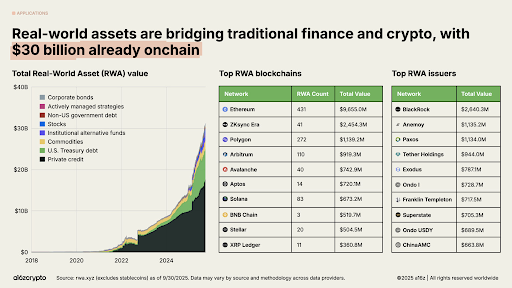
RWAs bridge traditional finance and crypto with $30B onchain, Source- a16zRWAs bridge traditional finance and crypto with $30B onchain, Source- a16z

Decentralized exchanges now account for almost one-fifth of all spot trading, and perpetual futures platforms like Hyperliquid are processing trillions in annual trades. Meanwhile, prediction markets such as Polymarket and Kalshi have entered the mainstream, reflecting a broader shift toward decentralized finance tools.

These developments show crypto’s evolution from speculative markets to practical, high-utility ecosystems. They also reveal how blockchain applications are moving closer to everyday use cases, from commerce to governance.

AI, Infrastructure, and the Path Ahead

Rapid improvements in blockchain infrastructure have made this growth possible. Networks now process more than 3,400 transactions per second, a hundredfold increase from five years ago. 

Solana has become a leading ecosystem, supporting DePIN projects and NFT platforms with $3 billion in annual revenue. Ethereum’s scaling via Layer 2 solutions has reduced transaction costs to fractions of a cent, expanding access for developers and users alike.

The convergence of crypto and AI is emerging as the next frontier. Decentralized identity systems are enabling “proof of human” verification, while crypto protocols power payment rails for autonomous AI agents. 

With traditional computing becoming increasingly centralized, blockchains may serve as the balancing force,  ensuring openness and transparency in the digital economy.

The State of Crypto 2025 report concludes that the industry has reached maturity. Institutional engagement, stablecoin adoption, and scalable blockchain infrastructure are transforming crypto into a foundational layer of global finance. 

The post Crypto Goes Mainstream in 2025 as Stablecoins and Institutions Lead Global Adoption: Report appeared first on Live Bitcoin News.

Market Opportunity
FINANCE Logo
FINANCE Price(FINANCE)
$0.0004999
$0.0004999$0.0004999
+195.79%
USD
FINANCE (FINANCE) Live Price Chart
Disclaimer: The articles reposted on this site are sourced from public platforms and are provided for informational purposes only. They do not necessarily reflect the views of MEXC. All rights remain with the original authors. If you believe any content infringes on third-party rights, please contact service@support.mexc.com for removal. MEXC makes no guarantees regarding the accuracy, completeness, or timeliness of the content and is not responsible for any actions taken based on the information provided. The content does not constitute financial, legal, or other professional advice, nor should it be considered a recommendation or endorsement by MEXC.

You May Also Like

Crucial US Stock Market Update: What Wednesday’s Mixed Close Reveals

Crucial US Stock Market Update: What Wednesday’s Mixed Close Reveals

BitcoinWorld Crucial US Stock Market Update: What Wednesday’s Mixed Close Reveals The financial world often keeps us on our toes, and Wednesday was no exception. Investors watched closely as the US stock market concluded the day with a mixed performance across its major indexes. This snapshot offers a crucial glimpse into current investor sentiment and economic undercurrents, prompting many to ask: what exactly happened? Understanding the Latest US Stock Market Movements On Wednesday, the closing bell brought a varied picture for the US stock market. While some indexes celebrated gains, others registered slight declines, creating a truly mixed bag for investors. The Dow Jones Industrial Average showed resilience, climbing by a notable 0.57%. This positive movement suggests strength in some of the larger, more established companies. Conversely, the S&P 500, a broader benchmark often seen as a barometer for the overall market, experienced a modest dip of 0.1%. The technology-heavy Nasdaq Composite also saw a slight retreat, sliding by 0.33%. This particular index often reflects investor sentiment towards growth stocks and the tech sector. These divergent outcomes highlight the complex dynamics currently at play within the American economy. It’s not simply a matter of “up” or “down” for the entire US stock market; rather, it’s a nuanced landscape where different sectors and company types are responding to unique pressures and opportunities. Why Did the US Stock Market See Mixed Results? When the US stock market delivers a mixed performance, it often points to a tug-of-war between various economic factors. Several elements could have contributed to Wednesday’s varied closings. For instance, positive corporate earnings reports from certain industries might have bolstered the Dow. At the same time, concerns over inflation, interest rate policies by the Federal Reserve, or even global economic uncertainties could have pressured growth stocks, affecting the S&P 500 and Nasdaq. Key considerations often include: Economic Data: Recent reports on employment, manufacturing, or consumer spending can sway market sentiment. Corporate Announcements: Strong or weak earnings forecasts from influential companies can significantly impact their respective sectors. Interest Rate Expectations: The prospect of higher or lower interest rates directly influences borrowing costs for businesses and consumer spending, affecting future profitability. Geopolitical Events: Global tensions or trade policies can introduce uncertainty, causing investors to become more cautious. Understanding these underlying drivers is crucial for anyone trying to make sense of daily market fluctuations in the US stock market. Navigating Volatility in the US Stock Market A mixed close, while not a dramatic downturn, serves as a reminder that market volatility is a constant companion for investors. For those involved in the US stock market, particularly individuals managing their portfolios, these days underscore the importance of a well-thought-out strategy. It’s important not to react impulsively to daily movements. Instead, consider these actionable insights: Diversification: Spreading investments across different sectors and asset classes can help mitigate risk when one area underperforms. Long-Term Perspective: Focusing on long-term financial goals rather than short-term gains can help weather daily market swings. Stay Informed: Keeping abreast of economic news and company fundamentals provides context for market behavior. Consult Experts: Financial advisors can offer personalized guidance based on individual risk tolerance and objectives. Even small movements in major indexes can signal shifts that require attention, guiding future investment decisions within the dynamic US stock market. What’s Next for the US Stock Market? Looking ahead, investors will be keenly watching for further economic indicators and corporate announcements to gauge the direction of the US stock market. Upcoming inflation data, statements from the Federal Reserve, and quarterly earnings reports will likely provide more clarity. The interplay of these factors will continue to shape investor confidence and, consequently, the performance of the Dow, S&P 500, and Nasdaq. Remaining informed and adaptive will be key to understanding the market’s trajectory. Conclusion: Wednesday’s mixed close in the US stock market highlights the intricate balance of forces influencing financial markets. While the Dow showed strength, the S&P 500 and Nasdaq experienced slight declines, reflecting a nuanced economic landscape. This reminds us that understanding the ‘why’ behind these movements is as important as the movements themselves. As always, a thoughtful, informed approach remains the best strategy for navigating the complexities of the market. Frequently Asked Questions (FAQs) Q1: What does a “mixed close” mean for the US stock market? A1: A mixed close indicates that while some major stock indexes advanced, others declined. It suggests that different sectors or types of companies within the US stock market are experiencing varying influences, rather than a uniform market movement. Q2: Which major indexes were affected on Wednesday? A2: On Wednesday, the Dow Jones Industrial Average gained 0.57%, while the S&P 500 edged down 0.1%, and the Nasdaq Composite slid 0.33%, illustrating the mixed performance across the US stock market. Q3: What factors contribute to a mixed stock market performance? A3: Mixed performances in the US stock market can be influenced by various factors, including specific corporate earnings, economic data releases, shifts in interest rate expectations, and broader geopolitical events that affect different market segments uniquely. Q4: How should investors react to mixed market signals? A4: Investors are generally advised to maintain a long-term perspective, diversify their portfolios, stay informed about economic news, and avoid impulsive decisions. Consulting a financial advisor can also provide personalized guidance for navigating the US stock market. Q5: What indicators should investors watch for future US stock market trends? A5: Key indicators to watch include upcoming inflation reports, statements from the Federal Reserve regarding monetary policy, and quarterly corporate earnings reports. These will offer insights into the future direction of the US stock market. Did you find this analysis of the US stock market helpful? Share this article with your network on social media to help others understand the nuances of current financial trends! To learn more about the latest stock market trends, explore our article on key developments shaping the US stock market‘s future performance. This post Crucial US Stock Market Update: What Wednesday’s Mixed Close Reveals first appeared on BitcoinWorld.
Share
Coinstats2025/09/18 05:30
Forbes' 2026 Crypto Investment Trends Outlook: Institutionalization, Tokenization, Stablecoins, and the AI Machine Economy

Forbes' 2026 Crypto Investment Trends Outlook: Institutionalization, Tokenization, Stablecoins, and the AI Machine Economy

PANews reported on January 2nd that Nina Bambysheva, Forbes' currency markets editor and analyst, published an article analyzing five major trends in crypto investment
Share
PANews2026/01/02 20:15
Zcash Price Faces Breakdown Risk

Zcash Price Faces Breakdown Risk

The post Zcash Price Faces Breakdown Risk appeared on BitcoinEthereumNews.com. Zcash price has maintained an apparent uptrend, fueling expectations of an impending
Share
BitcoinEthereumNews2026/01/02 20:35
