This section outlines the experimental setup for the new Instance-Incremental Learning benchmarks.This section outlines the experimental setup for the new Instance-Incremental Learning benchmarks.

Evaluating Instance-Incremental Learning: CIL Methods on Cifar-100 and ImageNet

2025/11/06 01:30

Abstract and 1 Introduction

  1. Related works

  2. Problem setting

  3. Methodology

    4.1. Decision boundary-aware distillation

    4.2. Knowledge consolidation

  4. Experimental results and 5.1. Experiment Setup

    5.2. Comparison with SOTA methods

    5.3. Ablation study

  5. Conclusion and future work and References

    \

Supplementary Material

  1. Details of the theoretical analysis on KCEMA mechanism in IIL
  2. Algorithm overview
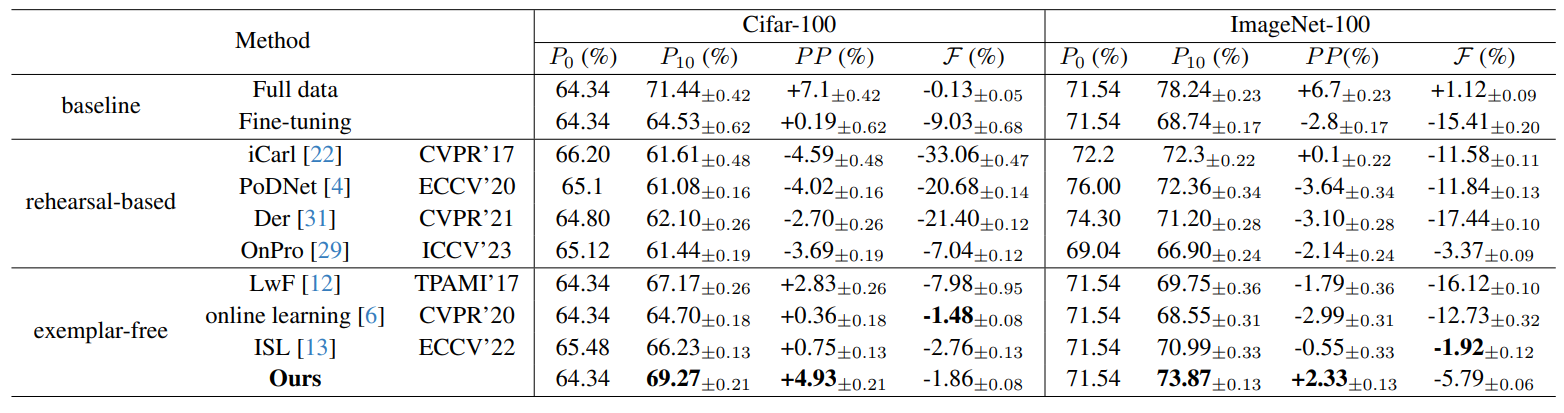
  3. Dataset details
  4. Implementation details
  5. Visualization of dusted input images
  6. More experimental results

5. Experimental results

We reorganize the training set of some existing datasets that are commonly used in the class-incremental learning to establish the benchmarks. Implementation details of our experiments can be found in the supplementary material.

5.1. Experiment Setup

5.1.1 Datasets

\
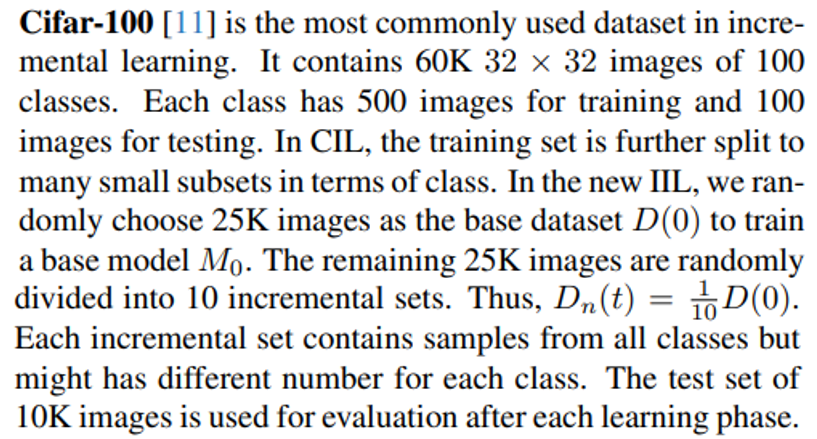
\ Table 1. Instance-incremental learning on Cifar-100 and ImageNet.The P P reflects the accuracy changing on test data Dtest over 10 IIL tasks. F is the forgetting rate on base training data D(0) after last IIL task. Results are average score and their 95% confidence interval of 5 runs with different incremental data orders. Following previous works, resnet-18 is used as the backbone network for all experiments.
\ Figure 4. Detailed performance promotion (P P) and forgetting rate (F) at each IIL phase. Best to view in color with scaling.

\ ImageNet [24] is another dataset that commonly used. The ImageNet-1000 which consists of 1.2 million training images and 150K testing images from 1000 classes. Following Douillard et al. [4, 6], we randomly select 100 classes (ImageNet-100) and split it into 1 base set with half of the training images and 10 incremental sets with another half of images as we do on Cifar-100.

\ Entity-30 included in BREEDS datasets [25] simulates the real-world sub-population shifting. For example, the base model learns the concept of dog with photos of “Poodles”, but on incremental data it has to extend the “dog” concept to “Terriers” or “Dalmatians”. Entity-30 has 240 subclasses with a large data size. As the sub-population shifting is a specific case of the instance-level concept drift, we evaluate the proposed method on Entity-30 following the setting of ISL [13].

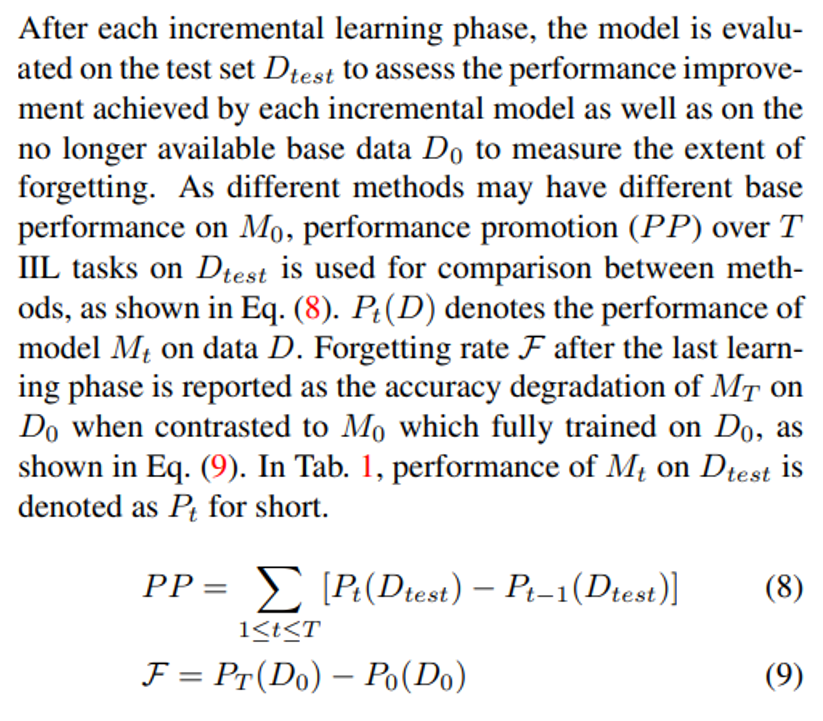
\ 5.1.2 Evaluation metrics

\
\ 5.1.3 Evaluated baselines

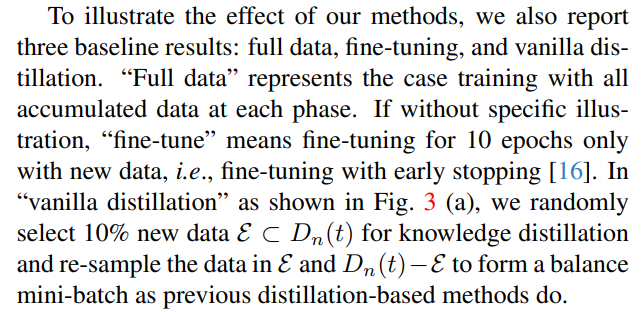
\ As few existing method is proposed for the IIL setting, we reproduce several classic and SOTA CIL methods by referring to their original code or paper with the minimum revision, including iCarl [22] and LwF [12] which utilize labellevel distillation, PODNet [4] which implements distillation at the feature level, Der [31] which expends the network dynamically and attains the best CIL results, OnPro [29] which uses online prototypes to enhance the existing boundaries, and online learning [6] which can be applied to the hybrid-incremental learning. ISL [13] proposed for incremental sub-population learning is the only method that can be directly implemented in the new IIL setting. As most CIL methods require old exemplars, to compare with them, we additionally set a memory of 20 exemplars per class for these methods. We aim to provide a fair and comprehensive comparison in the new IIL scenario. Details of reproducing these methods can be found in our supp. material.

\
\

:::info Authors:

(1) Qiang Nie, Hong Kong University of Science and Technology (Guangzhou);

(2) Weifu Fu, Tencent Youtu Lab;

(3) Yuhuan Lin, Tencent Youtu Lab;

(4) Jialin Li, Tencent Youtu Lab;

(5) Yifeng Zhou, Tencent Youtu Lab;

(6) Yong Liu, Tencent Youtu Lab;

(7) Qiang Nie, Hong Kong University of Science and Technology (Guangzhou);

(8) Chengjie Wang, Tencent Youtu Lab.

:::


:::info This paper is available on arxiv under CC BY-NC-ND 4.0 Deed (Attribution-Noncommercial-Noderivs 4.0 International) license.

:::

\

Disclaimer: The articles reposted on this site are sourced from public platforms and are provided for informational purposes only. They do not necessarily reflect the views of MEXC. All rights remain with the original authors. If you believe any content infringes on third-party rights, please contact service@support.mexc.com for removal. MEXC makes no guarantees regarding the accuracy, completeness, or timeliness of the content and is not responsible for any actions taken based on the information provided. The content does not constitute financial, legal, or other professional advice, nor should it be considered a recommendation or endorsement by MEXC.

You May Also Like

SEC issues investor guide on crypto wallets and custody risks

SEC issues investor guide on crypto wallets and custody risks

The SEC released a guide on crypto wallets and custody for investors.
Share
Cryptopolitan2025/12/14 08:38
UK Looks to US to Adopt More Crypto-Friendly Approach

UK Looks to US to Adopt More Crypto-Friendly Approach

The post UK Looks to US to Adopt More Crypto-Friendly Approach appeared on BitcoinEthereumNews.com. The UK and US are reportedly preparing to deepen cooperation on digital assets, with Britain looking to copy the Trump administration’s crypto-friendly stance in a bid to boost innovation.  UK Chancellor Rachel Reeves and US Treasury Secretary Scott Bessent discussed on Tuesday how the two nations could strengthen their coordination on crypto, the Financial Times reported on Tuesday, citing people familiar with the matter.  The discussions also involved representatives from crypto companies, including Coinbase, Circle Internet Group and Ripple, with executives from the Bank of America, Barclays and Citi also attending, according to the report. The agreement was made “last-minute” after crypto advocacy groups urged the UK government on Thursday to adopt a more open stance toward the industry, claiming its cautious approach to the sector has left the country lagging in innovation and policy.  Source: Rachel Reeves Deal to include stablecoins, look to unlock adoption Any deal between the countries is likely to include stablecoins, the Financial Times reported, an area of crypto that US President Donald Trump made a policy priority and in which his family has significant business interests. The Financial Times reported on Monday that UK crypto advocacy groups also slammed the Bank of England’s proposal to limit individual stablecoin holdings to between 10,000 British pounds ($13,650) and 20,000 pounds ($27,300), claiming it would be difficult and expensive to implement. UK banks appear to have slowed adoption too, with around 40% of 2,000 recently surveyed crypto investors saying that their banks had either blocked or delayed a payment to a crypto provider.  Many of these actions have been linked to concerns over volatility, fraud and scams. The UK has made some progress on crypto regulation recently, proposing a framework in May that would see crypto exchanges, dealers, and agents treated similarly to traditional finance firms, with…
Share
BitcoinEthereumNews2025/09/18 02:21


