

Must Read
OVERVIEW. The Sta. Clara fishing village is flanked by gas facilities owned and operated by First Gen Corp. Photo by Dan BuenaventuraOVERVIEW. The Sta. Clara fishing village is flanked by gas facilities owned and operated by First Gen Corp. Photo by Dan Buenaventura
‘Solar rush’: Surge in solar demand overwhelms local industry
For feedback or concerns regarding this content, please contact us at crypto.news@mexc.com
The surge in demand for solar installation has overwhelmed the local solar industry, which mainly sources its components from China.
Solar installers can barely keep up with the increasing demand that they now find themselves rejecting clients or making them wait.
“We had to turn down some because, the story is all, ‘I want it now,’” Richmond Reyes, president of solar installer and distributor EcoSolutions PH, told Rappler in an interview.
Reyes said prices of solar panels from China have “skyrocketed” with some increasing by as much as 30%. Prices of aluminum railings increased threefold. A high-quality battery priced P85,000 before now costs more than P100,000. It is also their practice to not stock up on components, said Reyes, because technology evolves quickly.
“We had clients who used to talk about how expensive it was,” Reyes shared. “Which we’re not, by the way. And now, they’re coming back and saying, ‘Sir, do you have a stock like this? Sir, can we buy one too?’”
The solar distributor company sources panels, aluminum railings, and batteries from China. Months before the war, China’s industry ministry had urged its solar sector to curb production due to overcapacity.
The United States and Israel’s attack on Iran led to the closure of the Strait of Hormuz, a critical waterway where most of the petroleum from the Gulf passes through. The war is causing a surge in fuel prices.
Now there is fear of future power outages or an increase in electricity bills due to disruptions to oil and liquified natural gas shipments. These fears have stoked an organic interest in solar power, especially across Filipino households that have the means to shift to solar and want to be insulated from future price shocks.
In a statement on Friday, April 10, the Center for Energy, Ecology, and Development warned of a possible increase of P5 per kilowatt-hour (kWh) in the Meralco franchise area due to price hikes in coal and gas. Energy Secretary Sharon Garin, however, said they expect only a “minimal” increase ranging from 30 to 40 centavos per kWh.
Reyes said it’s been an eye-opener for the local industry. With the demand surge, Reyes said he has been thinking about the kind of equipment they should be bringing to the Philippines. There’s also a need to further empower solar companies catering to households and businesses in islands in the Visayas and Mindanao.
Longer waiting time, lack of manpower
Visayas and Mindanao households who want to shift to solar have to wait longer than those in Luzon.
Shipping solar components from Manila to Cebu would require a two-week lead time, according to Lito Villar of non-profit organization Clean Energy Advocates and Practitioners of the Philippines Inc.
Villar also serves as consultant for Manila-based solar company Helios, and he said that their baseline of closing three to five clients per month has now increased to seven clients in a week.
“How do you install solar on everybody’s homes? So we say, ‘Sir, we can accommodate you. But instead of two weeks’ lead time, it will be four weeks,’” Villar told Rappler in an interview.
 POWERED. The elementary and high schools of Pangan-an, Lapu-Lapu city, received a 10 KVA solar panel from the Aboitiz Foundation. Photo by Jacqueline Hernandez/Rappler
For a long time, the local industry had to surmount the problem of convincing people that the high upfront cost of solar is worth it. Now they don’t have to convince people anymore. “Aside from the [bill], energy security is really important especially for the people who can afford it,” he said.
Aside from the component supply problem, Villar pointed out that more manpower is needed to cater to the demand. This means more people who have the technical skills to install rooftop solar on houses and respond to load changes, design issues, or safety risks.
Brenda Valerio of solar network New Energy Nexus Philippines said building a competent workforce ensures that rooftop solar is sustainable.
“[B]ut scaling this kind of training comes with real constraints, from limited trainers and facilities to the need for hands-on equipment and reaching trainees across dispersed locations,” Valerio said.
Valerio’s group is one of the initiators of the New Energy Academy, a platform for aspiring solar installers, technicians, and designers currently piloted in the Philippines.
According to Valerio, the academy produced 636 training graduates as of 2025 and is aiming to triple the number of graduates — ideally with more coming from areas outside Metro Manila.
‘Focus on renewables, not coal’
Solar is not the only alternative source being eyed to ensure the lights do not flicker.
The Department of Energy previously said the country may temporarily increase reliance on coal, which serves as baseload source. But think tanks are warning against relying more on coal.
The Institute for Climate and Sustainable Cities said that the reliance on imported fossil fuels leaves the Philippines vulnerable to global supply and price shocks. Favoring indigenous energy — solar, wind, hydro, and geothermal — would insulate the economy from these external disruptions, according to the ICSC.
“Indigenous energy resources are largely immune to global price swings and provide predictable generation costs, shielding consumers and the economy from abrupt price hikes,” the group said in a position paper.
Recent analysis from research group Zero Carbon Analytics said a return to coal will only offer short-term relief, but will expose countries to volatility of international markets. Further, the analysis said ASEAN can save up to $4 billion if it replaces 45 gigawatts of planned gas capacity with solar and battery storage.
“Energy security in Southeast Asia will not come from switching between fossil fuels,” Amy Kong, author of the report, said in a statement. “It will come from reducing dependence on them altogether.”
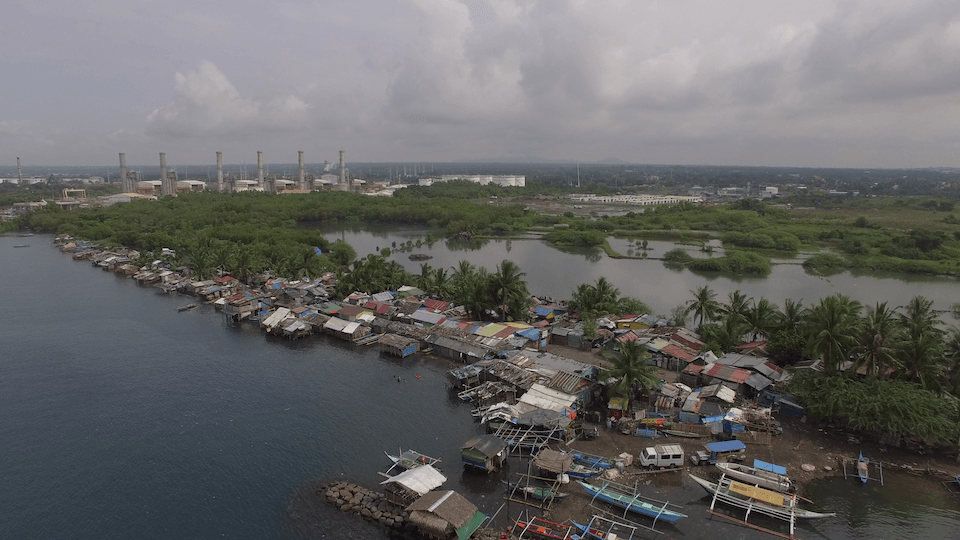 OVERVIEW. The Sta. Clara fishing village is flanked by gas facilities owned and operated by First Gen Corp. Photo by Dan Buenaventura
State-subsidized solar installations?
While rooftop solar installations can provide peace of mind for households that can afford it, this is not the case for many others, especially those in off-grid areas that rely on diesel for power generation.
CEED is thus urging the government to subsidize the installation of solar rooftop systems.
The group said that a 500-watt solar deployed to benefit one million households can generate P373,140,000 in electricity savings per month.
“An aggressive development of solar rooftop systems is a key and viable solution to ease costs for vulnerable communities, including off-grid and SPUG (small power utilities group) areas,” said Gerry Arances, executive director of CEED.
Apart from subsidized solar deployment, CEED called on the government to suspend pass-through costs in electricity bills.
But before any massive deployment, the issue of low supply must be addressed, not only to respond to this crisis but to implement the Philippines’ international climate commitments. The country targets to increase to 35% the share of renewables in the power mix by 2030. As of 2025, renewables reportedly make up 32.3% of the country’s energy mix.
“I think this crisis is accelerating all our goals,” Reyes said. “Now it’s a matter of us keeping up with the demand.” – Rappler.com
Quotes translated to English for brevity.


Disclaimer: The articles reposted on this site are sourced from public platforms and are provided for informational purposes only. They do not necessarily reflect the views of MEXC. All rights remain with the original authors. If you believe any content infringes on third-party rights, please contact crypto.news@mexc.com for removal. MEXC makes no guarantees regarding the accuracy, completeness, or timeliness of the content and is not responsible for any actions taken based on the information provided. The content does not constitute financial, legal, or other professional advice, nor should it be considered a recommendation or endorsement by MEXC.
You May Also Like

Tether Freezes USDT In 131 TRON Wallets After OFAC Sanctions Update
Tether froze USDT tied to 131 TRON wallets after an OFAC sanctions update, reviving the stablecoin compliance debate.
Share
NewsBTC2026/07/03 19:39

Trump's favorite song sanitizes decades of foreign policy failures
After musician after musician pulled out from President Donald Trump’s “Freedom 250” concert, he was left with Lee Greenwood, an opera tenor, a couple of military
Share
Alternet2026/07/03 19:50

Microsoft Unveils $2.5B AI Deployment Unit for Enterprise Clients
TLDR Microsoft launched Frontier Company with a $2.5 billion investment. The new business will focus on enterprise AI deployments. The initiative will use 6,000
Share
Blockonomi2026/07/03 19:38

