This paper explores the limits of standard Physics-Informed Neural Networks (PINNs) in handling shock waves in hyperbolic conservation laws, where artificial diffusion is typically added to approximate solutions. Instead, the authors introduce a non-diffusive neural network (NDNN) method that directly computes entropic shock waves without artificial viscosity. The approach is derived, implemented, and validated through multiple experiments—including shock wave interaction and generation—demonstrating convergence, accuracy, and efficiency for complex PDE systems.This paper explores the limits of standard Physics-Informed Neural Networks (PINNs) in handling shock waves in hyperbolic conservation laws, where artificial diffusion is typically added to approximate solutions. Instead, the authors introduce a non-diffusive neural network (NDNN) method that directly computes entropic shock waves without artificial viscosity. The approach is derived, implemented, and validated through multiple experiments—including shock wave interaction and generation—demonstrating convergence, accuracy, and efficiency for complex PDE systems.

Can Neural Networks Capture Shock Waves Without Diffusion? This Paper Says Yes

2025/09/19 18:38
3 min read
For feedback or concerns regarding this content, please contact us at crypto.news@mexc.com

Abstract and 1. Introduction

1.1. Introductory remarks

1.2. Basics of neural networks

1.3. About the entropy of direct PINN methods

1.4. Organization of the paper

  1. Non-diffusive neural network solver for one dimensional scalar HCLs

    2.1. One shock wave

    2.2. Arbitrary number of shock waves

    2.3. Shock wave generation

    2.4. Shock wave interaction

    2.5. Non-diffusive neural network solver for one dimensional systems of CLs

    2.6. Efficient initial wave decomposition

  2. Gradient descent algorithm and efficient implementation

    3.1. Classical gradient descent algorithm for HCLs

    3.2. Gradient descent and domain decomposition methods

  3. Numerics

    4.1. Practical implementations

    4.2. Basic tests and convergence for 1 and 2 shock wave problems

    4.3. Shock wave generation

    4.4. Shock-Shock interaction

    4.5. Entropy solution

    4.6. Domain decomposition

    4.7. Nonlinear systems

  4. Conclusion and References

1.2. Basics of neural networks
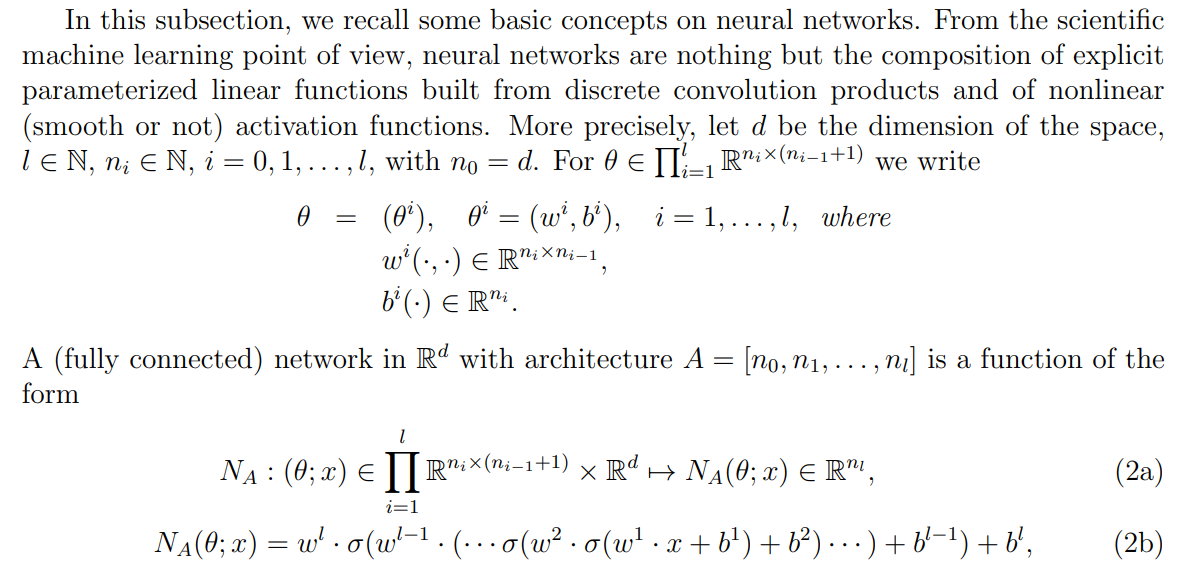
\ where σ : R 7→ R is a given function, called activation function, which acts on any vector or matrix component-wise. It is clear from this exposition that the network NA is defined uniquely by the architecture A. In all the networks we will consider the architecture A is given/fixed, and we will omit the letter A from NA.

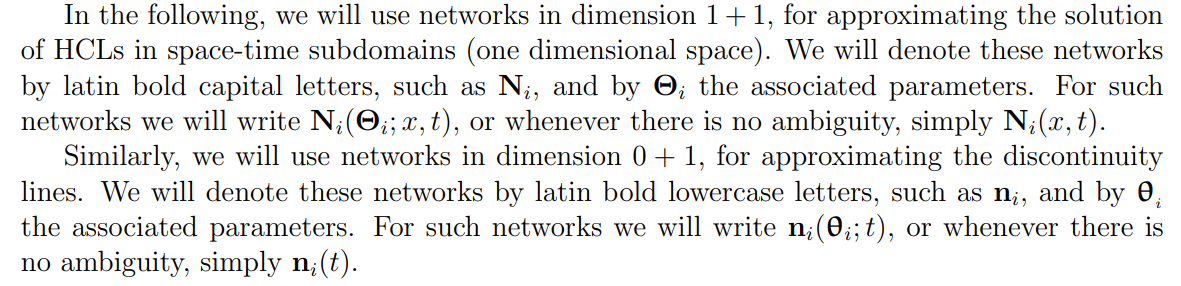
\ These network functions, which will be used to approximate solutions to HCLs, benefit from automatic differentiation with respect to x and θ (parameters). This feature allows an evaluation of (1) without error. Naturally, the computed solutions are restricted to the function space spanned by the neural networks.

\
1.3. About the entropy of direct PINN methods

We finish this introduction by a short discussion on the entropy of PINN solvers for HCLs. As direct PINN solvers can not directly capture shock waves (discontinuous weak solution), artificial diffusion is usually added to HCLs, uε is searched as the solution to

\ \
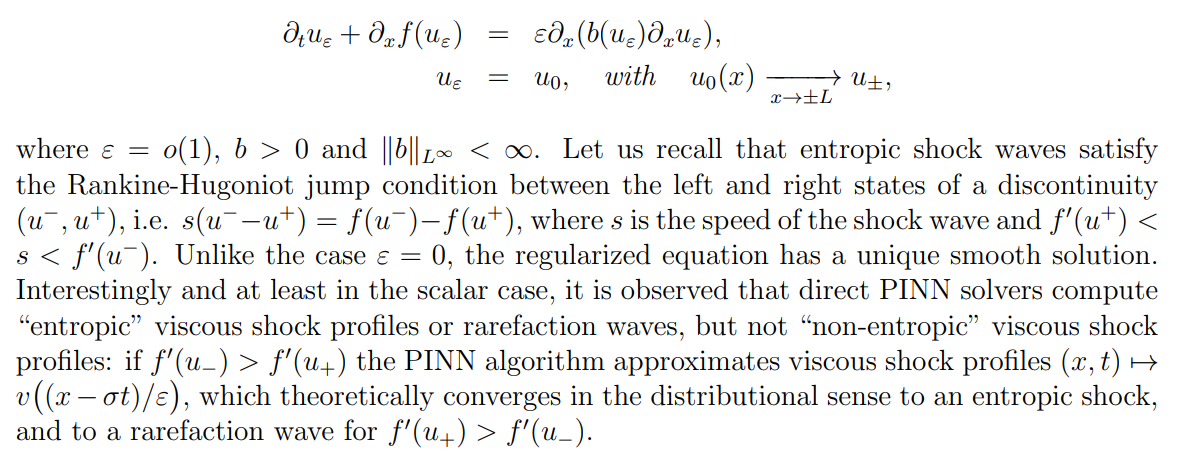
\ \ While we propose in Experiment 6 an illustration of this property of the PINN method, in this paper, we propose a totally different strategy which does not require the addition of any artificial viscosity, and computes entropic shock wave without diffusion.

1.4. Organization of the paper

This paper is organized as follows. Section 2 is devoted to the derivation of the basics of the non-diffusive neural network (NDNN) method. Different situations are analyzed including multiple shock waves, shock wave interaction, shock wave generation, and the extension to systems. In Section 3, we discuss the efficient implementation of the derived algorithm.

\ In Section 4, several numerical experiments are proposed to illustrate the convergence and the accuracy of the proposed algorithms. We conclude in Section 5.

\

:::info Authors:

(1) Emmanuel LORIN, School of Mathematics and Statistics, Carleton University, Ottawa, Canada, K1S 5B6 and Centre de Recherches Mathematiques, Universit´e de Montr´eal, Montreal, Canada, H3T 1J4 (elorin@math.carleton.ca);

(2) Arian NOVRUZI, a Corresponding Author from Department of Mathematics and Statistics, University of Ottawa, Ottawa, ON K1N 6N5, Canada (novruzi@uottawa.ca).

:::


:::info This paper is available on arxiv under CC by 4.0 Deed (Attribution 4.0 International) license.

:::

\

Market Opportunity
Waves Logo
Waves Price(WAVES)
$0.4731
$0.4731$0.4731
-0.08%
USD
Waves (WAVES) Live Price Chart
Disclaimer: The articles reposted on this site are sourced from public platforms and are provided for informational purposes only. They do not necessarily reflect the views of MEXC. All rights remain with the original authors. If you believe any content infringes on third-party rights, please contact crypto.news@mexc.com for removal. MEXC makes no guarantees regarding the accuracy, completeness, or timeliness of the content and is not responsible for any actions taken based on the information provided. The content does not constitute financial, legal, or other professional advice, nor should it be considered a recommendation or endorsement by MEXC.
Tags:

You May Also Like

Markets await Fed’s first 2025 cut, experts bet “this bull market is not even close to over”

Markets await Fed’s first 2025 cut, experts bet “this bull market is not even close to over”

Will the Fed’s first rate cut of 2025 fuel another leg higher for Bitcoin and equities, or does September’s history point to caution? First rate cut of 2025 set against a fragile backdrop The Federal Reserve is widely expected to…
Share
Crypto.news2025/09/18 00:27
How to earn from cloud mining: IeByte’s upgraded auto-cloud mining platform unlocks genuine passive earnings

How to earn from cloud mining: IeByte’s upgraded auto-cloud mining platform unlocks genuine passive earnings

The post How to earn from cloud mining: IeByte’s upgraded auto-cloud mining platform unlocks genuine passive earnings appeared on BitcoinEthereumNews.com. contributor Posted: September 17, 2025 As digital assets continue to reshape global finance, cloud mining has become one of the most effective ways for investors to generate stable passive income. Addressing the growing demand for simplicity, security, and profitability, IeByte has officially upgraded its fully automated cloud mining platform, empowering both beginners and experienced investors to earn Bitcoin, Dogecoin, and other mainstream cryptocurrencies without the need for hardware or technical expertise. Why cloud mining in 2025? Traditional crypto mining requires expensive hardware, high electricity costs, and constant maintenance. In 2025, with blockchain networks becoming more competitive, these barriers have grown even higher. Cloud mining solves this by allowing users to lease professional mining power remotely, eliminating the upfront costs and complexity. IeByte stands at the forefront of this transformation, offering investors a transparent and seamless path to daily earnings. IeByte’s upgraded auto-cloud mining platform With its latest upgrade, IeByte introduces: Full Automation: Mining contracts can be activated in just one click, with all processes handled by IeByte’s servers. Enhanced Security: Bank-grade encryption, cold wallets, and real-time monitoring protect every transaction. Scalable Options: From starter packages to high-level investment contracts, investors can choose the plan that matches their goals. Global Reach: Already trusted by users in over 100 countries. Mining contracts for 2025 IeByte offers a wide range of contracts tailored for every investor level. From entry-level plans with daily returns to premium high-yield packages, the platform ensures maximum accessibility. Contract Type Duration Price Daily Reward Total Earnings (Principal + Profit) Starter Contract 1 Day $200 $6 $200 + $6 + $10 bonus Bronze Basic Contract 2 Days $500 $13.5 $500 + $27 Bronze Basic Contract 3 Days $1,200 $36 $1,200 + $108 Silver Advanced Contract 1 Day $5,000 $175 $5,000 + $175 Silver Advanced Contract 2 Days $8,000 $320 $8,000 + $640 Silver…
Share
BitcoinEthereumNews2025/09/17 23:48
ArtGis Finance Partners with MetaXR to Expand its DeFi Offerings in the Metaverse

ArtGis Finance Partners with MetaXR to Expand its DeFi Offerings in the Metaverse

By using this collaboration, ArtGis utilizes MetaXR’s infrastructure to widen access to its assets and enable its customers to interact with the metaverse.
Share
Blockchainreporter2025/09/18 00:07