This article explores how neural networks can be combined with domain decomposition methods to solve complex nonlinear systems in fluid dynamics. Experiments on shallow water equations and Euler’s equations demonstrate that even simple neural architectures can approximate shock waves and discontinuities with surprising accuracy. While still at proof-of-concept stage, these results highlight the potential of AI-powered solvers for tackling problems that challenge traditional numerical methods.This article explores how neural networks can be combined with domain decomposition methods to solve complex nonlinear systems in fluid dynamics. Experiments on shallow water equations and Euler’s equations demonstrate that even simple neural architectures can approximate shock waves and discontinuities with surprising accuracy. While still at proof-of-concept stage, these results highlight the potential of AI-powered solvers for tackling problems that challenge traditional numerical methods.

AI Learns to Predict Shock Waves

2025/09/20 19:00

Abstract and 1. Introduction

1.1. Introductory remarks

1.2. Basics of neural networks

1.3. About the entropy of direct PINN methods

1.4. Organization of the paper

  1. Non-diffusive neural network solver for one dimensional scalar HCLs

    2.1. One shock wave

    2.2. Arbitrary number of shock waves

    2.3. Shock wave generation

    2.4. Shock wave interaction

    2.5. Non-diffusive neural network solver for one dimensional systems of CLs

    2.6. Efficient initial wave decomposition

  2. Gradient descent algorithm and efficient implementation

    3.1. Classical gradient descent algorithm for HCLs

    3.2. Gradient descent and domain decomposition methods

  3. Numerics

    4.1. Practical implementations

    4.2. Basic tests and convergence for 1 and 2 shock wave problems

    4.3. Shock wave generation

    4.4. Shock-Shock interaction

    4.5. Entropy solution

    4.6. Domain decomposition

    4.7. Nonlinear systems

  4. Conclusion and References

4.6. Domain decomposition

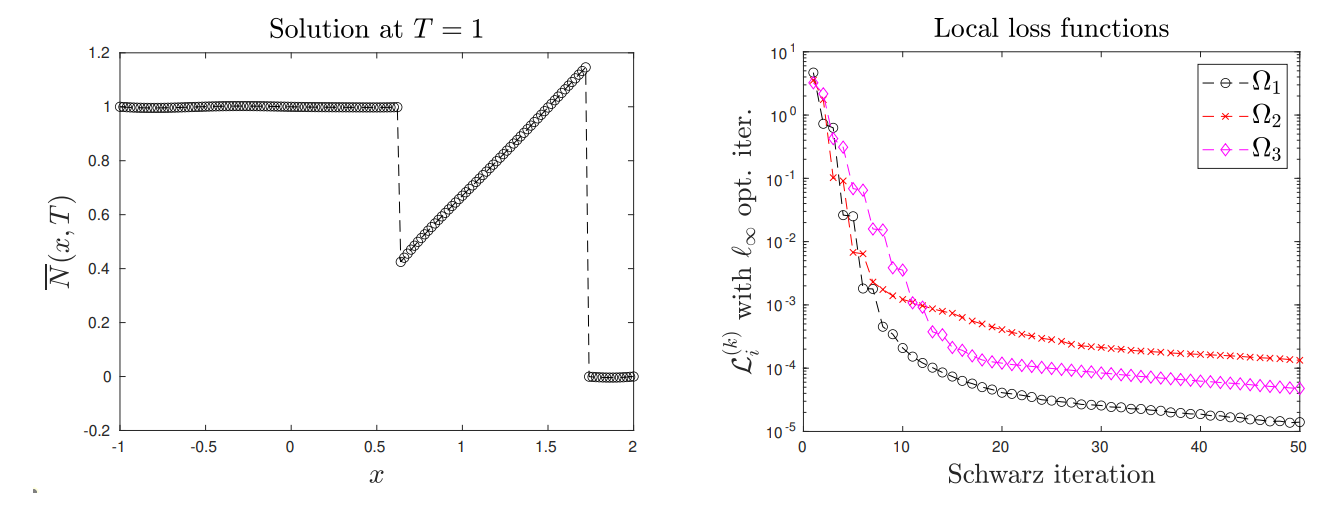
In this subsection, we propose an experiment illustrating the combination of the neural network based HCL solver developed in this paper with the domain decomposition method from Subsection 3.2. We numerically illustrate the convergence of the algorithm. The neural networks have 30 neurons and one hidden layer, and the number of learning nodes is 900 learning nodes.

\
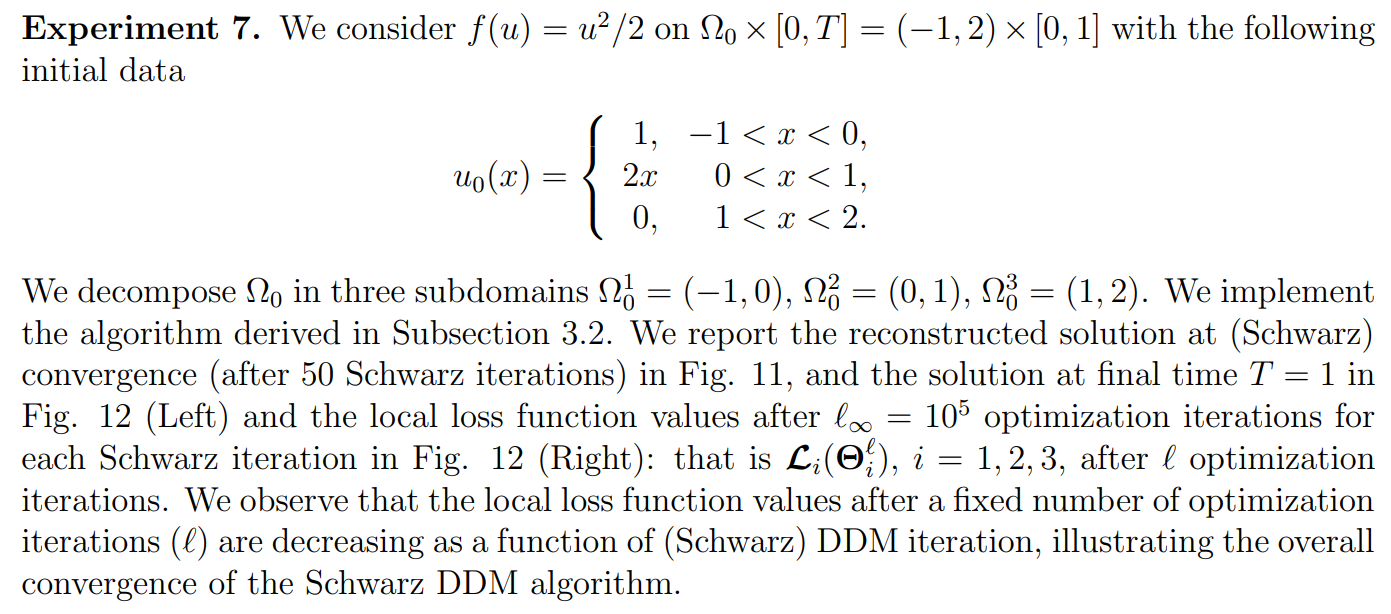
\ Figure 11: Experiment 7. Reconstructed space-time solution.
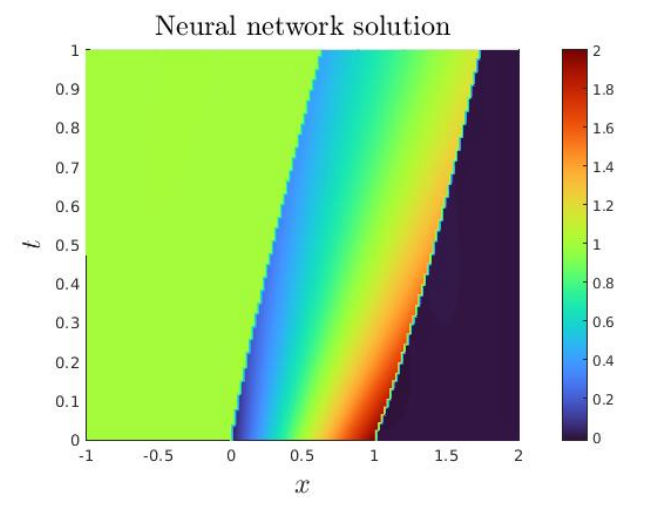
\ Figure 12: Experiment 7. (Left) Solution at T = 1. (Right) Local loss function values after a fixed number ℓ∞ of optimization iterations.

\ The DDM naturally makes sense for much more computationally complex problems. This test however illustrates a proof-of-concept of the SWR approach.

4.7. Nonlinear systems

In this subsection, we are interested in the numerical approximation of hyperbolic systems with shock waves.

\ Experiment 8. In this experiment we focus on the initial wave decomposition for a Riemann problem. The system considered here is the Shallow water equations (m = 2).

\ \

\ \ where h is the height of a compressible fluid, u its velocity, and g is the gravitational constant taken here equal to 1. The spatial domain is (−0.1, 0.1), the final time is T = 0.0025, and we impose null Dirichlet boundary conditions.

\ Experiment 8a. The initial data is given by

\ \
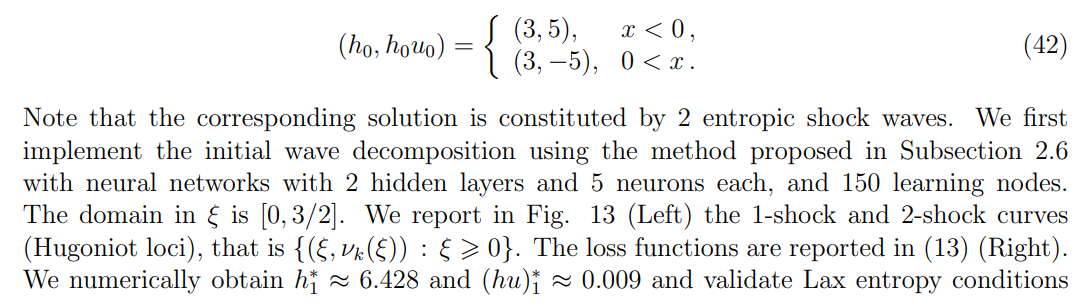
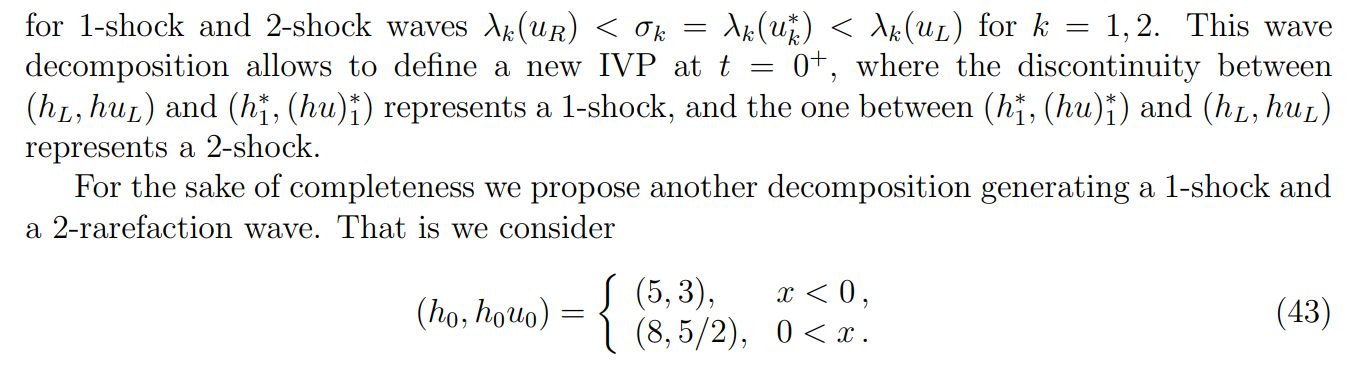
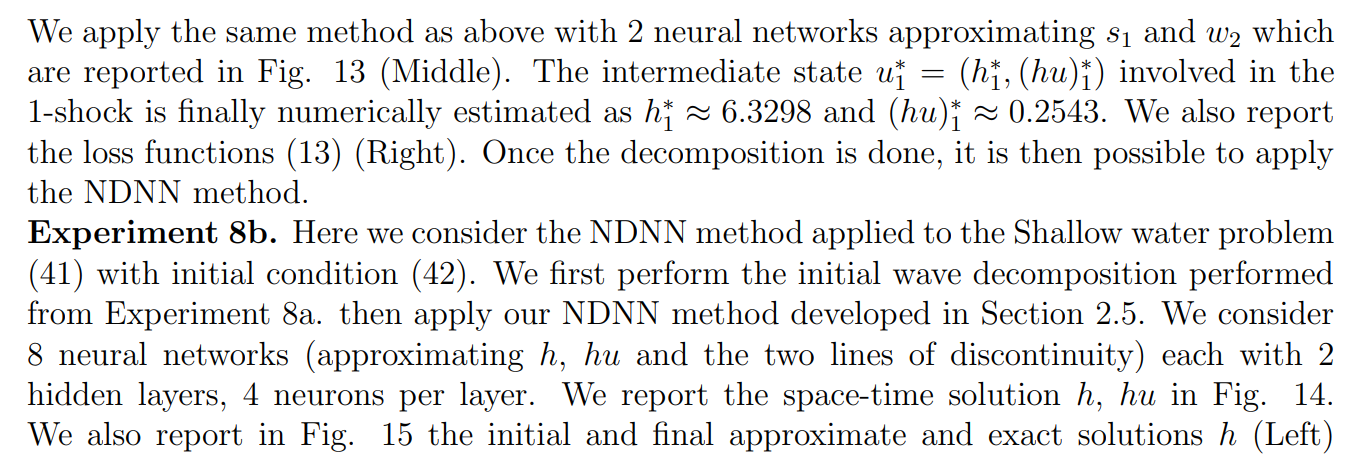
\ \ \ Figure 13: Experiment 8a. (Left) Shock curves in phase space with initial condition (42). (Middle) 1-shock curve and 2-rarefaction curve with initial condition (43). (Right) Loss functions for constructing simple waves (42) and (43)
\ \ \

\ \ \

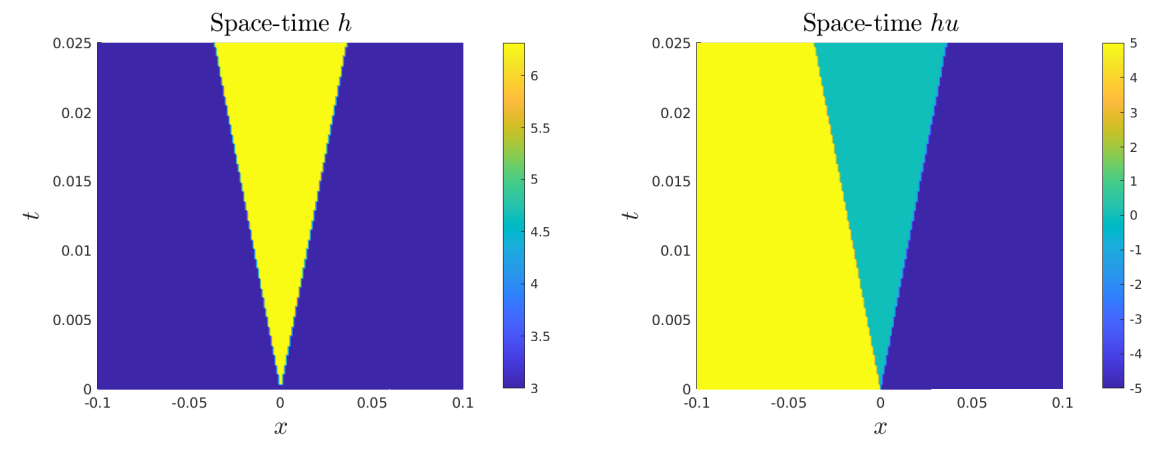
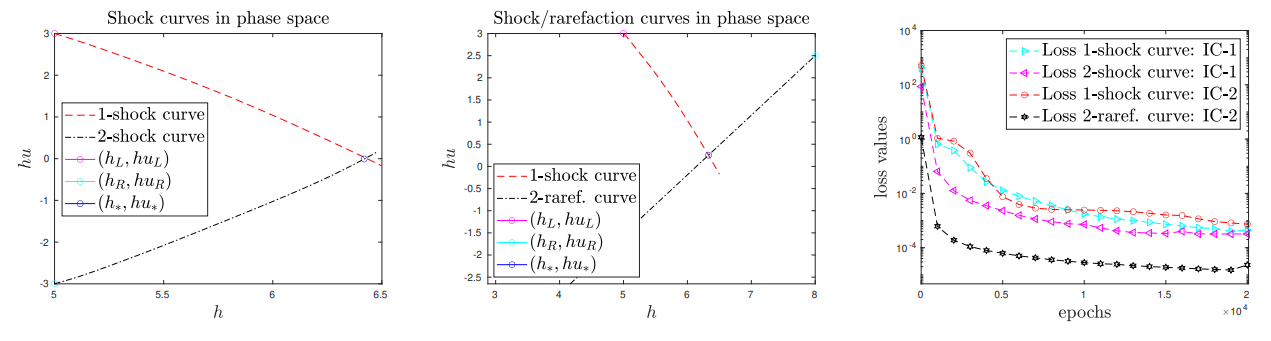
\ \ \ Figure 14: Experiment 8b. Approximate space-time solution (Left) h : (x, t) 7→ h(x, t). (Right) hu : (x, t) 7→ hu(x, t).

\ \ and hu (Middle), as well as the loss function Fig. 15 (Right). This experiment shows that

\ \ Figure 15: Experiment 8b. (Left) Approximate component x 7→ h(x, T). (Middle) Approximate component x 7→ hu(x, T). (Right) Loss function.
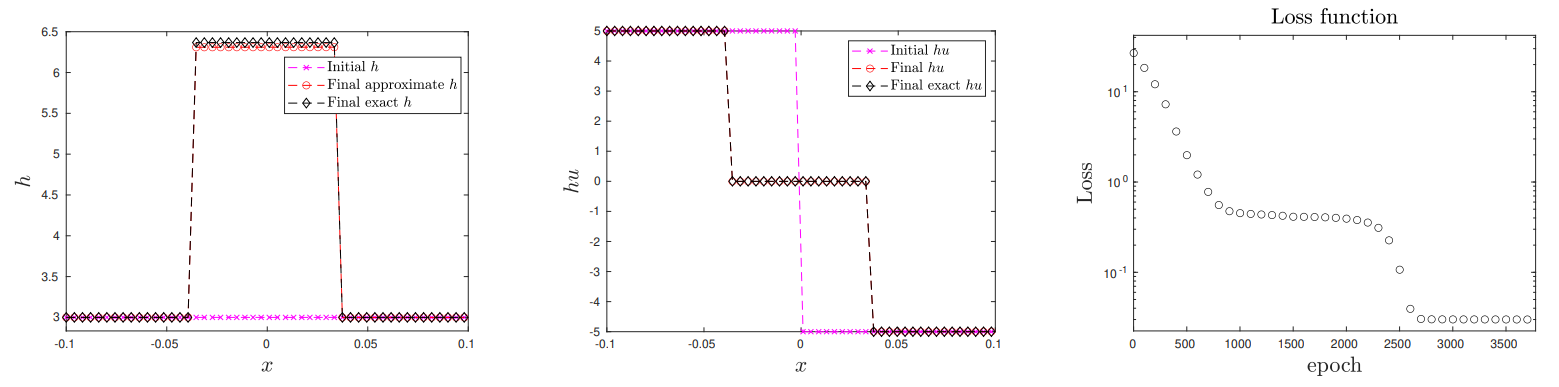
\ \ the proposed methodology allows for the computation of the solution to (at least simple) Riemann problems.

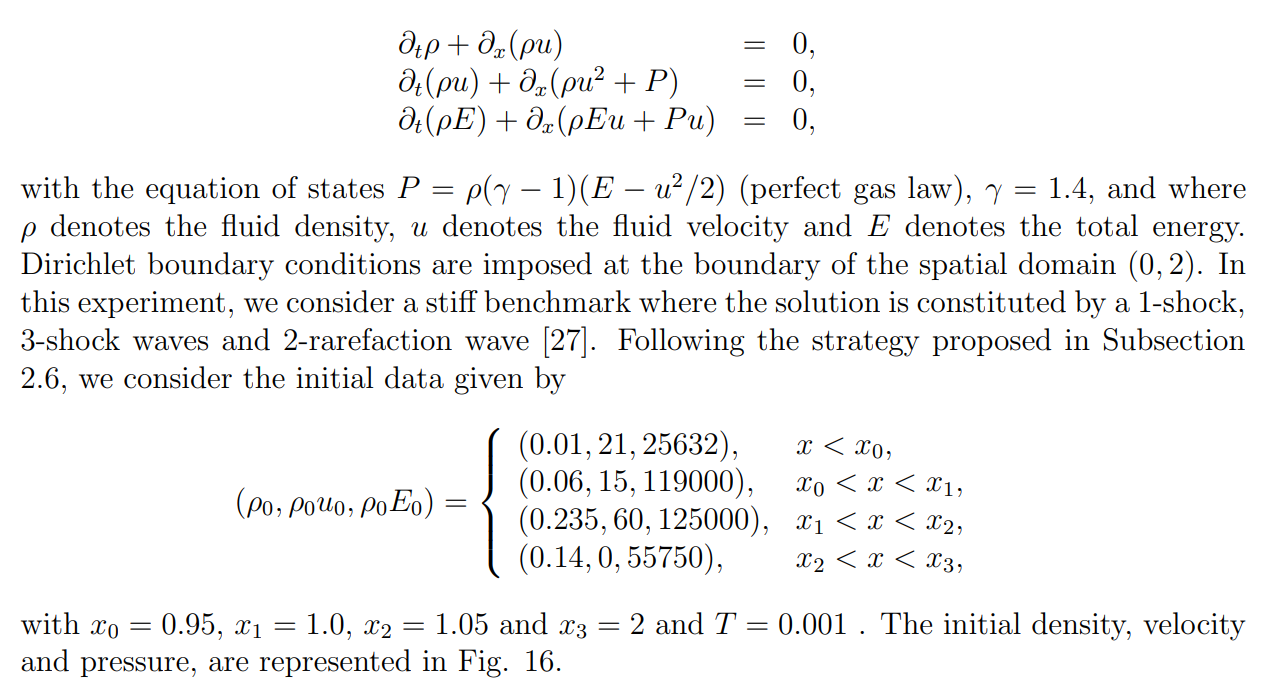
\ Experiment 9. In this last experiment, we consider Euler’s equations modeling compressible inviscid fluid flows. This is a 3-equation HCL which reads as follows (in conservative form)

\ \
\ \ \ Figure 16: Experiment 9. Initial data (Left) Density. (Middle) Velocity (Right) Pressure.
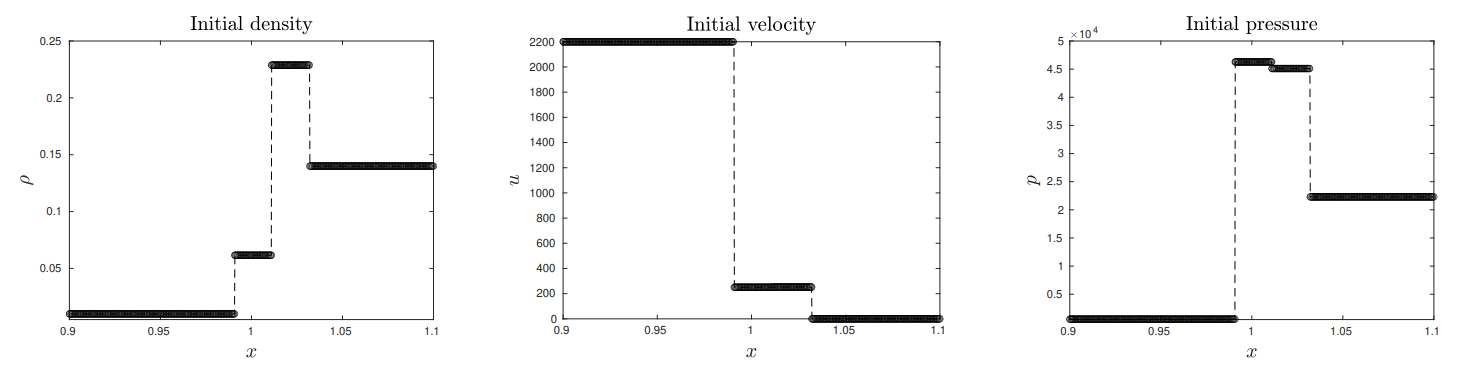
\ \ We implement the method developed in Subsection 2.5 with m = 3, 1 hidden layer and 30 neurons for each conservative component ρ, ρu, ρE and for the 3 lines of discontinuity. In Fig. 17 we report the density, velocity and pressure at initial and final times T. This test illustrates the precision of the proposed approach, with in particular an accurate approximation of the 2-contact discontinuity which is often hard to obtain with standard solvers.

\

:::info Authors:

(1) Emmanuel LORIN, School of Mathematics and Statistics, Carleton University, Ottawa, Canada, K1S 5B6 and Centre de Recherches Mathematiques, Universit´e de Montr´eal, Montreal, Canada, H3T 1J4 (elorin@math.carleton.ca);

(2) Arian NOVRUZI, a Corresponding Author from Department of Mathematics and Statistics, University of Ottawa, Ottawa, ON K1N 6N5, Canada (novruzi@uottawa.ca).

:::


:::info This paper is available on arxiv under CC by 4.0 Deed (Attribution 4.0 International) license.

:::

\

Disclaimer: The articles reposted on this site are sourced from public platforms and are provided for informational purposes only. They do not necessarily reflect the views of MEXC. All rights remain with the original authors. If you believe any content infringes on third-party rights, please contact service@support.mexc.com for removal. MEXC makes no guarantees regarding the accuracy, completeness, or timeliness of the content and is not responsible for any actions taken based on the information provided. The content does not constitute financial, legal, or other professional advice, nor should it be considered a recommendation or endorsement by MEXC.

You May Also Like

Polygon Tops RWA Rankings With $1.1B in Tokenized Assets

Polygon Tops RWA Rankings With $1.1B in Tokenized Assets

The post Polygon Tops RWA Rankings With $1.1B in Tokenized Assets appeared on BitcoinEthereumNews.com. Key Notes A new report from Dune and RWA.xyz highlights Polygon’s role in the growing RWA sector. Polygon PoS currently holds $1.13 billion in RWA Total Value Locked (TVL) across 269 assets. The network holds a 62% market share of tokenized global bonds, driven by European money market funds. The Polygon POL $0.25 24h volatility: 1.4% Market cap: $2.64 B Vol. 24h: $106.17 M network is securing a significant position in the rapidly growing tokenization space, now holding over $1.13 billion in total value locked (TVL) from Real World Assets (RWAs). This development comes as the network continues to evolve, recently deploying its major “Rio” upgrade on the Amoy testnet to enhance future scaling capabilities. This information comes from a new joint report on the state of the RWA market published on Sept. 17 by blockchain analytics firm Dune and data platform RWA.xyz. The focus on RWAs is intensifying across the industry, coinciding with events like the ongoing Real-World Asset Summit in New York. Sandeep Nailwal, CEO of the Polygon Foundation, highlighted the findings via a post on X, noting that the TVL is spread across 269 assets and 2,900 holders on the Polygon PoS chain. The Dune and https://t.co/W6WSFlHoQF report on RWA is out and it shows that RWA is happening on Polygon. Here are a few highlights: – Leading in Global Bonds: Polygon holds 62% share of tokenized global bonds (driven by Spiko’s euro MMF and Cashlink euro issues) – Spiko U.S.… — Sandeep | CEO, Polygon Foundation (※,※) (@sandeepnailwal) September 17, 2025 Key Trends From the 2025 RWA Report The joint publication, titled “RWA REPORT 2025,” offers a comprehensive look into the tokenized asset landscape, which it states has grown 224% since the start of 2024. The report identifies several key trends driving this expansion. According to…
Share
BitcoinEthereumNews2025/09/18 00:40