

The invisible flaw of AI in banks: Community Bank exposes customers’ sensitive data
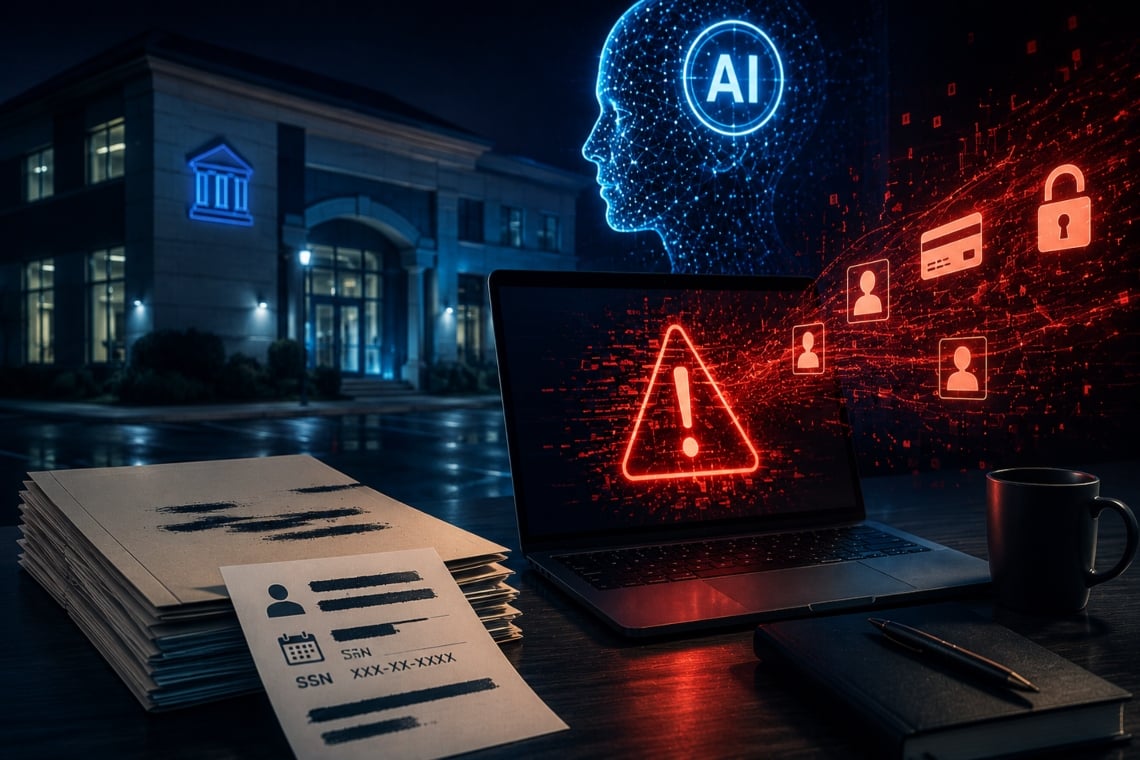
Community Bank, a regional institution operating in Pennsylvania, Ohio and West Virginia, has recently admitted a cybersecurity incident linked to the use of an artificial intelligence (AI) application not authorized by the bank, used by an employee.
The bank disclosed the incident through official documentation filed with the SEC on May 7, 2026, explaining that some customers’ sensitive data was improperly exposed.
The information involved includes full names, dates of birth and Social Security numbers, i.e. data that in the United States represent some of the most sensitive elements from the standpoint of personal and financial identity.
A simple artificial intelligence tool becomes a national security problem
The most significant aspect of the case is that it was not a sophisticated hacker attack, ransomware, or particularly advanced technical vulnerabilities.
The origin of the problem is instead internal. An employee allegedly used an external AI software tool without authorization, entering information that should never have left the bank’s controlled infrastructure.
This episode shows extremely clearly how the disorderly adoption of artificial intelligence is creating new operational risks even within the most regulated institutions.
As we know, in recent months the financial sector has strongly accelerated the integration of AI tools to increase productivity, automation and customer support.
However, many companies still seem unprepared to define concrete limits on the daily use of these tools by employees.
In the case of Community Bank it has not yet been clarified how many customers were affected, but the type of compromised data makes the case particularly sensitive.
In the United States, the unauthorized disclosure of Social Security numbers can in fact generate serious consequences, both for customers and for the financial institutions involved.
In any case, the bank has already initiated the mandatory notifications required by federal and state regulations, as well as direct contacts with customers potentially affected by the breach.
But the reputational damage could be much more difficult to contain than the technical procedures for incident response.
Is artificial intelligence entering companies faster than the rules?
The Community Bank case highlights an issue that now concerns the entire financial sector: the governance of artificial intelligence is progressing much more slowly than the actual spread of AI tools.
Many employees use chatbots, automated assistants and generative platforms on a daily basis to summarize documents, analyze data or speed up operational activities.
The critical point is that these applications often process information through external servers, creating enormous risks when sensitive data is uploaded.
In the banking world the issue becomes even more serious. Financial institutions operate under strict regulations such as the Gramm-Leach-Bliley Act, as well as numerous state laws on privacy and the management of personal information.
In theory, such a context should easily prevent the improper use of unauthorized tools. Yet reality shows that internal policies do not always manage to keep up with the speed at which AI enters everyday activities.
Not by chance, over the last two years several U.S. regulators have begun to raise alarm bells.
The Office of the Comptroller of the Currency, the FDIC and other supervisory authorities have repeatedly emphasized that AI risk management is becoming a growing priority for the banking system.
The problem, however, does not concern only regional banks. Large technology companies and international financial firms are also facing similar difficulties.
In the past some multinationals had already temporarily banned generative AI tools for their employees after discovering accidental uploads of proprietary code, corporate data or confidential information.
The difference is that, in the financial sector, an error of this kind can quickly turn into a wide-ranging regulatory, legal and reputational problem.
When highly sensitive personal data is involved, the risk of class actions by customers increases significantly.
In addition, authorities may impose additional audits, financial penalties or restrictive agreements on the future management of cybersecurity.
The real problem is not the technology, but human control
This case also demonstrates another element often underestimated in the AI debate: the main risk is not necessarily the technology itself, but human behavior around the technology.
Many companies continue to treat artificial intelligence tools as simple productivity software, without considering that entering data into external platforms can in fact be equivalent to an unauthorized sharing of confidential information.
And this is precisely where the central knot of the issue emerges. In many organizations internal rules exist only on paper or are not updated quickly enough in relation to technological evolution.
Employees therefore end up using AI tools spontaneously, often convinced they are improving productivity without truly perceiving the associated risk.
Meanwhile, the global context is becoming increasingly complex. In the United States and Europe, political pressure is growing to introduce specific regulations on artificial intelligence, especially in sensitive sectors such as finance, healthcare and critical infrastructure.
The European AI Act itself stems from the awareness that some applications require much stricter controls than others.


You May Also Like

Bitcoin Whales Are Quietly Accumulating: A Strategic Move That Could Signal Major Market Shift
Crypto Market Watch: Nexchain Presale Expands as BTC Stays at $116K, AVAX $30

The Real Cost of Retiring on the Beaches of Uruguay’s Punta del Este at 62 on $950,000



