

Must Read
STATE VISIT. Philippine President Ferdinand Marcos Jr. and Japanese Prime Minister Takaichi Sanae attend a joint press conference at the Akasaka Palace State GuestSTATE VISIT. Philippine President Ferdinand Marcos Jr. and Japanese Prime Minister Takaichi Sanae attend a joint press conference at the Akasaka Palace State Guest
Philippine-Japan GSOMIA: What is it? Why now?
For feedback or concerns regarding this content, please contact us at crypto.news@mexc.com
The Philippines and Japan announced Thursday, May 28, that it would begin negotiations on the General Security of Military Information Agreement (GSOMIA).
The forthcoming agreement would be the latest milestone in the growing defense and security ties between the two Asian countries. It is also a relationship set against a backdrop of rising maritime and territorial tensions, shifting geopolitical realities, and a shared ally that wants its partners to play larger roles in deterrence and regional security.
Philippine President Ferdinand Marcos Jr. and Japanese Prime Minister Takaishi Sanae made the announcement late May 28, following a bilateral meeting and Marcos’ address to the Japanese National Diet or its national parliament.
“Lastly, we jointly announced the commencement of the negotiations for the General Security of Military Information Agreement, as well as for the delimitation of our maritime borders. These are very important steps to further strengthen our defense cooperation and to uphold a rules-based maritime order. They will enhance the mutual trust between our two countries,” Marcos said during a press conference.
The Philippines currently has a GSOMIA with the United States, while Japan has the same agreement with South Korea and similar deals with other countries, including the US.
Manila took over two years to negotiate its GSOMIA with the US. It was signed in 2024 or just before the US transition from the Biden to the current Trump administration.
What sort of opportunities does GSOMIA open for the two countries, and why are Tokyo and Manila keen on forging this agreement now?
Info, intelligence-sharing
GSOMIA provides the framework through which the two countries can share defense and security intelligence and information in near real-time, if need be.
While the full text of GSOMIA with the US is not public, it shows up in big and small ways in near-plain sight in some corners of the Philippines’ defense and military establishments. In some cases, the use of electronic devices, especially if they’re personal property, may be limited.
Defense Secretary Gilberto Teodoro Jr. describes the Philippine-US GSOMIA deal as “a seal of good housekeeping.”
“It says, or it states as a premise, that we are operationally secure, our processes are safe and secure, and because of this, we will be able to cooperate with each other on a different level,” he said in November 2024.
The same could be said if the GSOMIA with Japan is finalized — it’s a tangible example of the trust Tokyo has in Manila’s commitment to keeping precious intelligence and critical information safe.
If GSOMIA is viewed alongside the existing strategic partnership that’s since been elevated to a comprehensive strategic partnership, as well as the Reciprocal Access Agreement between the Philippines and Japan, then it’s clear the two countries both trust each other the most in the region.
“The signing of the GSOMIA is a natural necessity in gluing the Philippines and Japan’s defense partnership. It allows countries to share best practices and institutional patterns to strengthen their intelligence cycle. The latter is needed to get an optimal common operating picture in anticipating contingencies and designing collective deterrence,” explained Joshua Espeña, a lecturer at the Polytechnic University of the Philippines and a fellow at the Manila-based International Development and Security Cooperation.
On the tactical and operational side, this would mean a wealth of more information for those authorized in the Philippine military, maritime units, and defense and security community.
It also opens the door to even closer coordination between the United States, Japan and Philippines, pushing forward a trilateral relationship that was established formally in 2023.
“For Filipinos at least, it needs all the help it can get from like-minded partners to cover all the operating gaps geographically, technologically, and diplomatically. The RAA and GSOMIA, therefore, are critical enablers of this cemented arrangement,” added Espeña.
On the flip side, a GSOMIA between the Philippines and Japan also allows the two countries to share information directly. An expert who’s been keeping close tabs on the Philippines’ pivot to external defense, as well as the expansion of its defense ties, says a GSOMIA with Japan is a “welcome development… given the uncertainty US unpredictability brings.”
It’s also a clear signal to China, which has used aggressive actions in both the South China Sea in waters close to the Philippines and in the East China Sea in waters close to Japan.
“Stronger ties between both countries sends a strong signal to China that its unilateral coercive activity is not welcome in the region, and that its neighbors are building both their own capacities, and jointly with other like-minded countries,” they said.
One theater
The same expert told Rappler that it’s up to the Philippines to make the most out of the uptake in Japan’s engagements. “The challenge to Manila is sustaining it, and keeping up with Tokyo’s operational tempo. Most of our difficulties from the PH side come from operationalizing agreements,” they said.
What does operationalizing mean, exactly? “If we really see ourselves as a hub for multilateral defense cooperation here in the region, we need to also strengthen both physical and digital infrastructure. Tokyo sees our potential as a key player in the region, and is very willing to support our capability and capacity development,” they added.
There is also another, bigger idea that leaders and senior officials often leave unspoken: Japan’s “One Theater” concept, or its defense strategy of seeing the China Sea, South China Sea and Korean Peninsula as a single “theater” or area for military operations.
Play Video 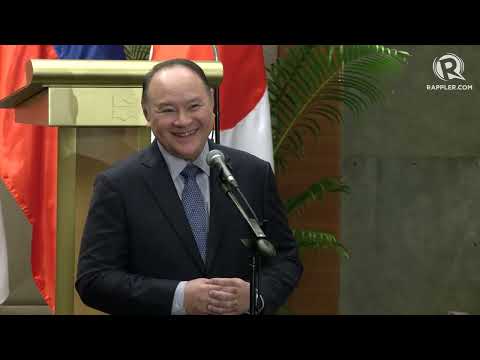
It’s been emphasized less in public talk for many reasons, including consideration towards South Korea, where the idea of military cooperation with Japan is still a sensitive issue. The Philippines and South Korea are strategic partners.
In an interview in early May 2026, Teodoro said increased engagements with Japan, including the participation of the Japan Self-Defense Forces for the first time in Balikatan 2026, is putting the one theater concept into action.
“We are interoperating… of course with the ability of the Philippines to go beyond its EEZ…we are still limited because we’re still filling that space. But eventually, we will need to work in a more expansive manner, at least in the high seas — naturally, to protect our seafarers,” said Teodoro.
Beyond 2028
The Philippines has amassed a fairly varied basket of friends and allies, with just over two years left in the Marcos administration. Militarily, agreements with New Zealand and Canada await ratification by a Philippine Senate in chaos. Manila just signed a States of the Visiting Forces Agreement (SOVFA) with France, and the same deal is being negotiated with the United Kingdom.
As impressive as the lineup of like-minded countries and partners are, the real question is how Manila makes the most of it. “It is not new knowledge that Manila tries to leverage its growing defense network to project that it is not alone. However, unless it can demonstrate that it can fight alone and strategically win, it can pose a significant loophole in its growing network,” said Espeña.
Japan is clearly poised to play a huge role until the end of Marcos’ term, and almost certainly beyond. Tokyo was a critical partner to the Philippines under former president Rodrigo Duterte, who had personal affinity with and for the late Japanese prime minister Abe Shinzo.
“The jury is still out on whether [the Philippines] can fully deter China; it remains steadfast against policy shifts after Mr. Marcos’ term. Domestically, polarization remains a major theme that influences foreign policy—especially if another Duterte would preside over Malacañang in 2028,” added Espeña.
If the Philippines shifts or does a 180 in its foreign and military policy after the 2028 elections, agreements with RAAs and SOVFA and GSOMIA are meant to bear those shifts. The question now would be if the foundation Manila’s been laying down can bear those pressures. — Rappler.com


Disclaimer: The articles reposted on this site are sourced from public platforms and are provided for informational purposes only. They do not necessarily reflect the views of MEXC. All rights remain with the original authors. If you believe any content infringes on third-party rights, please contact crypto.news@mexc.com for removal. MEXC makes no guarantees regarding the accuracy, completeness, or timeliness of the content and is not responsible for any actions taken based on the information provided. The content does not constitute financial, legal, or other professional advice, nor should it be considered a recommendation or endorsement by MEXC.
You May Also Like
Trump’s Supreme Court is coming for your job: analysis
In April, the Supreme Court handed down a controversial decision which critics say “eviscerated” the Voting Rights Act. Now, according to new reporting from Vox
Share
Alternet2026/06/11 04:58

Cathie Wood doubles down on crypto stocks during market rout
Cathie Wood has maintained sizable positions in crypto-linked stocks through her flagship ARKK fund even as roughly $3 trillion has been wiped from the S&P 500
Share
Crypto.news2026/06/11 04:48

Bitcoin, Gold, and U.S. Stocks Dive as Trump Pledges to Hit Iran ‘Extremely Hard’
The post Bitcoin, Gold, and U.S. Stocks Dive as Trump Pledges to Hit Iran ‘Extremely Hard’ appeared on BitcoinEthereumNews.com. In brief Bitcoin dropped Thursday
Share
BitcoinEthereumNews2026/04/02 17:57



