Kaspa (KAS) is growing even as its price stays low. The network has now processed over 2.17 billion transactions and passed 540,000 wallets. More people are usingKaspa (KAS) is growing even as its price stays low. The network has now processed over 2.17 billion transactions and passed 540,000 wallets. More people are using

Kaspa Whale Scandal – Founder Defends the Buyer While Community Gets Hurt

For feedback or concerns regarding this content, please contact us at crypto.news@mexc.com

Kaspa (KAS) is growing even as its price stays low. The network has now processed over 2.17 billion transactions and passed 540,000 wallets. More people are using it.

New tools are also coming online. Kaskad, Kaspa’s first lending platform, launched its governance token on MEXC. That opens the door to DeFi services built around KAS. The network is also getting ready for the Toccata hard fork. That is a big upgrade that will add native tokens and programmability.

Even with all this, the KAS price is trading near $0.030 and down almost 1% in the last day. The gap between what the network is doing and what the price is doing has people talking. Fresh criticism about the project’s leadership and how much influence large holders have has also popped up again on social media.

Kaspa Whale Controversy Sparks Community Debate

Community member Shai Wyborski reignited a heated discussion after criticizing what he described as the founder’s defense of a major whale investor. In his post, Wyborski said that influential buyers were allowed to do things that hurt the wider community. 

Yet those same people kept getting support from key figures in the project. He claimed this pushed other large investors away and left control in the hands of just a small group.

This complaint touches on an old worry in crypto: whether big holders have too much say over market mood and where a project heads. People are listening because the KAS price is still near multi-year lows, even as the network keeps growing. 

For some investors, this debate raises real questions. Who runs things? How open is the project? And are smaller holders getting enough attention as the network matures?

Dormant KAS Supply Hits Record High as Holders Refuse to Sell

A separate data point shared by Kaspa Daily paints a very different picture. The latest on-chain metrics show that 47.64% of all circulating KAS has not moved for more than one year. 

Back in late 2023, that number was around 15%. So the share of untouched supply has more than tripled in the last two and a half years.

What makes this interesting is that dormant supply kept growing even as the KAS price fell from about $0.20 down to $0.03. A lot of long-term holders chose not to sell, even after a steep drop. 

That means less supply is floating around on the market. It also shows strong belief from the people who own it. Nearly half of all KAS coins in circulation have not moved. That creates a scarcity situation. And that could matter later if demand ever comes back.

Key Catalysts Supporting the KAS Price

One of the biggest developments for Kaspa is the launch of Kaskad, the network’s first native lending protocol. Built on the Igra Layer 2 network, Kaskad allows users to borrow stablecoins using KAS as collateral. 

Its governance token, KSKD, was listed on MEXC on May 25. The platform targets yields between 8% and 12%, giving KAS holders new utility beyond simple transfers. A functioning lending market can increase capital efficiency and create additional demand for the asset.

Another big event is the Toccata hard fork. It is expected to go live sometime between June 5 and June 20. The upgrade will add native KRC-20 tokens and covenant programming. That moves Kaspa beyond just sending payments and opens it up to many more kinds of apps. The final test phase is already done, so there is less worry about things going wrong.

Supply numbers also look good. Kaspa’s circulating supply is about 27.48 billion coins. That is over 95% of its maximum supply of roughly 28.7 billion. New coins keep slowing down under the network’s Chromatic Phase schedule, and new issuance is expected to hit near zero by late 2026. Unlike many other Layer 1 networks that have big token unlocks ahead, Kaspa has very little future dilution.

Even so, the mood in the wider market is still a problem. Bitcoin dominance is high near 59%. The Fear & Greed Index is at 36. Those conditions have hurt a lot of altcoins.

Related Kaspa News: Kaspa Crashes 74% After Last Hard Fork: Can Toccata Ugrade Finally Save KAS Price in June?

Kaspa Price Analysis: Is a Reversal Starting?

We had a look at the KAS chart, and price action remains under pressure after a prolonged downtrend. Market value has dropped from over $1.1 billion in mid-May to about $828 million now. Lower highs and lower lows keep showing up on the chart. That tells you sellers are still running the show.

But the momentum numbers are starting to look a little better. The RSI histogram is still negative, but the bars are not as sharp as they were during past sell-offs. 
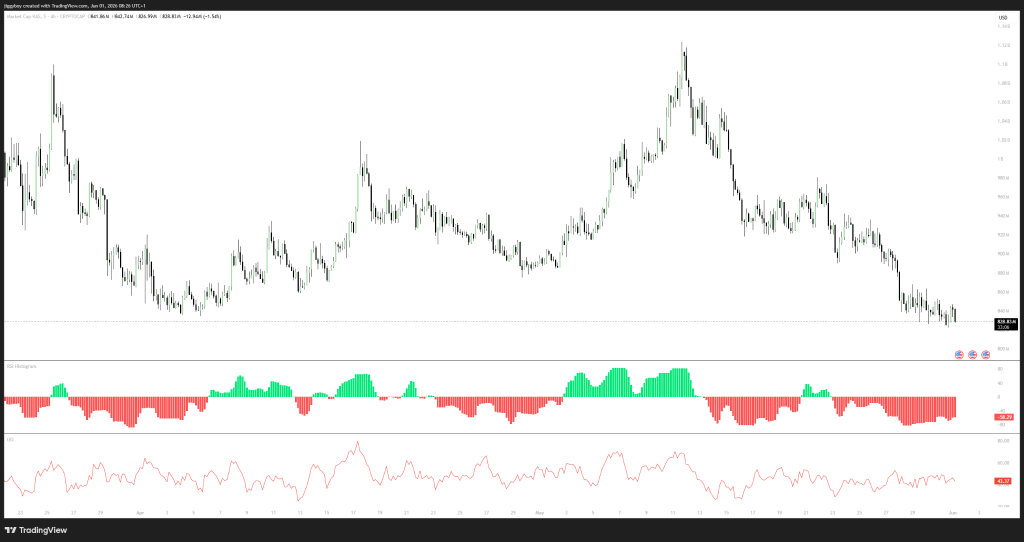
Source: Tradingview.com

The RSI itself has climbed back to 43 after spending time closer to oversold levels. That matches what Kaspa Daily pointed out as bullish divergence. Momentum has improved, even though the price has gone nowhere.

For buyers, the first job is to take back resistance near $0.035 to $0.040. A clean break above that zone could open the road to $0.05. If selling pressure continues, support remains near the $0.03 level, which has become an important psychological area for Kaspa.

With almost half of the circulating supply dormant, new demand generated by the Toccata upgrade or growing DeFi activity could have an outsized effect on the KAS price over the coming months.

Frequently Asked Questions

Can Kaspa price Reach $5❓

Kaspa reaching $5 is possible, but it would require a market capitalization well above $100 billion based on its circulating supply. Achieving that level would likely depend on massive adoption, successful ecosystem growth, and a strong crypto bull market.

Is Kaspa a Good Investment❓

Kaspa attracts investors with its fast BlockDAG technology, fair launch model, and upcoming smart contract capabilities. However, it remains a high-risk asset due to price volatility and the challenge of expanding adoption beyond its current user base.

Subscribe to our YouTube channel for daily crypto updates, market insights, and expert analysis.

The post Kaspa Whale Scandal – Founder Defends the Buyer While Community Gets Hurt appeared first on CaptainAltcoin.


Market Opportunity
ConstitutionDAO Logo
ConstitutionDAO Price(PEOPLE)
$0.005371
$0.005371$0.005371
+0.46%
USD
ConstitutionDAO (PEOPLE) Live Price Chart

Get Covered, Share 1M USDT

Get Covered, Share 1M USDTGet Covered, Share 1M USDT

Higher VVIP tiers, higher compensation odds.

Disclaimer: The articles reposted on this site are sourced from public platforms and are provided for informational purposes only. They do not necessarily reflect the views of MEXC. All rights remain with the original authors. If you believe any content infringes on third-party rights, please contact crypto.news@mexc.com for removal. MEXC makes no guarantees regarding the accuracy, completeness, or timeliness of the content and is not responsible for any actions taken based on the information provided. The content does not constitute financial, legal, or other professional advice, nor should it be considered a recommendation or endorsement by MEXC.

You May Also Like

Not a loophole: Singapore AI export controls let China tap US AI legally

Not a loophole: Singapore AI export controls let China tap US AI legally

American AI technology is reaching Chinese tech giants through a route that US export controls were never designed to close: Singapore. The city-state sits outside
Share
The Cryptonomist2026/07/10 14:46
Unlocking Massive Value: Curve Finance Revenue Sharing Proposal for CRV Holders

Unlocking Massive Value: Curve Finance Revenue Sharing Proposal for CRV Holders

BitcoinWorld Unlocking Massive Value: Curve Finance Revenue Sharing Proposal for CRV Holders The dynamic world of decentralized finance (DeFi) is constantly evolving, bringing forth new opportunities and innovations. A significant development is currently unfolding at Curve Finance, a leading decentralized exchange (DEX). Its founder, Michael Egorov, has put forth an exciting proposal designed to offer a more direct path for token holders to earn revenue. This initiative, centered around a new Curve Finance revenue sharing model, aims to bolster the value for those actively participating in the protocol’s governance. What is the “Yield Basis” Proposal and How Does it Work? At the core of this forward-thinking initiative is a new protocol dubbed Yield Basis. Michael Egorov introduced this concept on the CurveDAO governance forum, outlining a mechanism to distribute sustainable profits directly to CRV holders. Specifically, it targets those who stake their CRV tokens to gain veCRV, which are essential for governance participation within the Curve ecosystem. Let’s break down the initial steps of this innovative proposal: crvUSD Issuance: Before the Yield Basis protocol goes live, $60 million in crvUSD will be issued. Strategic Fund Allocation: The funds generated from the sale of these crvUSD tokens will be strategically deployed into three distinct Bitcoin-based liquidity pools: WBTC, cbBTC, and tBTC. Pool Capping: To ensure balanced risk and diversified exposure, each of these pools will be capped at $10 million. This carefully designed structure aims to establish a robust and consistent income stream, forming the bedrock of a sustainable Curve Finance revenue sharing mechanism. Why is This Curve Finance Revenue Sharing Significant for CRV Holders? This proposal marks a pivotal moment for CRV holders, particularly those dedicated to the long-term health and governance of Curve Finance. Historically, generating revenue for token holders in the DeFi space can often be complex. The Yield Basis proposal simplifies this by offering a more direct and transparent pathway to earnings. By staking CRV for veCRV, holders are not merely engaging in governance; they are now directly positioned to benefit from the protocol’s overall success. The significance of this development is multifaceted: Direct Profit Distribution: veCRV holders are set to receive a substantial share of the profits generated by the Yield Basis protocol. Incentivized Governance: This direct financial incentive encourages more users to stake their CRV, which in turn strengthens the protocol’s decentralized governance structure. Enhanced Value Proposition: The promise of sustainable revenue sharing could significantly boost the inherent value of holding and staking CRV tokens. Ultimately, this move underscores Curve Finance’s dedication to rewarding its committed community and ensuring the long-term vitality of its ecosystem through effective Curve Finance revenue sharing. Understanding the Mechanics: Profit Distribution and Ecosystem Support The distribution model for Yield Basis has been thoughtfully crafted to strike a balance between rewarding veCRV holders and supporting the wider Curve ecosystem. Under the terms of the proposal, a substantial portion of the value generated by Yield Basis will flow back to those who contribute to the protocol’s governance. Returns for veCRV Holders: A significant share, specifically between 35% and 65% of the value generated by Yield Basis, will be distributed to veCRV holders. This flexible range allows for dynamic adjustments based on market conditions and the protocol’s performance. Ecosystem Reserve: Crucially, 25% of the Yield Basis tokens will be reserved exclusively for the Curve ecosystem. This allocation can be utilized for various strategic purposes, such as funding ongoing development, issuing grants, or further incentivizing liquidity providers. This ensures the continuous growth and innovation of the platform. The proposal is currently undergoing a democratic vote on the CurveDAO governance forum, giving the community a direct voice in shaping the future of Curve Finance revenue sharing. The voting period is scheduled to conclude on September 24th. What’s Next for Curve Finance and CRV Holders? The proposed Yield Basis protocol represents a pioneering approach to sustainable revenue generation and community incentivization within the DeFi landscape. If approved by the community, this Curve Finance revenue sharing model has the potential to establish a new benchmark for how decentralized exchanges reward their most dedicated participants. It aims to foster a more robust and engaged community by directly linking governance participation with tangible financial benefits. This strategic move by Michael Egorov and the Curve Finance team highlights a strong commitment to innovation and strengthening the decentralized nature of the protocol. For CRV holders, a thorough understanding of this proposal is crucial for making informed decisions regarding their staking strategies and overall engagement with one of DeFi’s foundational platforms. FAQs about Curve Finance Revenue Sharing Q1: What is the main goal of the Yield Basis proposal? A1: The primary goal is to establish a more direct and sustainable way for CRV token holders who stake their tokens (receiving veCRV) to earn revenue from the Curve Finance protocol. Q2: How will funds be generated for the Yield Basis protocol? A2: Initially, $60 million in crvUSD will be issued and sold. The funds from this sale will then be allocated to three Bitcoin-based pools (WBTC, cbBTC, and tBTC), with each pool capped at $10 million, to generate profits. Q3: Who benefits from the Yield Basis revenue sharing? A3: The proposal states that between 35% and 65% of the value generated by Yield Basis will be returned to veCRV holders, who are CRV stakers participating in governance. Q4: What is the purpose of the 25% reserve for the Curve ecosystem? A4: This 25% reserve of Yield Basis tokens is intended to support the broader Curve ecosystem, potentially funding development, grants, or other initiatives that contribute to the platform’s growth and sustainability. Q5: When is the vote on the Yield Basis proposal? A5: A vote on the proposal is currently underway on the CurveDAO governance forum and is scheduled to run until September 24th. If you found this article insightful and valuable, please consider sharing it with your friends, colleagues, and followers on social media! Your support helps us continue to deliver important DeFi insights and analysis to a wider audience. To learn more about the latest DeFi market trends, explore our article on key developments shaping decentralized finance institutional adoption. This post Unlocking Massive Value: Curve Finance Revenue Sharing Proposal for CRV Holders first appeared on BitcoinWorld.
Share
Coinstats2025/09/18 00:35
Q2 Market Insights: Bitcoin regains dominance in risk-averse environment, ETFs remain critical to market structure


Q2 Market Insights: Bitcoin regains dominance in risk-averse environment, ETFs remain critical to market structure

The market will show a downward trend in the short term, and then rebound and set new highs in the second half of the year.
Share
PANews2025/04/28 19:40

Record Ads, Stock Down 7%

Record Ads, Stock Down 7%Record Ads, Stock Down 7%

Jul 29: Meta earnings face the market's question.

