

Ethereum Price Prediction: Ethereum's Most Uncomfortable Year
Ethereum's Most Uncomfortable Year
Ethereum price entered 2026 at roughly $3,000 and has spent the first half of the year steadily losing ground in ways that have genuinely surprised even long-time ETH holders. The list of headwinds is longer than usual. ETF outflows ran for a record 17 consecutive days in May.
Ethereum co-founder Vitalik Buterin sold millions of dollars of ETH in early 2026, creating a co-founder confidence deficit that the market has not fully forgiven. The Ethereum Foundation cut 23% of its staff. Layer 2 networks are cannibalizing mainnet fee revenue. And the Glamsterdam hard fork — the biggest upgrade since The Merge and ETH's most credible near-term catalyst — has been pushed from its original H1 target to Q3 2026.
As of June 15, 2026, ETH is trading at $1,719 on Bybit — up 2.64% in the last 24 hours but still down roughly 43% from where it opened 2026 and 65% below its all-time high of $4,946.05. The market cap is $207.55 billion, comfortably holding the number two position. And despite all of the above, Ethereum's institutional base is doing something that should not be overlooked: buying.
BitMine — the Tom Lee-associated Ethereum treasury company — holds more than 5.3 million ETH and is sitting on approximately $9.2 billion in unrealized losses. Their response has been to file to raise another $300 million specifically to buy more ETH. Standard Chartered maintains a $4,000 year-end target. Polymarket gives a 76% chance that ETH hits $1,500 before year-end — a bearish signal — but also shows significant conviction around a 2026 recovery. The story of ETH in mid-2026 is a story of two simultaneous and contradictory realities: weak price action and strengthening institutional conviction.
What Happened: The 2026 Selloff Story
January – February 2026: The Vitalik Factor
Early 2026 brought a damaging narrative that still lingers: Vitalik Buterin, Ethereum's co-founder, sold significant ETH holdings in the first months of the year. For a project whose technical credibility has always rested partly on its founder's conviction, this was psychologically damaging in a way that a random large-holder dump would not be.
Retail sentiment interpreted the sales as a vote of no confidence from the person who knows the project best. Vitalik's subsequent public statements — including his defense of Ethereum's protocol as running on software and validators, not the Ethereum Foundation's headcount — have not fully reversed that perception.
March – April 2026: EF Staff Cuts + ETF Underperformance
The Ethereum Foundation announced a 23% staff reduction — framed as a deliberate move toward a leaner, more decentralized structure. Simultaneously, U.S. Spot Ethereum ETFs — which launched in May 2024 with initial optimism — began showing a pattern of persistent outflows.
The correlation between ETF flow and ETH price became increasingly visible: months with net inflows closed green, months with outflows closed red. April 2026 showed $355.98 million in inflows and ETH gained 7.38%. May reversed to deep outflows, and the price collapsed.
May 2026: The Record 17-Day Outflow Streak
May 2026 became the defining month of ETH's 2026 bear narrative. Spot Ethereum ETFs logged a record 17 consecutive days of net outflows totaling $401 million — the longest and deepest outflow streak since the ETFs launched. This coincided with broader macro fears, S&P 500 correction territory, and a confirmed death cross on Ethereum's daily chart.
Polymarket probabilities for ETH hitting $1,500 before year-end climbed to 76%. ETH breached $1,700 to the downside before finding temporary support.
June 8, 2026: The Outflow Streak Breaks
On June 8, 2026, U.S. Spot ETH ETFs recorded $82.37 million in net inflows — snapping the 17-day streak alongside a parallel recovery in Bitcoin ETF flows. ETH was trading near $1,689 that day, up 1.3% in 24 hours. BitMine filed its $300 million preferred stock offering the same week. For the first time in months, the momentum of institutional behavior turned, even if price had not fully followed.
Glamsterdam: The Upgrade That Could Change Everything
If there is one reason to take a fundamentally different view of Ethereum in H2 2026 compared to H1, it is Glamsterdam. This is not a routine maintenance upgrade. It is the largest technical advancement Ethereum has made since The Merge in September 2022, and its scope directly addresses the most damaging criticisms that have followed ETH throughout 2026.
|
Glamsterdam Feature |
What It Actually Does |
|
|
Parallel Transaction Processing |
Executes multiple transactions simultaneously — replaces sequential processing. Enables 10,000 TPS target, up from ~50 TPS currently |
|
|
Gas Fee Reduction |
78.6% reduction in gas fees across simple ETH transfers AND complex smart contract calls. Both simple and advanced use cases benefit equally |
|
|
Gas Limit Increase |
Rises from 60 million to 200 million per block — direct throughput multiplier at the base layer |
|
|
Enshrined PBS (ePBS) |
Block building moves directly on-chain — removes external relay dependency. Increases decentralization and validator efficiency |
|
|
EIP-1559 Burn Mechanics |
Lower fees + higher activity = more ETH burns. Deflationary pressure increases as network usage grows |
|
|
Target TPS |
10,000 transactions/second |
~10x current mainnet throughput |
|
Current Testing Status |
Devnet-4 complete; Devnet-5 underway |
Two active test networks running |
|
Estimated Mainnet Launch |
Q3 2026 (aspirational) |
Roadmap updated June 4, 2026 |
The timing of Glamsterdam relative to ETH's price history matters. Ethereum upgrades have a well-documented relationship with price action. Before The Merge in September 2022, ETH rallied over 100% from its June lows. The Shapella upgrade in April 2023 defied sell-the-news expectations and rallied 10% post-activation.
Dencun in early 2024 generated 60% gains in the months leading in. If the pattern holds, ETH's current position — deeply oversold, with a major upgrade approaching in Q3 — sets up a potential pre-upgrade accumulation window.
The bear case around Glamsterdam is equally real: delay risk. Developer documentation references Q3 2026 but explicitly describes the date as aspirational. Base engineering teams have flagged scope creep as a risk. If Glamsterdam slips to Q4 or later, the one catalyst that could shift institutional sentiment will have disappointed — which typically accelerates rather than slows selling in technical assets.
"Glamsterdam is the strongest technical argument for Ethereum in over a year — arriving precisely when ETH price sits at historically depressed levels." — XBTFX Blog, April 2026
Technical Analysis — June 15, 2026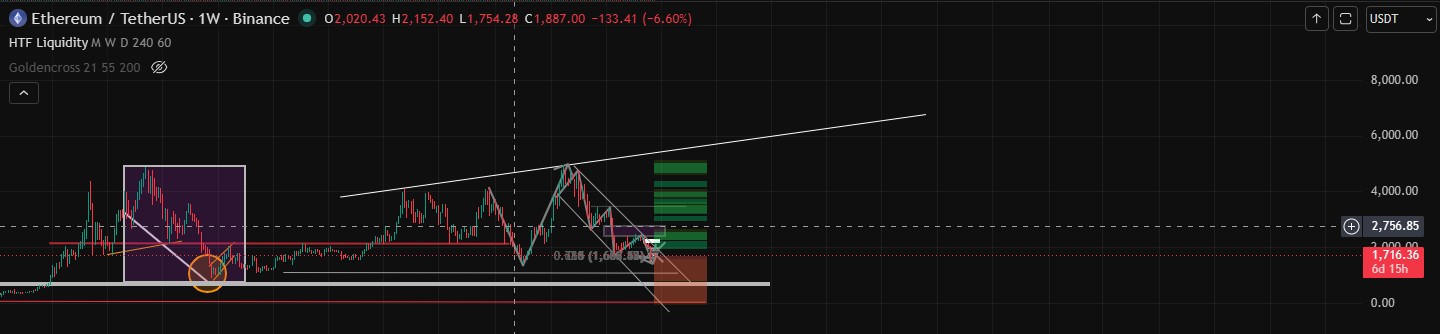
Price Predictions — All Timeframes (June 15, 2026)
Short-Term (June – July 2026)
|
Scenario |
Price Range |
Probability |
Key Driver |
|
Bull Case |
$1,800 – $2,000 |
25% |
ETF inflows continue; $1,750 resistance breaks; Glamsterdam confirmed |
|
Base Case |
$1,600 – $1,750 |
50% |
Range consolidation; ETF flow neutral; waiting for Glamsterdam |
|
Bear Case |
$1,400 – $1,600 |
25% |
ETF outflows resume; $1,654 support breaks; Glamsterdam delayed |
Q3 2026 (July – September) — The Glamsterdam Window
|
Scenario |
Price Range |
Probability |
Key Driver |
|
Bull Case |
$2,059 – $2,500 |
30% |
Glamsterdam launches on time; cost basis cluster 1 breaks; institutional FOMO |
|
Base Case |
$1,600 – $1,950 |
45% |
Pre-upgrade rally attempt; range-bound; macro uncertainty |
|
Bear Case |
$1,200 – $1,500 |
25% |
Glamsterdam delayed; BTC drops; outflows resume; sentiment breaks |
End of Year 2026 (December)
|
Scenario |
Price Range |
Probability |
Key Driver |
|
Bull Case |
$3,000 – $4,000 |
20% |
Standard Chartered $4,000 target; Glamsterdam delivered; Hegota announced |
|
Base Case |
$1,800 – $2,400 |
50% |
Changelly consensus; post-upgrade consolidation; ETF flows stabilize |
|
Bear Case |
$800 – $1,400 |
30% |
Macro deterioration; Glamsterdam delayed; L2 narrative accelerates |
Long-Term (2027 – 2028)
|
Scenario |
Price Range |
Probability |
Key Driver |
|
Ultra-Bull |
$10,000 – $40,000 |
10% |
SC's $40K long-term; Glamsterdam + Hegota delivered; ETH = global settlement |
|
Bull Case |
$4,000 – $8,000 |
25% |
New ATH in 2027 bull; 10K TPS live; RWA dominance |
|
Base Case |
$2,000 – $4,500 |
40% |
Steady institutional adoption; Bitcoin-correlated recovery |
|
Bear Case |
$500 – $1,500 |
25% |
L2 commoditization; competitor chains; ETH fee burns collapse |
Key Risk Factors
Near-Term Risks
•$1,654 Support Break: If ETH loses its June 15 intraday low of $1,654, there is no meaningful technical structure until the $1,400-$1,500 zone. With Polymarket at 76% probability for $1,500 before year-end, this scenario has significant market conviction behind it.
•Glamsterdam Delay: The single most important risk for H2 2026. A Q4 or 2027 slip in the Glamsterdam timeline removes the primary catalyst narrative and risks accelerating selling from institutions already sitting on losses.
•June Seasonality: Historical data shows average June returns of -6.74% since 2016, with only three green Junes in a decade. Seasonal headwinds are real, even in a year with strong catalysts.
Medium-Term Risks
• L2 Cannibalisation: Multiple-layer 2 networks are now competitive enough to host virtually all the activity that used to generate mainnet fees. If general-purpose L2s continue scaling, mainnet ETH fee burns may continue declining — weakening the EIP-1559 deflationary case.
• ETF Flow Reversal: The May outflow streak showed how quickly institutional flows can turn negative. If the June 8 reversal proves temporary and outflows resume, it will lose its most important near-term support mechanism.
• Vitalik Overhang: If the Ethereum co-founder makes additional large sales in H2 2026, the psychological impact on retail sentiment could be disproportionate relative to the actual supply impact.
Long-Term Risks
•Competitor L1 Displacement: Solana, Avalanche, and emerging chains continue taking market share in DeFi and gaming use cases. If Glamsterdam does not deliver the 10,000 TPS target on schedule, the window for Ethereum to reclaim throughput leadership may close.
•Quantum Resistance Timeline: The Strawmap vision includes quantum resistance as a long-term goal. If quantum computing advances faster than Ethereum's cryptographic roadmap, it creates a systemic risk that is currently underpriced by the market.
The Bull Case: Why Institutions Are Buying at $1,600
The most coherent explanation for why BitMine is raising $300 million to buy more while sitting on a $9.2 billion unrealized loss is the same reason long-duration investors buy any asset during a technically confirmed downtrend: they believe the price they see today is disconnected from the value they expect tomorrow.
•30% of Supply Locked: 37 million ETH in staking creates a structural supply constraint that does not exist for most assets. Sellers cannot access staked ETH instantaneously, and the staking yield makes holding progressively more attractive relative to selling.
•Glamsterdam Changes the Fee Math: If Glamsterdam delivers 78.6% lower gas fees and 10x throughput, on-chain activity should increase substantially. More activity means more EIP-1559 burns. More burns tighten supply further. The deflationary mechanism becomes more powerful precisely when the upgrade ships.
•Institutional Entry at Generational Lows: When sophisticated capital with long time horizons chooses to accumulate at $1,600 despite publicly declared losses of $9.2 billion, it is worth asking what they see that the market does not. The answer, based on public statements, is: a $40,000 long-term price target from Standard Chartered and a conviction that the current price represents a mispricing of infrastructure, not a correct valuation of a declining asset.
•ETF Infrastructure Maturing: BlackRock's ETH ETF now offers staking yield. This makes Ethereum ETFs structurally more competitive against fixed-income products than Bitcoin ETFs will ever be. As rates decline, yield-bearing ETH ETFs become increasingly attractive to institutional allocators who currently cannot hold crypto directly.
Conclusion: Ethereum Is at a Fork in the Road
The name is appropriate. Ethereum is, literally, at a fork in the road — waiting for Glamsterdam to ship, watching ETF flows reverse, and sitting at prices that the largest institutional holder in history considers a buying opportunity even while nursing billions in losses.
The near-term picture, June 15, 2026, is fragile. The $1,725 to $1,750 resistance zone is overhead. The $1,654 support needs to hold. The death cross is confirmed. June seasonality is historically unfavorable. And the Glamsterdam launch date is aspirational, not guaranteed. Any one of these factors going the wrong way in the next four to six weeks could push toward the $1,400 to $1,500 range that Polymarket has priced with 76% confidence.
But the medium-term picture — Q3 2026 and beyond — is the most technically compelling case for since The Merge. A network upgrade that cuts fees by 78.6% and increases throughput 10x, delivered against a backdrop of historically low prices, 30% locked supply, and growing institutional conviction, is the kind of asymmetric setup that long-duration investors have historically rewarded. The question is whether Glamsterdam ships on time and whether the macro environment cooperates.
Ethereum's 2026 story is not written yet. It is being written right now, in the testing networks running Devnet-5, in the weekly ETF flow reports, and in the accumulation wallets of institutional buyers who have decided that $1,600 Ethereum is a better long-term entry than $4,000 Ethereum was.
|
OVERALL X SENTIMENT BREAKDOWN — JUNE 15, 2026 Bearish: 55% — ETF outflows, Vitalik selling, death cross, Glamsterdam delay risk, $1,500 Polymarket probability at 76%. Neutral/Watching: 30% — Waiting for Glamsterdam confirmation; watching $1,654 support; monitoring ETF flows weekly. Bullish: 15% — Citing BitMine accumulation, $1,540 bounce structure, oversold RSI, June 8 ETF reversal. Key X Trend: 'Glamsterdam delay' vs. 'institutional accumulation' is the dominant debate. |
Disclaimer: This report is produced entirely for informational and educational purposes. It does not constitute financial, investment, or legal advice. All price predictions are speculative estimates drawn from publicly available analyst data and on-chain metrics — actual results may differ materially. The $1,719 current price is sourced from Bybit as of June 15, 2026. Cryptocurrency markets are highly volatile. Always conduct your own independent research (DYOR) before making any financial decisions.


You May Also Like

68% of global BTC miners came from the U.S., Russia, and China, Q1 2026

Vitalik Buterin Proposes Self-Sovereign AI Stack To Protect Users From Risks Of AI Agents

Why DOGEBALL is One of the Best Coins to Buy in 2026 After Legendary Success of XRP



