

Pudgy Penguins Ends Pudgy Party Mobile Game, Shifts Focus
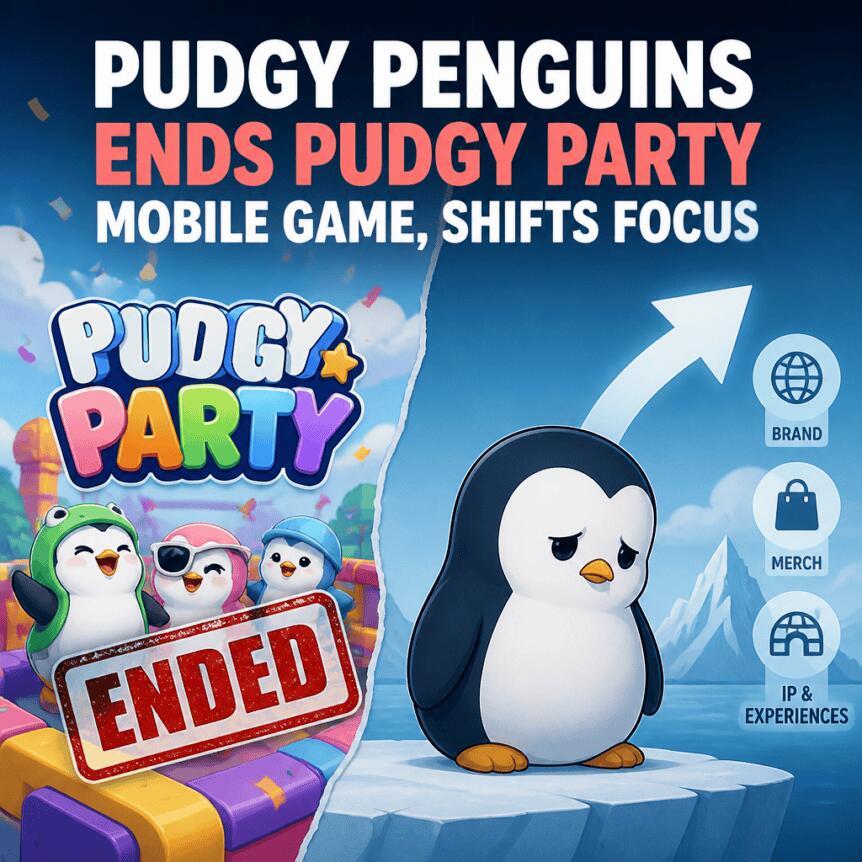
NFT brand Pudgy Penguins is winding down its mobile game Pudgy Party and pausing any further development, according to an announcement from the project’s team on X. The studio says it will redirect its gaming efforts toward Pudgy World, a browser-based experience it frames as the “flagship” game within the Pudgy Penguins ecosystem.
The shift comes after Pudgy Party launched in August 2025. The team said the game exceeded 500,000 downloads on Google Play, with total downloads topping 1 million across platforms. By consolidating its roadmap behind Pudgy World, Pudgy Penguins is signaling that it wants a single gaming product designed for broader reach and longer-term scalability.
Key takeaways
- Pudgy Party is being sunset: the team says it will wind down operations and halt further development.
- Pudgy Penguins is consolidating gaming around Pudgy World, described as the ecosystem’s flagship browser experience.
- Pudgy Party hit 500,000+ downloads on Google Play and more than 1 million total downloads, despite the pivot.
- The move reflects ongoing difficulty in Web3 gaming: another project, Fishing Frenzy, is also shutting down.
Pudgy Penguins exits one mobile game to focus on a “flagship”
In its X post, the Pudgy Party team described the decision as difficult, but argued that Pudgy World holds “greater potential for scalability” and is more likely to bring new users into the Pudgy Penguins brand.
That reasoning matters for investors and players because it points to a core challenge in crypto-gaming: building a product that can sustain a player base while integrating with Web3 monetization and brand ecosystems. A mobile launch can generate early traction—as Pudgy Party did—but the team’s decision suggests that user acquisition and retention may not have translated into a durable long-term plan.
Pudgy Penguins has positioned itself beyond NFTs, pursuing initiatives across toys, gaming, licensing, and broader entertainment. The gaming consolidation therefore appears less like an abandonment of the category and more like a strategic attempt to concentrate development resources behind one experience that can serve as a stable on-ramp for the brand.
What Pudgy Party’s download numbers imply—and what they don’t
Pudgy Party’s stated reach—500,000+ downloads on Google Play and over 1 million total—signals that there was consumer interest. But a pivot after those milestones suggests that download counts alone may not be sufficient to justify ongoing development.
For readers watching Web3 gaming, the important distinction is between “top-of-funnel” adoption and “business model” sustainability. Mobile downloads can be driven by marketing, brand recognition, or viral momentum. Turning that into long-term engagement and a viable revenue structure is typically harder—especially for projects that must balance Web2-style game economics with token incentives, on-chain components, or crypto-native distribution.
Pudgy Penguins’ rationale explicitly mentions scalability and onboarding, which hints that the team believes the browser-based format or ecosystem design of Pudgy World may better support ongoing growth.
Web3 gaming’s recurring problem: product-market-business fit
Pudgy Party’s wind-down arrives during a broader wave of uncertainty in Web3 gaming. Earlier, Fishing Frenzy and its developer, Uncharted, announced they would cease operations after concluding they couldn’t establish a sustainable crypto-gaming thesis.
In an X post shared on Monday, Fishing Frenzy said it was “unable to prove our thesis on crypto gaming” and “could not find product-market-business fit.” The team said it spent the previous year testing multiple approaches and targeting different audiences without finding a path that gave them confidence to continue.
This parallel is significant: it suggests that even projects that experiment actively and iterate for extended periods may struggle to find a stable formula that combines gameplay appeal, user retention, and a monetization model that can withstand market and platform realities.
How Fishing Frenzy is shutting down—and what it’s doing with USDC and tokens
Fishing Frenzy said it will shut down its servers on June 25 at 2:00 a.m. UTC. The project also made notable changes to its token and sales mechanics: it stopped selling USDC packages and adjusted the FISH token so it is spend-only and untradable.
The team said remaining USDC in the FISH/USDC liquidity pool would be redistributed to community members and stakers. By outlining a specific redistribution plan rather than a vague “we’ll figure it out,” the project is trying to manage expectations as it exits.
These details matter because they show the practical constraints that Web3 gaming projects face when they can’t scale their business: token utility can be constrained, markets can lose liquidity, and teams may ultimately need to wind down infrastructure while addressing on-chain balances and user expectations.
NFT market backdrop: capitalization rises, but the sector is still far from prior highs
Alongside the gaming-specific developments, NFT market conditions have been fluctuating. CoinGecko data cited in the original reporting shows total NFT market capitalization climbed to nearly $1.5 billion on Monday, up from more than $1.3 billion on Friday. Still, that level remains dramatically below the sector’s 2022 peak of over $17 billion.
For builders and brand-led NFT ecosystems like Pudgy Penguins, this environment can increase pressure to demonstrate real utility. When the broader market is well below prior highs, it often becomes harder to finance development through speculative demand alone—making it more likely that teams will prune or restructure product lines to focus on what can be scaled efficiently.
At the same time, modest rebounds in market capitalization can give projects breathing room, but the trajectory of Web3 gaming may depend less on NFT prices day-to-day and more on whether games can stand alone as compelling user experiences while delivering coherent incentives.
Going forward, the key question is whether Pudgy World can deliver the scalability and new-user onboarding that Pudgy Penguins is targeting, especially in a market where other crypto games have struggled to prove long-term business fit. Readers should watch for updates on Pudgy World’s rollout and for any further clarification from Pudgy Penguins on how gaming will tie back into the broader brand beyond NFTs.
This article was originally published as Pudgy Penguins Ends Pudgy Party Mobile Game, Shifts Focus on Crypto Breaking News – your trusted source for crypto news, Bitcoin news, and blockchain updates.


You May Also Like
Altseason Outlook Begins to Build on Strong Support From ALTSZN in Rotation

How America can stage a 'remarkable comeback' after Trump’s 'bread and circuses'
CFTC Chairman Selig taps two new senior officials as agency expands amid prediction market fights



