Solana (SOL) has lower chances of being affected by the potential supply pressure from Grayscale's influence compared to Litecoin (LTC) if the Securities and Exchange Commission (SEC) approves altcoin exchange-traded funds (ETFs).Solana (SOL) has lower chances of being affected by the potential supply pressure from Grayscale's influence compared to Litecoin (LTC) if the Securities and Exchange Commission (SEC) approves altcoin exchange-traded funds (ETFs).

Long Solana, Short Litecoin trade attractive if altcoin ETFs are approved: K33

  • A long Solana, short Litecoin trading strategy could be attractive if altcoin ETFs gain SEC approval.
  • Grayscale's SOL trust represents 0.1% of Solana's circulating supply and has never traded below its net asset value.
  • The firm's LTC trust comprises 2.65% of Litecoin's circulating supply and has often traded at steep discounts to its underlying assets.

Solana (SOL) has lower chances of being affected by the potential supply pressure from Grayscale's influence compared to Litecoin (LTC) if the Securities and Exchange Commission (SEC) approves altcoin exchange-traded funds (ETFs).

Solana and Litecoin ETFs fuel deliberation ahead of SEC decision

Solana and Litecoin could see diverging investor sentiment if the SEC approves altcoin ETFs, noted Vetle Lunde, Head of Research at K33, in a Tuesday report.

Lunde noted that a "long SOL, short LTC" trade may be attractive if altcoin ETFs are launched, citing the differences in the trading histories of Grayscale's Solana and Litecoin trusts.

The firm's Solana trust, which began trading in 2023, represents only 0.1% of the circulating SOL supply and has never traded below its net asset value (NAV). K33 noted that this removes the risk of excess supply hitting the market if Grayscale's SOL trust is converted into an ETF.

On the other hand, the Grayscale Litecoin trust, which went public earlier than its Solana counterpart, traded at steep discounts during the 2022 bear market and for most of 2025.

Lunde highlighted that Grayscale holds a large portion of LTC's circulating supply — 2.65%. Given its history of occasionally trading at discounts, the firm's Litecoin trust could experience significant outflows upon conversion to an ETF.

"We see a long SOL, short LTC trade as attractive after ETF launches, assuming they occur around the same time. Given LTC's history of sharp reactions to positive news, we'll likely wait a few days post-launch before acting."
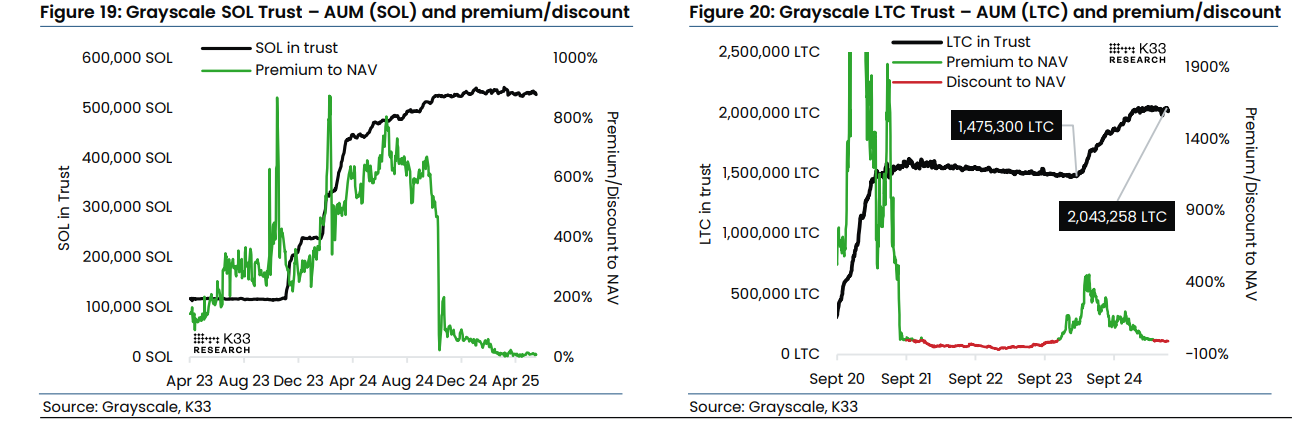
Grayscale SOL & LTC Trusts. Source: K33 Research

Intense outflows from Grayscale Bitcoin and Ethereum trusts also pressured BTC and ETH ETFs during their respective launches last year. However, inflows into several other products were able to offset outflows from Grayscale to a large extent.

Unlike Bitcoin and Ethereum ETFs, Grayscale is one of the only three issuers, alongside Canary Capital and CoinShares, that have filed for an LTC ETF, "meaning fewer issuers are present to offset the potential outflows," the report states.

The prediction from K33 comes as the US Securities and Exchange Commission (SEC) approved generic listing standards for crypto ETFs. The regulator is also expected to make a decision on Litecoin and Solana ETF filings in early October, before deciding on other funds later in the month.

Solana and Litecoin trade around $210 and $107, down 2% and up 0.1%, respectively, over the past 24 hours.


Market Opportunity
Polytrade Logo
Polytrade Price(TRADE)
$0,07548
$0,07548$0,07548
+10,01%
USD
Polytrade (TRADE) Live Price Chart
Disclaimer: The articles reposted on this site are sourced from public platforms and are provided for informational purposes only. They do not necessarily reflect the views of MEXC. All rights remain with the original authors. If you believe any content infringes on third-party rights, please contact service@support.mexc.com for removal. MEXC makes no guarantees regarding the accuracy, completeness, or timeliness of the content and is not responsible for any actions taken based on the information provided. The content does not constitute financial, legal, or other professional advice, nor should it be considered a recommendation or endorsement by MEXC.

You May Also Like

Visa Expands USDC Stablecoin Settlement For US Banks

Visa Expands USDC Stablecoin Settlement For US Banks

The post Visa Expands USDC Stablecoin Settlement For US Banks appeared on BitcoinEthereumNews.com. Visa Expands USDC Stablecoin Settlement For US Banks
Share
BitcoinEthereumNews2025/12/17 15:23
Nasdaq Company Adds 7,500 BTC in Bold Treasury Move

Nasdaq Company Adds 7,500 BTC in Bold Treasury Move

The live-streaming and e-commerce company has struck a deal to acquire 7,500 BTC, instantly becoming one of the largest public […] The post Nasdaq Company Adds 7,500 BTC in Bold Treasury Move appeared first on Coindoo.
Share
Coindoo2025/09/18 02:15
Curve Finance votes on revenue-sharing model for CRV holders

Curve Finance votes on revenue-sharing model for CRV holders

The post Curve Finance votes on revenue-sharing model for CRV holders appeared on BitcoinEthereumNews.com. Curve Finance has proposed a new protocol called Yield Basis that would share revenue directly with CRV holders, marking a shift from one-off incentives to sustainable income. Summary Curve Finance has put forward a revenue-sharing protocol to give CRV holders sustainable income beyond emissions and fees. The plan would mint $60M in crvUSD to seed three Bitcoin liquidity pools (WBTC, cbBTC, tBTC), with 35–65% of revenue distributed to veCRV stakers. The DAO vote runs from up to Sept. 24, with the proposal seen as a major step to strengthen CRV tokenomics after past liquidity and governance challenges. Curve Finance founder Michael Egorov has introduced a proposal to give CRV token holders a more direct way to earn income, launching a system called Yield Basis that aims to turn the governance token into a sustainable, yield-bearing asset.  The proposal has been published on the Curve DAO (CRV) governance forum, with voting open until Sept. 24. A new model for CRV rewards Yield Basis is designed to distribute transparent and consistent returns to CRV holders who lock their tokens for veCRV governance rights. Unlike past incentive programs, which relied heavily on airdrops and emissions, the protocol channels income from Bitcoin-focused liquidity pools directly back to token holders. To start, Curve would mint $60 million worth of crvUSD, its over-collateralized stablecoin, with proceeds allocated across three pools — WBTC, cbBTC, and tBTC — each capped at $10 million. 25% of Yield Basis tokens would be reserved for the Curve ecosystem, and between 35% and 65% of Yield Basis’s revenue would be given to veCRV holders. By emphasizing Bitcoin (BTC) liquidity and offering yields without the short-term loss risks associated with automated market makers, the protocol hopes to draw in professional traders and institutions. Context and potential impact on Curve Finance The proposal comes as Curve continues to modify…
Share
BitcoinEthereumNews2025/09/18 14:37