This section critically reviews the status of holographic duality in condensed matter physics, noting the decline of the heuristic 'holo-hacking' approach.This section critically reviews the status of holographic duality in condensed matter physics, noting the decline of the heuristic 'holo-hacking' approach.

The Ubiquitous NFL Problem: Comparing Bosonization, Eikonal, and Holographic Techniques

2025/10/31 23:00
  • Prologue
  • Diagrammatic(s) Rules
  • Straight-forward Eikonal
  • Legacy Bosonization
  • Wonton Holography
  • Holographic Propagators
  • Strange Cuprates
  • Stranger Things
  • Epilogue

Wonton Holography

Compared to what it has been just recently [26], the seemingly endless flurry of holographic publications in JHEP, PRD, and other traditional ’condensed matter oriented’ venues has been steadily coming to a mere trickle. Those few holographic exercises that do occasionally pop out still tend to begin with the mantra ’holography is well known to be an established method for studying strongly correlated systems’. However, this optimistic reassurance often appears to be in a rather stark contrast with the typical summary that sounds more like ’as no unambiguous agreement with experiment was found, the problem is left to future work’.

\ Also, much of the original thrust towards boldly treating an arbitrary condensed matter system of interest as yet another application of some opportunistically chosen weakly-coupled semiclassical gravity has retreated into a ’safer-haven’ topic of hydrodynamics (which, while highlighted and revitalized by holography, can be - and of course had long been - successfully discussed without ever mentioning the latter).

\ On the outside, it may seem as though the heuristic ’holo-hacking’ (a.k.a. ’bottom up’ or ’non-AdS/nonCFT’) approach tends to pick out its favorite gravity-like bulk theory on the basis of such physically compelling reasons as an existence of the previously found classical solutions and normal modes’ spectra, availability of the numerical simulation software, or mere need to engage students with the tangible computational tasks.

\ However, apart from having become a massive and customary practice, there hasn’t been much effort made towards any serious justification of neither the overall holographic scheme, nor its specific ’dictionary’ which was copy-pasted from the original string-theoretical framework. In that regard, it might be worth keeping in mind that just because everyone else on a highway may be driving above the posted speed limit does not by itself make it legal.

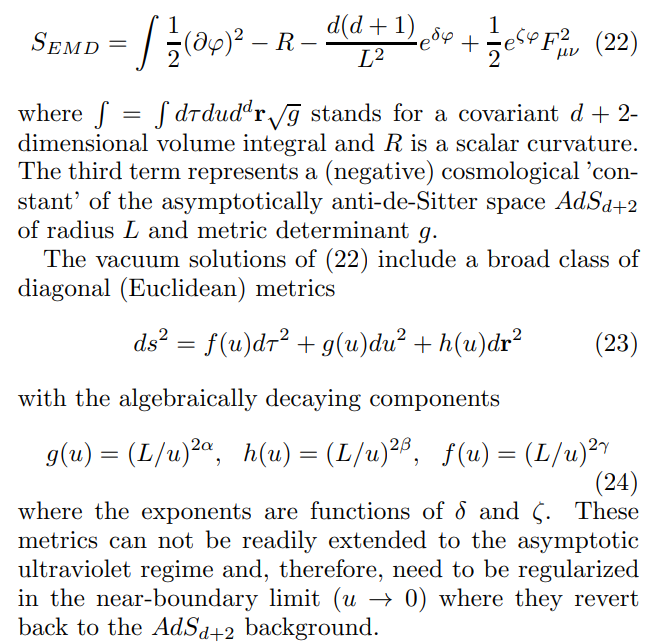
\ In light of the above, comparing holographic propagators to the predictions of other techniques could provide an additional testing ground for, both, the alternate methods as well as the holographic approach itself. the bulk metric, gauge, and scalar (dilaton) fields [26]

\
\
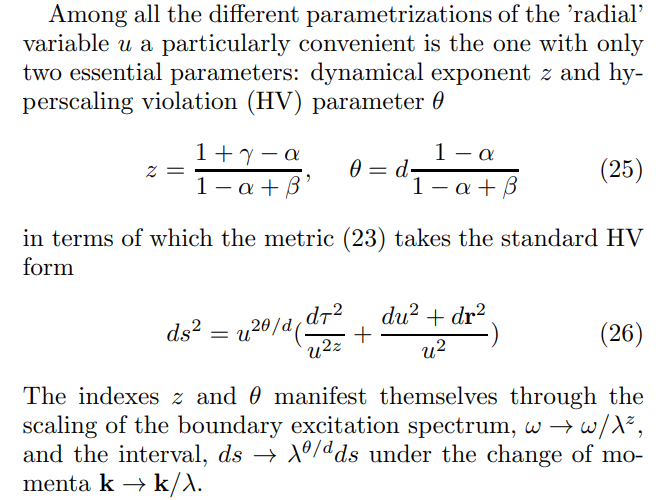
\ Among all the classical solutions of the theory (22) there is a special class of Lifshitz metrics (θ = 0) which were discovered in the semiclassical (ThomasFermi) analysis of matter back-reaction on the metric, as well as in the ’electron star’ scenarios, etc. [27].

\ More generally, any viable solutions of (22) must obey certain stability (’null energy’) conditions [26]

\

\

:::info Author:

(1) D. V. Khveshchenko, Department of Physics and Astronomy, University of North Carolina, Chapel Hill, NC 27599.

:::


:::info This paper is available on arxiv under CC BY 4.0 DEED license.

:::

\

Disclaimer: The articles reposted on this site are sourced from public platforms and are provided for informational purposes only. They do not necessarily reflect the views of MEXC. All rights remain with the original authors. If you believe any content infringes on third-party rights, please contact service@support.mexc.com for removal. MEXC makes no guarantees regarding the accuracy, completeness, or timeliness of the content and is not responsible for any actions taken based on the information provided. The content does not constitute financial, legal, or other professional advice, nor should it be considered a recommendation or endorsement by MEXC.

You May Also Like

Spot XRP ETFs Nears $1B AUM Milestone as Streak of No Outflows Continues

Spot XRP ETFs Nears $1B AUM Milestone as Streak of No Outflows Continues

The post Spot XRP ETFs Nears $1B AUM Milestone as Streak of No Outflows Continues appeared on BitcoinEthereumNews.com. The U.S. Spot XRP ETFs is now near the $1 billion mark of assets under management in less than a month since their launch. This follows from the product maintaining consistent inflows with no single outflow recorded yet. XRP ETFs See Continuous Inflows Since Launch Since its first launch on November 14, spot XRP funds have seen continued inflows. According to data from SoSoValue, the total inflows into these funds have now risen to $881.25 million. The funds attracted $12.84 million of new money yesterday. The daily trading volumes remained stable at $26.74 million. Source: SoSoValue Reaching nearly $1 billion in less than 30 days makes the product among the fastest growing crypto investment products in the United States. Notably, Spot Solana ETFs also accumulated over $600 million since their launch. On the other hand, Bitcoin and Ethereum ETFs are holding about $58 billion and about $13 billion in assets under management respectively. Much of the early growth traces back to the first Canary Capital’s XRP ETF. Its opening on November 13 brought one of the strongest crypto ETF openings to date. It saw more than $59 million in first-day trading volume and $245 million in net inflows. Shortly after Canary’s launch, firms like Grayscale, Bitwise, and Franklin Templeton introduced their own XRP products. Bitwise’s fund also did well on its launch, recording over $105 million in early inflows. Meanwhile, the market is getting ready for yet another addition. 21Shares’ U.S. spot XRP fund also got the green light from the SEC. It will trade under the ticker TOXR on the Cboe BZX Exchange. XRP Products Keep Gaining Momentum in the Market The token’s funds continued to expand this week. REX Shares and Tuttle Capital have launched the T-REX 2X Long XRP Daily Target ETF. This new ETF allows traders…
Share
BitcoinEthereumNews2025/12/05 14:11
Headwind Helps Best Wallet Token

Headwind Helps Best Wallet Token

The post Headwind Helps Best Wallet Token appeared on BitcoinEthereumNews.com. Google has announced the launch of a new open-source protocol called Agent Payments Protocol (AP2) in partnership with Coinbase, the Ethereum Foundation, and 60 other organizations. This allows AI agents to make payments on behalf of users using various methods such as real-time bank transfers, credit and debit cards, and, most importantly, stablecoins. Let’s explore in detail what this could mean for the broader cryptocurrency markets, and also highlight a presale crypto (Best Wallet Token) that could explode as a result of this development. Google’s Push for Stablecoins Agent Payments Protocol (AP2) uses digital contracts known as ‘Intent Mandates’ and ‘Verifiable Credentials’ to ensure that AI agents undertake only those payments authorized by the user. Mandates, by the way, are cryptographically signed, tamper-proof digital contracts that act as verifiable proof of a user’s instruction. For example, let’s say you instruct an AI agent to never spend more than $200 in a single transaction. This instruction is written into an Intent Mandate, which serves as a digital contract. Now, whenever the AI agent tries to make a payment, it must present this mandate as proof of authorization, which will then be verified via the AP2 protocol. Alongside this, Google has also launched the A2A x402 extension to accelerate support for the Web3 ecosystem. This production-ready solution enables agent-based crypto payments and will help reshape the growth of cryptocurrency integration within the AP2 protocol. Google’s inclusion of stablecoins in AP2 is a massive vote of confidence in dollar-pegged cryptocurrencies and a huge step toward making them a mainstream payment option. This widens stablecoin usage beyond trading and speculation, positioning them at the center of the consumption economy. The recent enactment of the GENIUS Act in the U.S. gives stablecoins more structure and legal support. Imagine paying for things like data crawls, per-task…
Share
BitcoinEthereumNews2025/09/18 01:27