Stablecoins Evolving Into Critical Infrastructure for Institutional Markets Stablecoins are transitioning from niche crypto tools to essential components of theStablecoins Evolving Into Critical Infrastructure for Institutional Markets Stablecoins are transitioning from niche crypto tools to essential components of the

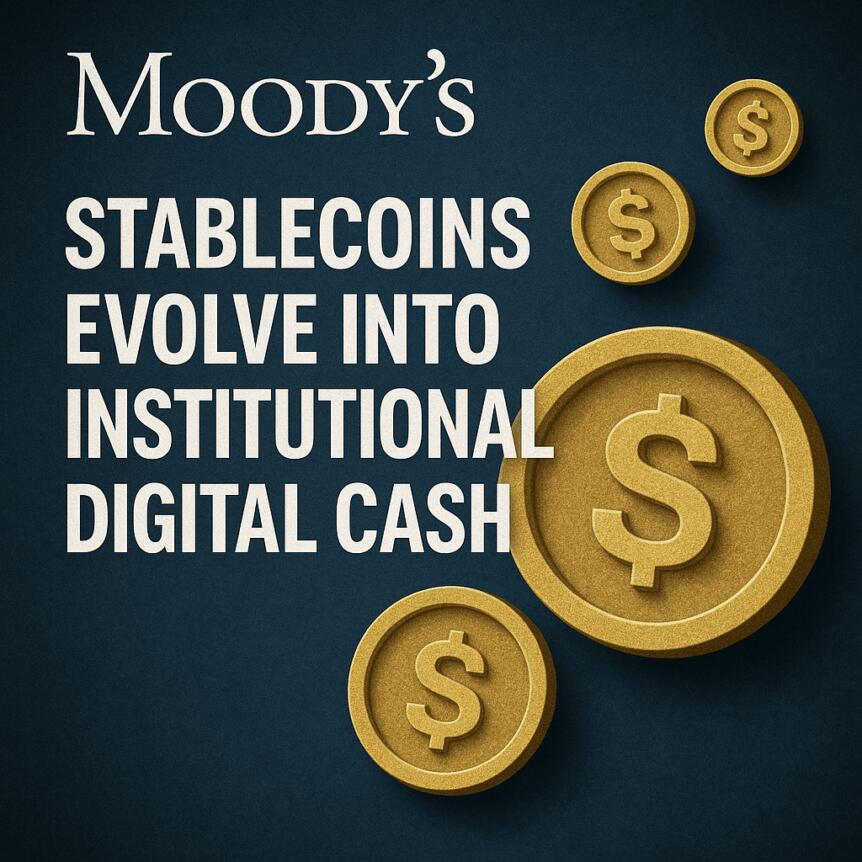
Moody’s: Stablecoins Evolve into Institutional Digital Cash
For feedback or concerns regarding this content, please contact us at crypto.news@mexc.com
Moody’s: Stablecoins Evolve Into Institutional Digital Cash

Stablecoins Evolving Into Critical Infrastructure for Institutional Markets

Stablecoins are transitioning from niche crypto tools to essential components of the institutional financial ecosystem, according to a recent report by Moody’s. The research highlights a significant surge in stablecoin activity, with processed settlement volumes jumping by approximately 87% in 2025 to reach an estimated $9 trillion, driven by on-chain transactions used for liquidity management, collateral transfers, and settlement processes.

Key Takeaways

  • Stablecoin settlement volume soared in 2025, indicating their growing role in institutional finance.
  • They are increasingly integrated into the infrastructure of digital and traditional finance, complementing tokenized bonds, funds, and credit products.
  • Major banks and asset managers are piloting blockchain settlement networks, tokenization platforms, and digital custody solutions, with projected investments surpassing $300 billion by 2030.
  • Regulation is beginning to adapt, with frameworks such as the EU’s MiCA and various licensing initiatives worldwide shaping the landscape, but operational risks remain significant.

Tickers mentioned: None

Sentiment: Optimistic about the technological shift, cautious regarding regulatory and operational risks.

Price impact: Neutral. While institutional adoption is increasing, regulatory clarity and security measures are critical for sustainable growth.

Market context: The move toward digital cash infrastructure aligns with broader trends of tokenization and blockchain integration across conventional financial markets.

Market Adoption and Infrastructure Development

According to Moody’s, stablecoins—particularly fiat-backed variants and tokenized deposits—are serving as the backbone for cross-border payments, repo transactions, and collateral transfers in the evolving digital economy. These assets act as “digital cash,” enabling seamless liquidity and settlement functions in a growing tokenized financial environment.

Moody’s Digital Economy – Global 2026 Outlook. Source: Moody’s

Financial institutions such as Citigroup and Société Générale have conducted successful trials using stablecoins for intraday liquidity and funds transfers, demonstrating the integration of these digital assets into existing banking systems. JPMorgan’s JPM Coin exemplifies the use of deposit tokens that facilitate programmable payments and liquidity management within traditional banking infrastructure.

Regulatory and Security Challenges

The report emphasizes that regulation is progressively evolving to accommodate these changes, with frameworks like Europe’s MiCA and licensing schemes in the Gulf region providing legal clarity. However, the transition introduces new risks such as smart contract bugs, oracle failures, cyberattacks, and interoperability issues across multiple blockchain networks. Moody’s stresses that security, governance, and interoperability will be pivotal for the reliable functioning of stablecoins as systemic settlement assets.

This article was originally published as Moody’s: Stablecoins Evolve into Institutional Digital Cash on Crypto Breaking News – your trusted source for crypto news, Bitcoin news, and blockchain updates.


Disclaimer: The articles reposted on this site are sourced from public platforms and are provided for informational purposes only. They do not necessarily reflect the views of MEXC. All rights remain with the original authors. If you believe any content infringes on third-party rights, please contact crypto.news@mexc.com for removal. MEXC makes no guarantees regarding the accuracy, completeness, or timeliness of the content and is not responsible for any actions taken based on the information provided. The content does not constitute financial, legal, or other professional advice, nor should it be considered a recommendation or endorsement by MEXC.

You May Also Like

Big U.S. banks cut prime rate to 7.25% after Fed’s interest rate cut
Big U.S. banks cut prime rate to 7.25% after Fed’s interest rate cut

The post Big U.S. banks cut prime rate to 7.25% after Fed’s interest rate cut appeared on BitcoinEthereumNews.com. Big U.S. banks have lowered their prime lending rate to 7.25%, down from 7.50%, after the Federal Reserve announced a 25 basis point rate cut on Wednesday, the first adjustment since December. The change directly affects consumer and business loans across the country. According to Reuters, JPMorgan Chase, Citigroup, Wells Fargo, and Bank of America all implemented the new rate immediately following the Fed’s announcement. The prime rate is what banks charge their most trusted borrowers, usually large companies. But it’s also the base for what everyone else pays; mortgages, small business loans, credit cards, and personal loans. With this cut, borrowing gets slightly cheaper across the board. Inflation still isn’t under control. It’s above the 2% goal, and the impact of President Donald Trump’s tariffs remains uncertain. Fed reacts to rising unemployment concerns Richard Flynn, managing director at Charles Schwab UK, said jobless claims are at their highest in almost four years, despite the Fed originally planning to keep rates unchanged through the summer. “Although the summer began with expectations of holding rates steady, the labor market has shown more signs of weakness than anticipated,” Flynn said. Hiring has slowed because of uncertainty around Trump’s trade policy. Companies are hesitating to add staff, which is why job growth has nearly stalled. As fewer people are hired, spending starts to shrink. And that’s when things start to unravel. That’s what the Fed is trying to get ahead of with this rate cut. The cut also helps banks directly. Lower rates mean more people may qualify for loans again. During the previous rate hikes, lending standards got tighter. Now, with cheaper credit, smaller businesses could get approved again. If well-funded businesses feel confident, they may hire again. That could eventually help the consumer side of the economy bounce back, but that’s…
Share
BitcoinEthereumNews2025/09/18 16:32
MAGA supporters enraged over Cory Booker's call to action in Michigan

MAGA supporters enraged over Cory Booker's call to action in Michigan

Sen. Cory Booker (D-NJ) delivered a passionate speech at the Michigan Democratic Women's Caucus, telling a crowd, "What we need is foot soldiers for our democracy
Share
Rawstory2026/04/22 08:45
Putin Set for State Visit to China This Week

Putin Set for State Visit to China This Week

Putin Set for State Visit to China Amid Rising Global Geopolitical Tensions Vladimir Putin is reportedly expected to make a state visit to China this week, a cl
Share
Hokanews2026/05/16 22:41

No Chart Skills? Still Profit

No Chart Skills? Still ProfitNo Chart Skills? Still Profit

Copy top traders in 3s with auto trading!


