

New Bitcoin Core Keyholder: TheCharlatan Joins The Inner Circle
Bitcoin Core’s maintainer set has expanded for the first time in nearly three years, with pseudonymous contributor TheCharlatan (also known online as “sedited”) added to the project’s small group of “Trusted Keys” holders, an operational role that carries commit authority to Bitcoin Core’s master branch.
The move matters because it touches the narrowest choke point in Bitcoin’s most widely used node implementation: who can cryptographically sign and merge the code that ultimately ships to users. TheCharlatan was added on January 8, 2026, according to the project’s trusted-keys history on GitHub, which shows a new entry committed under the “sedited” account.
Bitcoin Core developers sign software updates with their PGP keys, but only a small subset of keys are recognized for commit access in the project’s verification tooling, a practical constraint designed to keep release signing and merge authority legible, auditable, and socially accountable.
With TheCharlatan’s addition, the Trusted Keys group now includes Marco Falke, Gloria Zhao, Ryan Ofsky, Hennadii Stepanov, Ava Chow, and TheCharlatan. The prior addition to the trusted-keys list was in May 2023, when Ofsky was added.
Protos reported the promotion as having broad support among Core contributors, citing a group chat in which at least 20 members agreed and no one objected to the nomination language. The nomination framed the decision in terms of review quality and judgment about what should ship. “He is a reliable reviewer… worked extensively in critical areas. He thinks carefully about what we ship… . He understands the technical consensus process well.”
Who Is The New Bitcoin Core Key Holder?
Protos identified TheCharlatan as a University of Zurich computer science graduate from South Africa, with a focus on reproducibility and Bitcoin Core’s validation logic.
In practice, that points to two areas that Core contributors tend to treat as release-critical. First, reproducible builds aim to make the path from source to binaries independently verifiable, an important property for a security-sensitive client where users want assurance they’re running what maintainers reviewed.
Second, Protos said TheCharlatan has worked on validation logic in ways that build on Carl Dong’s kernel library effort, separating validating from non-validating logic used to determine whether a block extends the best-work chain.
While Bitcoin’s development process is intentionally consensus-driven and diffuse, commit keys remain a concrete locus of responsibility. Protos situated the current model historically, noting that early Bitcoin development concentrated commit access in Satoshi Nakamoto’s hands before moving to a succession of maintainers. “Only Satoshi Nakamoto possessed Commit-level access… . Nakamoto first passed his key privilege to Gavin Andresen…”
Protos also referenced the later push to decentralize commit-key control into a group under Wladimir van der Laan, in the shadow of legal threats tied to Craig Wright’s claims, part of a broader effort to avoid any single maintainer becoming a practical or legal single point of failure.
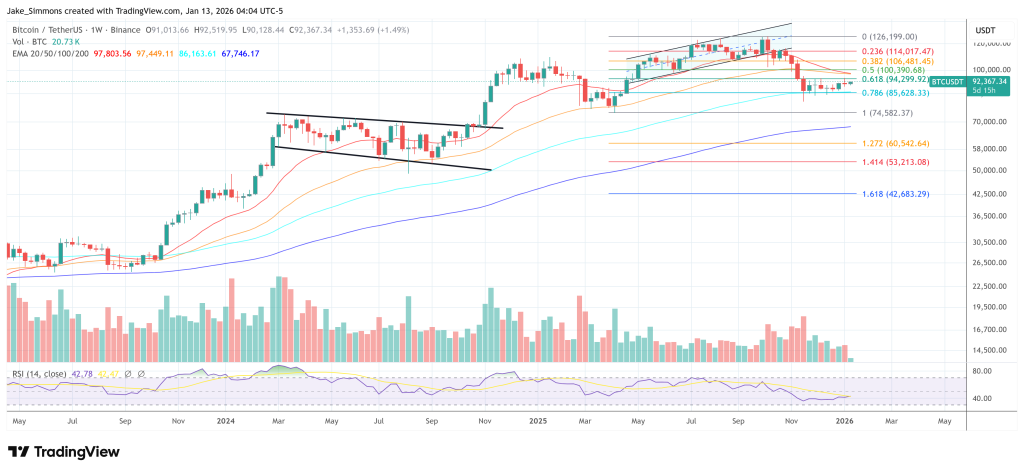
At press time, BTC traded at $92,367.


You May Also Like

BTC Fell 11.6%, Altcoins Sank

A Critical Signal For The Cryptocurrency Market




