

2.5 billion people need assistive tech. Inclusive Tech’s hackathon shows how Africa can build it
For three days every November, tech developers and persons with disabilities in Ghana gather in Accra, the nation’s capital, for a rare competition in Africa’s tech landscape.
Inside halls converted into temporary workspaces, teams huddle around tables, coding, tinkering, and arguing through ideas that could become the next generation of assistive technology built on the continent.
The gathering is the Disability Inclusive Hackathon, known as DI-Hack, organised by Inclusive Tech Group Ghana, a non-profit founded by Millicent Agangiba and working at the intersection of disability, technology, and inclusion.
Now in its fifth year, the hackathon was created with a clear mission: to reduce Africa’s dependence on imported assistive technologies that are often expensive and poorly suited to local realities.
The 2025 edition of the hackathon was held from November 26 to 28 at the University of Ghana, with teams developing assistive technologies across different disability clusters on the continent.
The top prize went to SMARTi, which developed EchoSign, a real-time sign language translation tool designed for people with hearing impairment. Built specifically for Ghanaian Sign Language, EchoSign works offline and offers both sign-to-text and text-to-sign translation through a 3D animated avatar, making it suitable for environments with low or no internet connectivity.
Second place went to FPE or Funability Inclusive Park and Equipment, which developed inclusive playground equipment that allows children with physical disabilities to play alongside their non-disabled peers. The equipment incorporates sensor detectors, pressure-sensitive LEDs, audio feedback, vibration pads, and remote-control operation to support multi-sensory adaptive play.
Team Orcta placed third with TheraBand, a wearable device to support people with mental health conditions. The tool combines a smart headband with AI-powered emotional detection to identify emotional spikes early and provide real-time regulation and learning support.
The top three teams received medals and cash prizes of ₵10,000 [$925), ₵7,000 [$648], and ₵4,000 [$270], respectively.
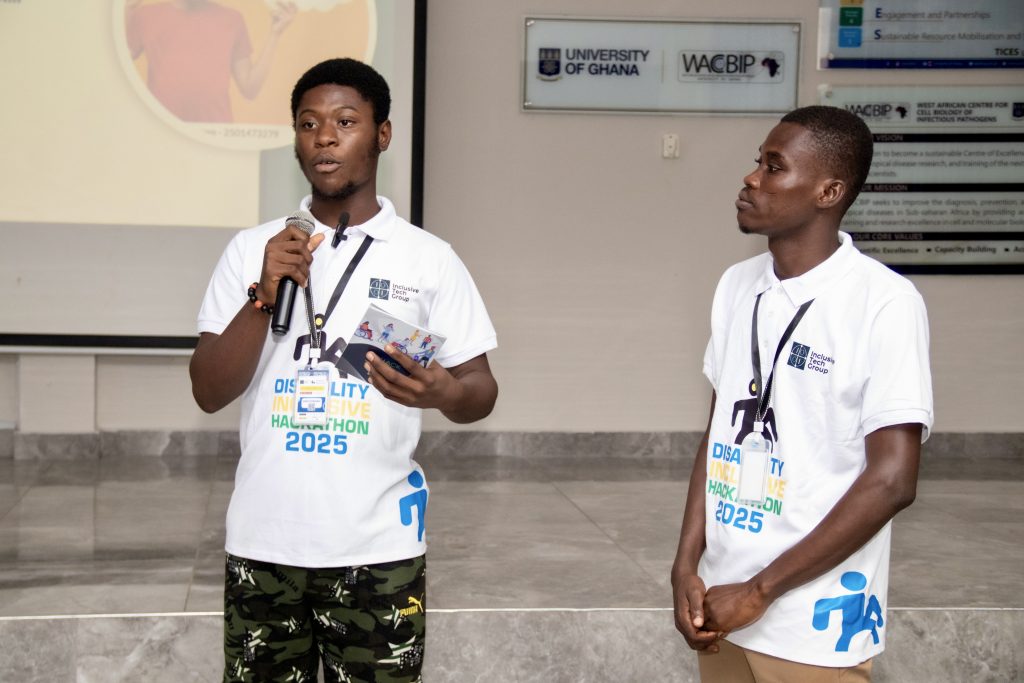 DI-Hack 2025 organised by Inclusive Tech Group Ghana. Image Source: Inclusive Tech Group.
The assistive technology gap in Ghana and beyond
Globally, an estimated 2.5 billion people need at least one assistive product, according to the World Health Organisation (WHO).
That figure is expected to rise to 3.5 billion by 2050, driven by aging populations and the growing prevalence of chronic conditions.
Despite this rising demand, access remains uneven, particularly in Africa. In the WHO African Region, only about 15 to 25%of people who need assistive products can access them.
In Ghana, about 8% of the population, roughly 2.1 million people, live with some form of disability, according to the latest national census. Yet digital systems, from government portals to employment platforms and assistive technology, are still rarely designed with accessibility as a requirement.
“When technology is inaccessible, it doesn’t just inconvenience people,” Agangiba says. “It locks persons with disabilities out of education, employment, healthcare, and governance.”
The exclusion persists even as the market grows. Across Africa, the assistive technology market was valued at about $523 million in 2023 and is projected to exceed $1 billion by 2030. Much of this demand, however, continues to be met by imported products.
The result, Agangiba says, is a widening design-reality gap.
“You can’t keep transferring technology built for London or Berlin and expect it to work in Accra,” she says. “Context matters.”
Building with lived experience
DI-Hack is organised annually ahead of the International Day of Persons with Disabilities, marked globally on December 3. Each edition brings together ten selected teams. Every team includes two or three developers aged between 18 and 35 and at least one person with a disability aged between 18 and 40.
The structure is deliberate. The person with a disability identifies a real challenge in their daily life and works alongside developers throughout the hackathon to design a solution.
For Agangiba, the common thread is co-creation. “When persons with disabilities are involved from the start, the technologies become more usable, more relevant, and more dignified,” she says.
“You cannot simulate disability,” she adds. “If the person with disability is not part of the thinking, the testing, and the decision-making, the solution might fail.”
Teams move from ideation to prototyping and final pitches within 72 hours, guided by mentors and accessibility experts. Participants camp together for the duration, an arrangement organisers say deepens both technical collaboration and social inclusion.
What has been built so far
Across five editions, DI-Hack has produced dozens of prototypes addressing real-world accessibility challenges, grounded in lived experience and African environments.
One of the most notable projects is a Smart Navigation Stick developed by Team Oracle. The team included Sarah Kekeli, a visually impaired philosophy graduate, alongside developers Frederick Minta and Albert Essilfie.
Kekeli did not initially plan to join the team. She attended the hackathon without registering and overheard the developers discussing how white canes work.
“What they were describing wasn’t how the white cane actually works,” she says. “So I explained it to them.”
That intervention changed the project’s direction. Kekeli told the team about a smart cane she had encountered before and explained what worked and what didn’t. The developers asked her to join the team.
Rather than building an entirely new cane, the team developed a detachable smart device that could be fixed to a traditional white cane. The decision emerged directly from testing and feedback led by Kekeli and other visually impaired users.
“The first idea was bulky and made the cane heavy,” Kekeli says. “I also told them the beeping sound would attract too much attention in public.”
She suggested adding a button that would allow users to silence the sound and switch to vibration. The team redesigned the device. It became smaller, lighter, and easier to move around with.
Minta says that feedback reshaped how the team thought about usability.
“She emphasised flexibility and control,” he says. “Making the device detachable meant users didn’t have to abandon tools they were already comfortable with.”
Other DI-Hack teams have developed solutions ranging from call-to-text applications for deaf users to inclusive playground designs that allow children with disabilities to play alongside their peers.
In earlier editions, teams have also tackled physical mobility challenges, including the development of an automated wheelchair prototype that can be operated using a joystick or remote control. More recent editions have introduced AI-powered smart shoes to support navigation for visually impaired users, as well as gesture-based communication tools aimed at improving how deaf people communicate in public in emergencies.
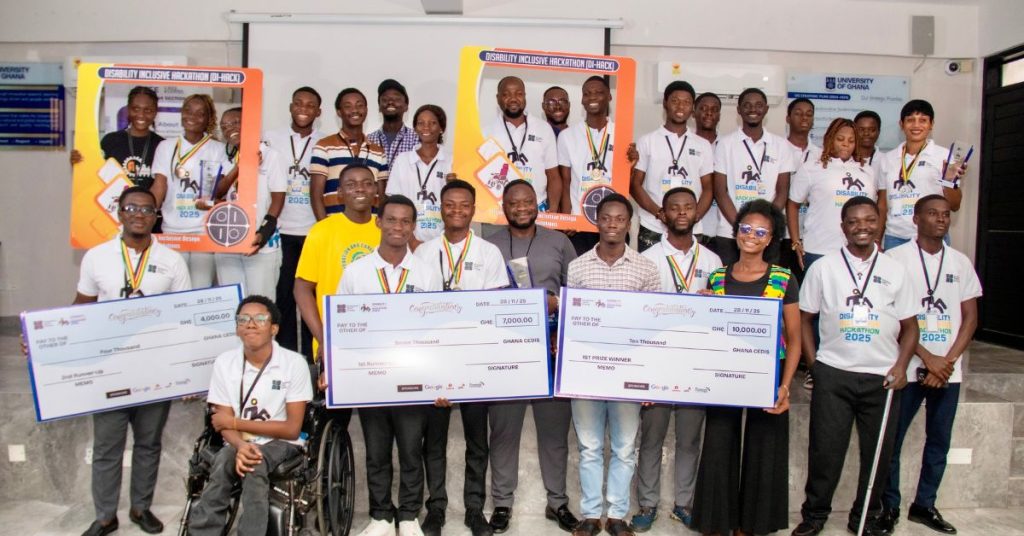 Winning projects at Disability Inclusive Hackathon 2025. Image Source: Inclusive Tech Group Ghana.
Beyond the hackathon
DI-Hack is Inclusive Tech Group’s flagship programme, but it is only one part of the organisation’s work.
Since 2020, the group says it has trained more than 400 persons with disabilities across Ghana in digital literacy, ICT skills, and digital marketing. Its programmes serve people with visual, hearing, and mobility impairments, as well as those who acquire disabilities later in life.
Beyond training, Inclusive Tech Group has also invested in long-term infrastructure for inclusive learning.
One of its most significant projects is an inclusive technology lab established at the University of Mines and Technology through support from AngloGold Ashanti, a mining company in Western Ghana. The lab was created in November 2023, after the university was identified as lacking basic assistive facilities for students with disabilities.
The space is equipped with assistive technologies, including screen readers, braille devices, and hearing aids. For Agangiba, the lab reflects a broader goal: embedding accessibility into institutions rather than treating it as a temporary intervention.
In Ghana’s Eastern Region, the organisation recently trained 100 women with disabilities in digital marketing and digital record-keeping with support from UNESCO Ghana and the Mastercard Foundation.
Follow-up sessions showed that at least 25 participants began actively applying the skills, with some receiving business orders from outside their communities for the first time.
Inclusive Tech Group also supports people who acquire disabilities later in life, helping them rebuild their education and careers rather than being pushed into long-term unemployment.
One such case is Confidence Kakri, who lost her sight while writing her West African Senior School Certificate Examination. Before then, she had been on an academic track toward becoming an accountant. Losing her vision abruptly ended those plans.
“I stayed home for a while, thinking there was no way a blind person could go to school and become something in life,” Kakri says.
Her return to education began after she was introduced to Inclusive Tech Group through a friend. Through the organisation’s STEM Beyond Sight programme, Kakri received training and assistive technology that made it possible for her to resume her secondary education.
The programme focuses on researching and developing ways blind students can study science, technology, engineering, and mathematics in Ghana and across Africa. Many African schools and universities prevent blind students from studying STEM courses due to the absence of assistive technologies and the technical expertise needed to support their learning. At the secondary level, mathematics is often waived for blind students, while subjects like physics and chemistry are treated as off-limits.
Kakri was determined to return to school. With support from Inclusive Tech Group, she restarted her secondary education from SS1 after spending time at home and began working toward completing her studies.
The challenges
Despite its growing impact, Inclusive Tech Group operates in a constrained environment. Funding remains its biggest challenge, both for sustaining programmes and for helping innovations move beyond the prototype stage.
The organisation relies on a mix of corporate partnerships, institutional grants, and individual contributions to keep its work running. Over the years, support has come from organisations such as Google Ghana, UNESCO Ghana, the Mastercard Foundation, IEEE Ghana, as well as private donors and volunteers.
That patchwork support has enabled programmes like DI-Hack and community training to continue. But it has not resolved a deeper problem within Africa’s assistive tech ecosystem: the difficulty of moving promising ideas from prototype to product.
Team Oracle’s Smart Navigation Stick illustrates this tension. The prototype has been tested for nearly six months and has reached a stable stage. But scaling remains out of reach.
An estimated $5,000 would allow the team to produce about 100 units for wider testing across institutions serving persons with visual impairment. Without that funding, the project remains at the prototype stage.
“Funding is the reason many assistive tech ideas don’t go commercial,” Kekeli says. “Investors often don’t see it as a large enough market.”
Policy challenges compound the problem. Ghana’s original Persons with Disability Act was passed in 2006, at a time when digital accessibility was not yet a major consideration. While the updated disability policy framework now includes provisions related to digital accessibility and inclusion, advocates say enforcement remains weak.
“If accessibility is not enforced, developers will not prioritise it,” Agangiba says. “The policy exists, but it has to be implemented.”
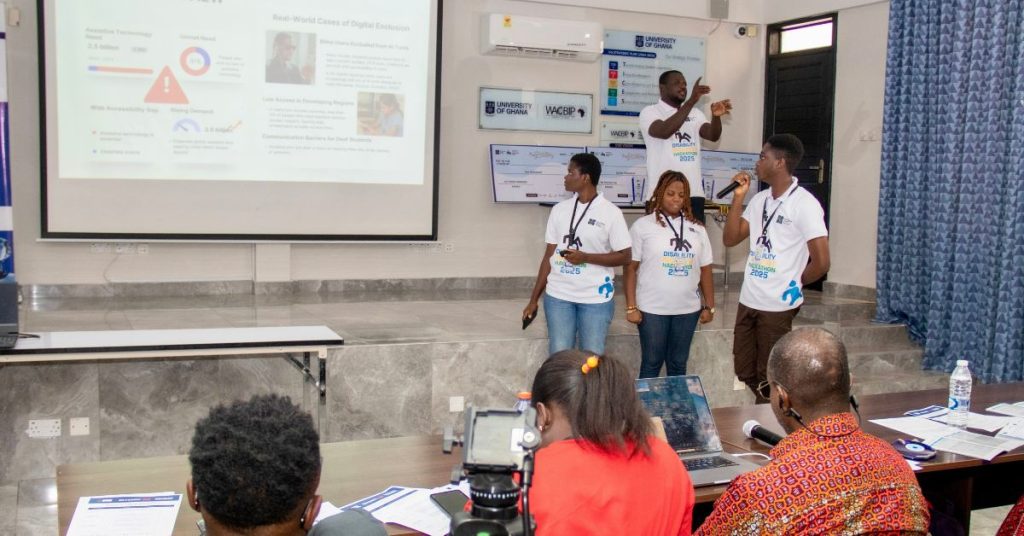 Disability Inclusive Hackathon 2025. Image Source: Inclusive Tech Group Ghana.
From experiments to enforcement
Inclusive Tech Group plans to expand DI-Hack beyond Ghana, with Nigeria among the countries under consideration. But Agangiba is clear: hackathons alone will not close Africa’s accessibility gap.
For her, the work continues long after the teams pack up. Inclusive Tech Group spends much of its time lobbying government agencies, tech firms, and regulators, pushing accessibility from a “nice-to-have” into a requirement. That advocacy often begins with basic education.
“Some developers don’t even believe people with disabilities use digital systems,” Agangiba says. “So before you talk about standards, you first have to change mindsets.
That lack of awareness shows up in public infrastructure. During her doctoral research, Agangiba encountered government developers who questioned how blind people could use online services at all. Those conversations explain why accessibility remains largely absent from public digital platforms, even as policies now recognise its importance.
Lobbying, she says, is slow and often exhausting, but necessary. “You don’t go once and stop. You keep showing up. You keep engaging institutions. That’s the only way systems change.”
DI-Hack fits into that strategy. The prototypes become proof that inclusive design is possible, practical, and locally relevant. They give advocates something tangible to point to when pushing for enforcement, funding, and adoption.
Each November, a hall in Accra becomes the starting line. What happens there doesn’t stay in the room; it can tip the balance between Africa’s assistive technology remaining experimental or finally becoming the standard.


You May Also Like

Solana Whale Dump Drama: $137M Exit Sparks SOL Price Panic vs Bull Debate

SoFi (SOFI) Stock Drops Despite Unveiling Always-On Enterprise Banking Solution




