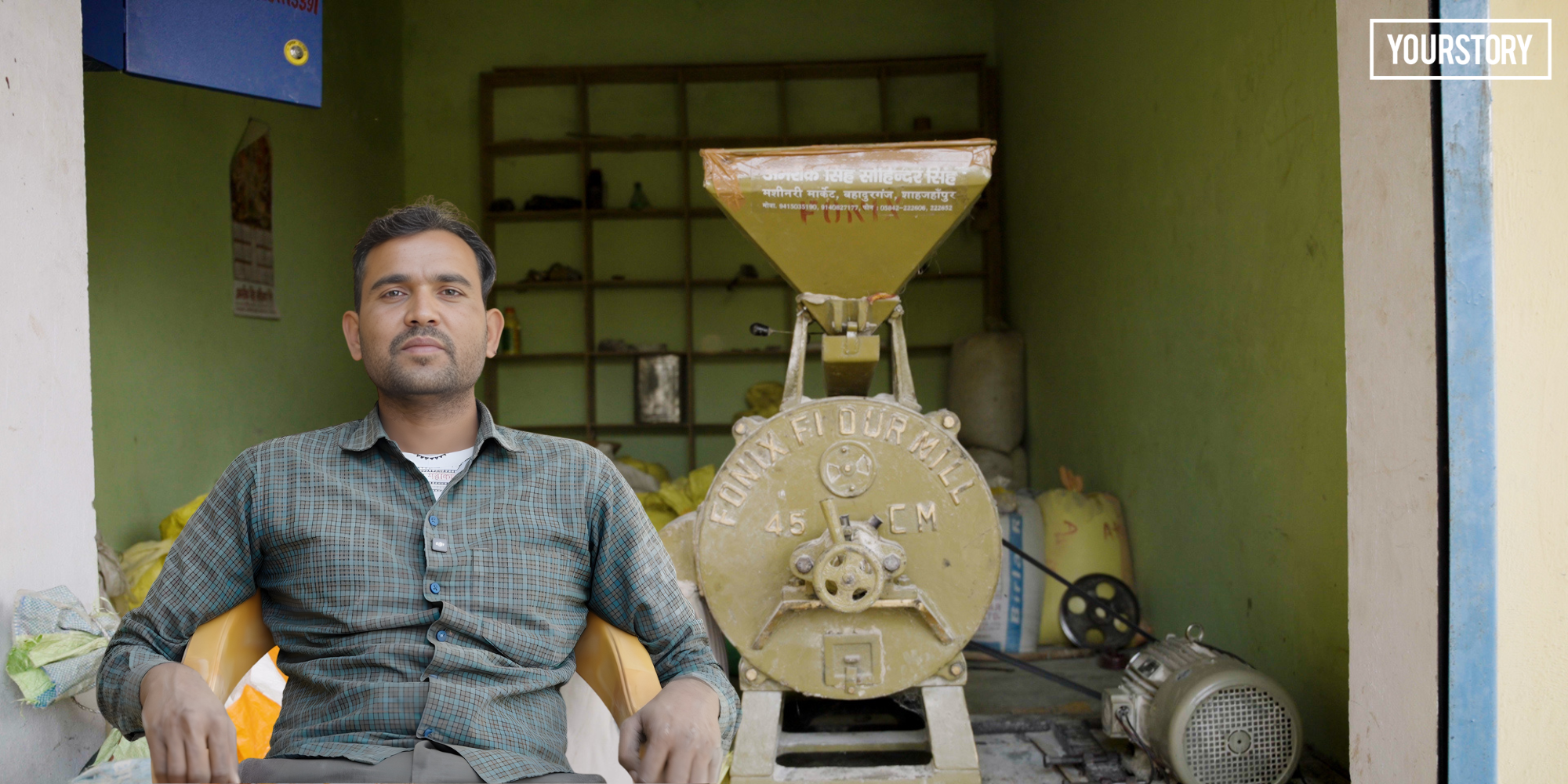
Yogesh Kumar lives in Chauhanapur village of Shahjahanpur district, where a small solar-powered flour mill now draws a steady streamYogesh Kumar lives in Chauhanapur village of Shahjahanpur district, where a small solar-powered flour mill now draws a steady stream

A solar-powered flour mill finds steady ground in Shahjahanpur
3 min read

Yogesh Kumar lives in Chauhanapur village of Shahjahanpur district, where a small solar-powered flour mill now draws a steady stream of customers from nearby hamlets. 

For the past few months, he has been running the unit almost daily, grinding wheat and other grains for households that until recently depended on diesel-run mills that often shut down or worked irregularly.

The business itself is straightforward. The mill grinds grain brought by villagers and charges a per-kilo fee for the service, with work varying by season and daylight hours. Powered by solar panels, the unit runs for six to seven hours in winter and longer in brighter months, allowing it to operate without the fuel costs and breakdowns common to older machines.

Learning by observing

Kumar was the first in his family to start a business of his own. There was no prior enterprise at home to fall back on, and the idea did not arrive through a detailed plan. He recalls visiting a friend’s unit outside the village, watching how a solar-powered mill functioned, and slowly realising that the same model could work closer to home.

After returning, he began looking up details on his phone and then approached the local office to understand the process better. That early curiosity turned into paperwork and repeated visits to offices and the bank. 

The loan he eventually secured under the Mukhyamantri Yuva Udyami Vikas Abhiyan (CM YUVA) Yojana made it possible to purchase the machinery and install the solar system, something he says would not have been feasible with his savings alone.

The entire process took around two months. Once approvals came through, suppliers delivered and installed the equipment, and the mill became operational soon after. 

“At first, I wondered whether it would work or not, but once everything was in place, the work began to feel easier,” he said, explaining that what felt uncertain at the start became manageable once the system was in place.

Finding demand close to home

The decision to set up an atta chakki in the village was driven by a simple assessment of local need. While diesel mills existed in the area, they were unreliable and expensive to run. 

Kumar saw that a solar-powered option could offer regular service without interruptions, giving him a clear advantage.

Today, customers come not just from his own village but from four or five neighbouring ones as well. On an average day, the mill earns a modest but consistent income, enough to cover daily expenses and wages for those who help during busier periods. 

Kumar plans staffing based on seasonal demand, adding hands after festivals and harvests when grain arrivals increase.

Looking ahead, Kumar speaks cautiously about expansion. He hopes to add an oil-pressing unit alongside the mill once the current operation stabilises further. For now, his focus remains on keeping the existing setup running smoothly and serving the villages that rely on it.

The flour mill’s presence has brought a sense of predictability to his workdays, replacing earlier uncertainty with routine. What began as an idea sparked by observation has settled into a small but steady livelihood, rooted firmly in local demand and shaped by careful, incremental steps rather than haste.


Disclaimer: The articles reposted on this site are sourced from public platforms and are provided for informational purposes only. They do not necessarily reflect the views of MEXC. All rights remain with the original authors. If you believe any content infringes on third-party rights, please contact service@support.mexc.com for removal. MEXC makes no guarantees regarding the accuracy, completeness, or timeliness of the content and is not responsible for any actions taken based on the information provided. The content does not constitute financial, legal, or other professional advice, nor should it be considered a recommendation or endorsement by MEXC.
Tags:

You May Also Like

Galaxy Digital’s 2025 Loss: SOL Bear Market

Galaxy Digital’s 2025 Loss: SOL Bear Market

The post Galaxy Digital’s 2025 Loss: SOL Bear Market appeared on BitcoinEthereumNews.com. Galaxy Digital, a digital assets and artificial intelligence infrastructure
Share
BitcoinEthereumNews2026/02/04 09:49
FCA, crackdown on crypto

FCA, crackdown on crypto

The post FCA, crackdown on crypto appeared on BitcoinEthereumNews.com. The regulation of cryptocurrencies in the United Kingdom enters a decisive phase. The Financial Conduct Authority (FCA) has initiated a consultation to set minimum standards on transparency, consumer protection, and digital custody, in order to strengthen market confidence and ensure safer operations for exchanges, wallets, and crypto service providers. The consultation was published on May 2, 2025, and opened a public discussion on operational responsibilities and safeguarding requirements for digital assets (CoinDesk). The goal is to make the rules clearer without hindering the sector’s evolution. According to the data collected by our regulatory monitoring team, in the first weeks following the publication, the feedback received from professionals and operators focused mainly on custody, incident reporting, and insurance requirements. Industry analysts note that many responses require technical clarifications on multi-sig, asset segregation, and recovery protocols, as well as proposals to scale obligations based on the size of the operator. FCA Consultation: What’s on the Table The consultation document clarifies how to apply rules inspired by traditional finance to the crypto perimeter, balancing innovation, market integrity, and user protection. In this context, the goal is to introduce minimum standards for all firms under the supervision of the FCA, an essential step for a more transparent and secure sector, with measurable benefits for users. The proposed pillars Obligations towards consumers: assessment on the extension of the Consumer Duty – a requirement that mandates companies to provide “good outcomes” – to crypto services, with outcomes for users that are traceable and verifiable. Operational resilience: introduction of continuity requirements, incident response plans, and periodic testing to ensure the operational stability of platforms even in adverse scenarios. Financial Crime Prevention: strengthening AML/CFT measures through more stringent transaction monitoring and structured counterpart checks. Custody and safeguarding: definition of operational methods for the segregation of client assets, secure…
Share
BitcoinEthereumNews2025/09/18 05:40
HKMA Launches Fintech Blueprint with AI, DLT, Quantum and Cybersecurity Focus

HKMA Launches Fintech Blueprint with AI, DLT, Quantum and Cybersecurity Focus

The Hong Kong Monetary Authority (HKMA) published a Fintech Promotion Blueprint to support responsible innovation and fintech development in the banking sector.
Share
Fintechnews2026/02/04 10:20