The U.S. Senate Banking Committee has introduced a long-awaited draft bill to reshape how digital assets are classified and regulated in the United States. Titled the Responsible Financial Innovation Act of 2025 , the draft introduced by Senate Banking Chair Tim Scott (R-SC), alongside Senators Cynthia Lummis (R-WY), Bill Hagerty (R-TN), and Bernie Moreno (R-OH), seeks to create a comprehensive legal framework for digital assets, addressing long-standing regulatory uncertainty in the crypto space. New Senate Crypto Bill Proposes Clear Framework for Token Classification and Oversight The legislation, released just days after the GENIUS Act was signed into law, builds on momentum from the House-passed CLARITY Act and incorporates key elements from the bipartisan Lummis-Gillibrand initiative. Source: Responsible Financial Innovation Act of 2025 One of the bill’s most consequential provisions is the explicit recognition that digital assets, referred to as “ancillary assets,” are not inherently securities. It clarifies that secondary market transactions involving these tokens should not automatically fall under securities laws. However, exceptions apply: if a token’s value is closely tied to promises of profit through managerial efforts, securities laws could still be triggered. In addition, the draft legislation attempts to resolve the persistent jurisdictional tension between the SEC and CFTC. Under the proposed framework, most digital assets would be regulated as commodities, falling primarily under the Commodity Futures Trading Commission (CFTC), while the SEC would retain oversight of investment contracts and investor protection matters. The bill instructs the SEC to modernize disclosure rules and adapt its record-keeping systems to account for blockchain-based financial activity, ensuring compatibility with Web3 ecosystems. Beyond token classification, the legislation spans more than 35 areas of focus. It includes requests for public feedback on topics such as stablecoin regulation, custody frameworks, DeFi exemptions, and illicit finance concerns, including tactics like “ pig butchering” scams . The draft also proposes a “safe harbor” for forward-looking statements, shielding developers from premature enforcement actions, provided their projects meet certain transparency and decentralization standards. Additionally, developers who do not custody user funds could be exempt from some registration requirements, an important provision for open-source innovators. Senator Tim Scott emphasized the bill’s collaborative approach, saying, “This bill gives Congress the opportunity to hear from industry and regulators alike before finalizing a legal framework that protects consumers and encourages responsible innovation.” Stakeholder input is now being solicited, particularly on areas where the SEC and CFTC’s jurisdiction may overlap, with Senate Banking Committee hearings expected in the coming weeks as lawmakers move toward introducing a finalized version. Senate Push for Market Structure Reform Gains Momentum After GENIUS Act Signing Momentum for U.S. crypto legislation continued to build this week with the new draft legislation after President Donald Trump signed the GENIUS Act into law , marking a landmark moment in federal regulation. 🏛️U.S. President Donald Trump signed the GENIUS Act into law on Friday afternoon in a landmark bill signing at the White House. https://t.co/WWqbXyzetr — Cryptonews.com (@cryptonews) July 18, 2025 The GENIUS Act, passed with broad bipartisan support, provides the first federal framework for stablecoin issuers and will take effect 18 months after signing or 120 days after federal regulators, including the Treasury and the Federal Reserve, issue final rules. Alongside the GENIUS Act, two other major proposals, the CLARITY Act and the Anti-CBDC Surveillance State Act, are advancing in Congress. The CLARITY Act was recently approved by the House Agriculture Committee. Meanwhile, the Anti-CBDC Act seeks to block any retail digital dollar issued by the Federal Reserve. 🇺🇸 GENIUS Act, Anti-CBDC Act, and CLARITY Act pass crucial procedural vote 215-211 in Congress after Trump's decisive Oval Office intervention rescues stalled crypto agenda. #GeniusAct #Trump https://t.co/Lm2tCBbimp — Cryptonews.com (@cryptonews) July 16, 2025 Industry executives are watching closely. Ian De Bode of Ondo Finance described the new legislation as “the beginning of a new regulatory era,” pointing to bipartisan cooperation and the role of key figures like Patrick McHenry. Senator Tim Scott said lawmakers are planning to finalize crypto market structure legislation by September 30 . With the GENIUS Act now law and several other bills in motion, the U.S. digital asset space is edging closer to a defined regulatory framework, one that could reshape the crypto sector heading into 2026.The U.S. Senate Banking Committee has introduced a long-awaited draft bill to reshape how digital assets are classified and regulated in the United States. Titled the Responsible Financial Innovation Act of 2025 , the draft introduced by Senate Banking Chair Tim Scott (R-SC), alongside Senators Cynthia Lummis (R-WY), Bill Hagerty (R-TN), and Bernie Moreno (R-OH), seeks to create a comprehensive legal framework for digital assets, addressing long-standing regulatory uncertainty in the crypto space. New Senate Crypto Bill Proposes Clear Framework for Token Classification and Oversight The legislation, released just days after the GENIUS Act was signed into law, builds on momentum from the House-passed CLARITY Act and incorporates key elements from the bipartisan Lummis-Gillibrand initiative. Source: Responsible Financial Innovation Act of 2025 One of the bill’s most consequential provisions is the explicit recognition that digital assets, referred to as “ancillary assets,” are not inherently securities. It clarifies that secondary market transactions involving these tokens should not automatically fall under securities laws. However, exceptions apply: if a token’s value is closely tied to promises of profit through managerial efforts, securities laws could still be triggered. In addition, the draft legislation attempts to resolve the persistent jurisdictional tension between the SEC and CFTC. Under the proposed framework, most digital assets would be regulated as commodities, falling primarily under the Commodity Futures Trading Commission (CFTC), while the SEC would retain oversight of investment contracts and investor protection matters. The bill instructs the SEC to modernize disclosure rules and adapt its record-keeping systems to account for blockchain-based financial activity, ensuring compatibility with Web3 ecosystems. Beyond token classification, the legislation spans more than 35 areas of focus. It includes requests for public feedback on topics such as stablecoin regulation, custody frameworks, DeFi exemptions, and illicit finance concerns, including tactics like “ pig butchering” scams . The draft also proposes a “safe harbor” for forward-looking statements, shielding developers from premature enforcement actions, provided their projects meet certain transparency and decentralization standards. Additionally, developers who do not custody user funds could be exempt from some registration requirements, an important provision for open-source innovators. Senator Tim Scott emphasized the bill’s collaborative approach, saying, “This bill gives Congress the opportunity to hear from industry and regulators alike before finalizing a legal framework that protects consumers and encourages responsible innovation.” Stakeholder input is now being solicited, particularly on areas where the SEC and CFTC’s jurisdiction may overlap, with Senate Banking Committee hearings expected in the coming weeks as lawmakers move toward introducing a finalized version. Senate Push for Market Structure Reform Gains Momentum After GENIUS Act Signing Momentum for U.S. crypto legislation continued to build this week with the new draft legislation after President Donald Trump signed the GENIUS Act into law , marking a landmark moment in federal regulation. 🏛️U.S. President Donald Trump signed the GENIUS Act into law on Friday afternoon in a landmark bill signing at the White House. https://t.co/WWqbXyzetr — Cryptonews.com (@cryptonews) July 18, 2025 The GENIUS Act, passed with broad bipartisan support, provides the first federal framework for stablecoin issuers and will take effect 18 months after signing or 120 days after federal regulators, including the Treasury and the Federal Reserve, issue final rules. Alongside the GENIUS Act, two other major proposals, the CLARITY Act and the Anti-CBDC Surveillance State Act, are advancing in Congress. The CLARITY Act was recently approved by the House Agriculture Committee. Meanwhile, the Anti-CBDC Act seeks to block any retail digital dollar issued by the Federal Reserve. 🇺🇸 GENIUS Act, Anti-CBDC Act, and CLARITY Act pass crucial procedural vote 215-211 in Congress after Trump's decisive Oval Office intervention rescues stalled crypto agenda. #GeniusAct #Trump https://t.co/Lm2tCBbimp — Cryptonews.com (@cryptonews) July 16, 2025 Industry executives are watching closely. Ian De Bode of Ondo Finance described the new legislation as “the beginning of a new regulatory era,” pointing to bipartisan cooperation and the role of key figures like Patrick McHenry. Senator Tim Scott said lawmakers are planning to finalize crypto market structure legislation by September 30 . With the GENIUS Act now law and several other bills in motion, the U.S. digital asset space is edging closer to a defined regulatory framework, one that could reshape the crypto sector heading into 2026.

Senate Shakes Up Crypto With Major New Market Structure Draft

The U.S. Senate Banking Committee has introduced a long-awaited draft bill to reshape how digital assets are classified and regulated in the United States.

Titled the Responsible Financial Innovation Act of 2025, the draft introduced by Senate Banking Chair Tim Scott (R-SC), alongside Senators Cynthia Lummis (R-WY), Bill Hagerty (R-TN), and Bernie Moreno (R-OH), seeks to create a comprehensive legal framework for digital assets, addressing long-standing regulatory uncertainty in the crypto space.

New Senate Crypto Bill Proposes Clear Framework for Token Classification and Oversight

The legislation, released just days after the GENIUS Act was signed into law, builds on momentum from the House-passed CLARITY Act and incorporates key elements from the bipartisan Lummis-Gillibrand initiative.
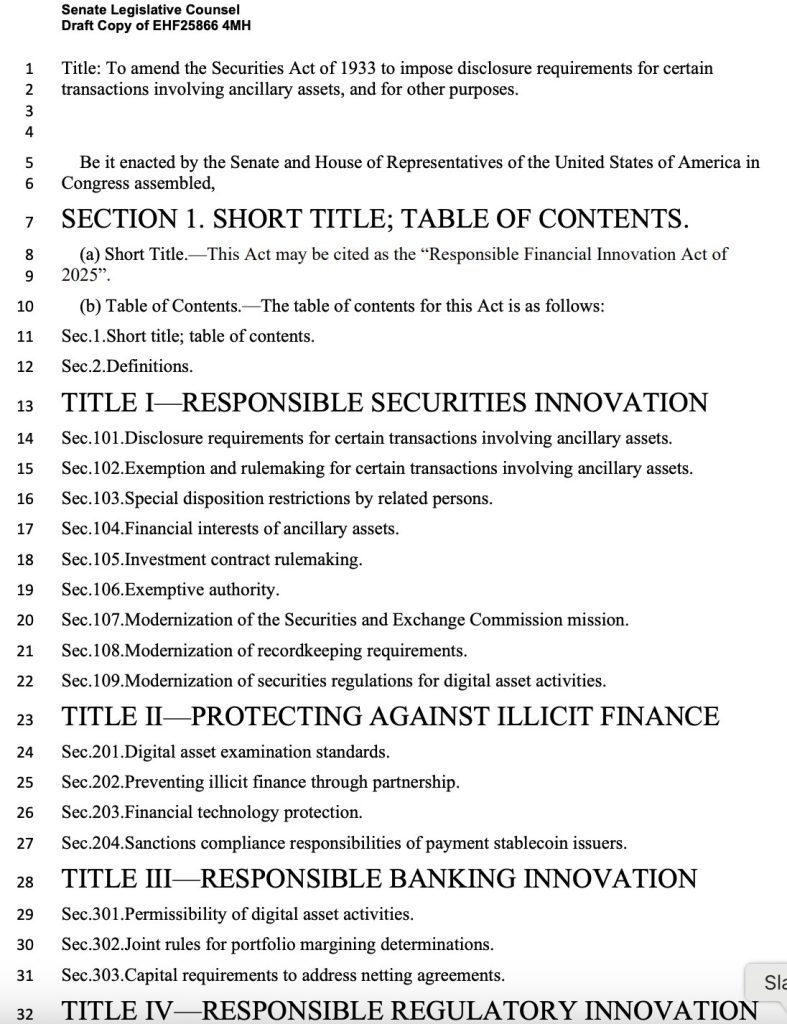
Source: Responsible Financial Innovation Act of 2025

One of the bill’s most consequential provisions is the explicit recognition that digital assets, referred to as “ancillary assets,” are not inherently securities. It clarifies that secondary market transactions involving these tokens should not automatically fall under securities laws.

However, exceptions apply: if a token’s value is closely tied to promises of profit through managerial efforts, securities laws could still be triggered.

In addition, the draft legislation attempts to resolve the persistent jurisdictional tension between the SEC and CFTC. Under the proposed framework, most digital assets would be regulated as commodities, falling primarily under the Commodity Futures Trading Commission (CFTC), while the SEC would retain oversight of investment contracts and investor protection matters.

The bill instructs the SEC to modernize disclosure rules and adapt its record-keeping systems to account for blockchain-based financial activity, ensuring compatibility with Web3 ecosystems.

Beyond token classification, the legislation spans more than 35 areas of focus. It includes requests for public feedback on topics such as stablecoin regulation, custody frameworks, DeFi exemptions, and illicit finance concerns, including tactics like “pig butchering” scams.

The draft also proposes a “safe harbor” for forward-looking statements, shielding developers from premature enforcement actions, provided their projects meet certain transparency and decentralization standards.

Additionally, developers who do not custody user funds could be exempt from some registration requirements, an important provision for open-source innovators.

Senator Tim Scott emphasized the bill’s collaborative approach, saying, “This bill gives Congress the opportunity to hear from industry and regulators alike before finalizing a legal framework that protects consumers and encourages responsible innovation.”

Stakeholder input is now being solicited, particularly on areas where the SEC and CFTC’s jurisdiction may overlap, with Senate Banking Committee hearings expected in the coming weeks as lawmakers move toward introducing a finalized version.

Senate Push for Market Structure Reform Gains Momentum After GENIUS Act Signing

Momentum for U.S. crypto legislation continued to build this week with the new draft legislation after President Donald Trump signed the GENIUS Act into law, marking a landmark moment in federal regulation.

The GENIUS Act, passed with broad bipartisan support, provides the first federal framework for stablecoin issuers and will take effect 18 months after signing or 120 days after federal regulators, including the Treasury and the Federal Reserve, issue final rules.

Alongside the GENIUS Act, two other major proposals, the CLARITY Act and the Anti-CBDC Surveillance State Act, are advancing in Congress. The CLARITY Act was recently approved by the House Agriculture Committee. Meanwhile, the Anti-CBDC Act seeks to block any retail digital dollar issued by the Federal Reserve.

Industry executives are watching closely. Ian De Bode of Ondo Finance described the new legislation as “the beginning of a new regulatory era,” pointing to bipartisan cooperation and the role of key figures like Patrick McHenry.

Senator Tim Scott said lawmakers are planning to finalize crypto market structure legislation by September 30.

With the GENIUS Act now law and several other bills in motion, the U.S. digital asset space is edging closer to a defined regulatory framework, one that could reshape the crypto sector heading into 2026.


Market Opportunity
Threshold Logo
Threshold Price(T)
$0.009247
$0.009247$0.009247
+3.34%
USD
Threshold (T) Live Price Chart
Disclaimer: The articles reposted on this site are sourced from public platforms and are provided for informational purposes only. They do not necessarily reflect the views of MEXC. All rights remain with the original authors. If you believe any content infringes on third-party rights, please contact service@support.mexc.com for removal. MEXC makes no guarantees regarding the accuracy, completeness, or timeliness of the content and is not responsible for any actions taken based on the information provided. The content does not constitute financial, legal, or other professional advice, nor should it be considered a recommendation or endorsement by MEXC.

You May Also Like

Japan-Based Bitcoin Treasury Company Metaplanet Completes $1.4 Billion IPO! Will It Buy Bitcoin? Here Are the Details

Japan-Based Bitcoin Treasury Company Metaplanet Completes $1.4 Billion IPO! Will It Buy Bitcoin? Here Are the Details

The post Japan-Based Bitcoin Treasury Company Metaplanet Completes $1.4 Billion IPO! Will It Buy Bitcoin? Here Are the Details appeared on BitcoinEthereumNews.com. Japan-based Bitcoin treasury company Metaplanet announced today that it has successfully completed its public offering process. Metaplanet Grows Bitcoin Treasury with $1.4 Billion IPO The company’s CEO, Simon Gerovich, stated in a post on the X platform that a large number of institutional investors participated in the process. Among the investors, mutual funds, sovereign wealth funds, and hedge funds were notable. According to Gerovich, approximately 100 institutional investors participated in roadshows held prior to the IPO. Ultimately, over 70 investors participated in Metaplanet’s capital raising. Previously disclosed information indicated that the company had raised approximately $1.4 billion through the IPO. This funding will accelerate Metaplanet’s growth plans and, in particular, allow the company to increase its balance sheet Bitcoin holdings. Gerovich emphasized that this step will propel Metaplanet to its next stage of development and strengthen the company’s global Bitcoin strategy. Metaplanet has recently become one of the leading companies in Japan in promoting digital asset adoption. The company has previously stated that it views Bitcoin as a long-term store of value. This large-scale IPO is considered a significant step in not only strengthening Metaplanet’s capital but also consolidating Japan’s role in the global crypto finance market. *This is not investment advice. Follow our Telegram and Twitter account now for exclusive news, analytics and on-chain data! Source: https://en.bitcoinsistemi.com/japan-based-bitcoin-treasury-company-metaplanet-completes-1-4-billion-ipo-will-it-buy-bitcoin-here-are-the-details/
Share
BitcoinEthereumNews2025/09/18 08:42
Will XRP Price Increase In September 2025?

Will XRP Price Increase In September 2025?

Ripple XRP is a cryptocurrency that primarily focuses on building a decentralised payments network to facilitate low-cost and cross-border transactions. It’s a native digital currency of the Ripple network, which works as a blockchain called the XRP Ledger (XRPL). It utilised a shared, distributed ledger to track account balances and transactions. What Do XRP Charts Reveal? […]
Share
Tronweekly2025/09/18 00:00
Korean lawmaker calls for institutionalization of stablecoins

Korean lawmaker calls for institutionalization of stablecoins

The post Korean lawmaker calls for institutionalization of stablecoins appeared on BitcoinEthereumNews.com. A South Korean lawmaker has urged the country to swiftly
Share
BitcoinEthereumNews2025/12/20 16:24