Bitcoin (BTC) Price: Is $50,000 the Next Stop? What Analysts Are Saying Right Now
TLDR
- Bitcoin dropped below $63,000 on February 24, 2026, down nearly 7% for the week
- Large whale holders are moving BTC to exchanges, signaling potential further selling
- Trump’s tariff hike from 10% to 15% has dampened risk appetite across markets
- The Bitcoin fear and greed index hit a new low of 8, indicating extreme fear
- Key support sits at $60,000; a break could push prices to the mid-to-low $50,000 range
Bitcoin dropped below $63,000 on February 24, 2026, extending a week of losses that has already seen the price fall nearly 7%.
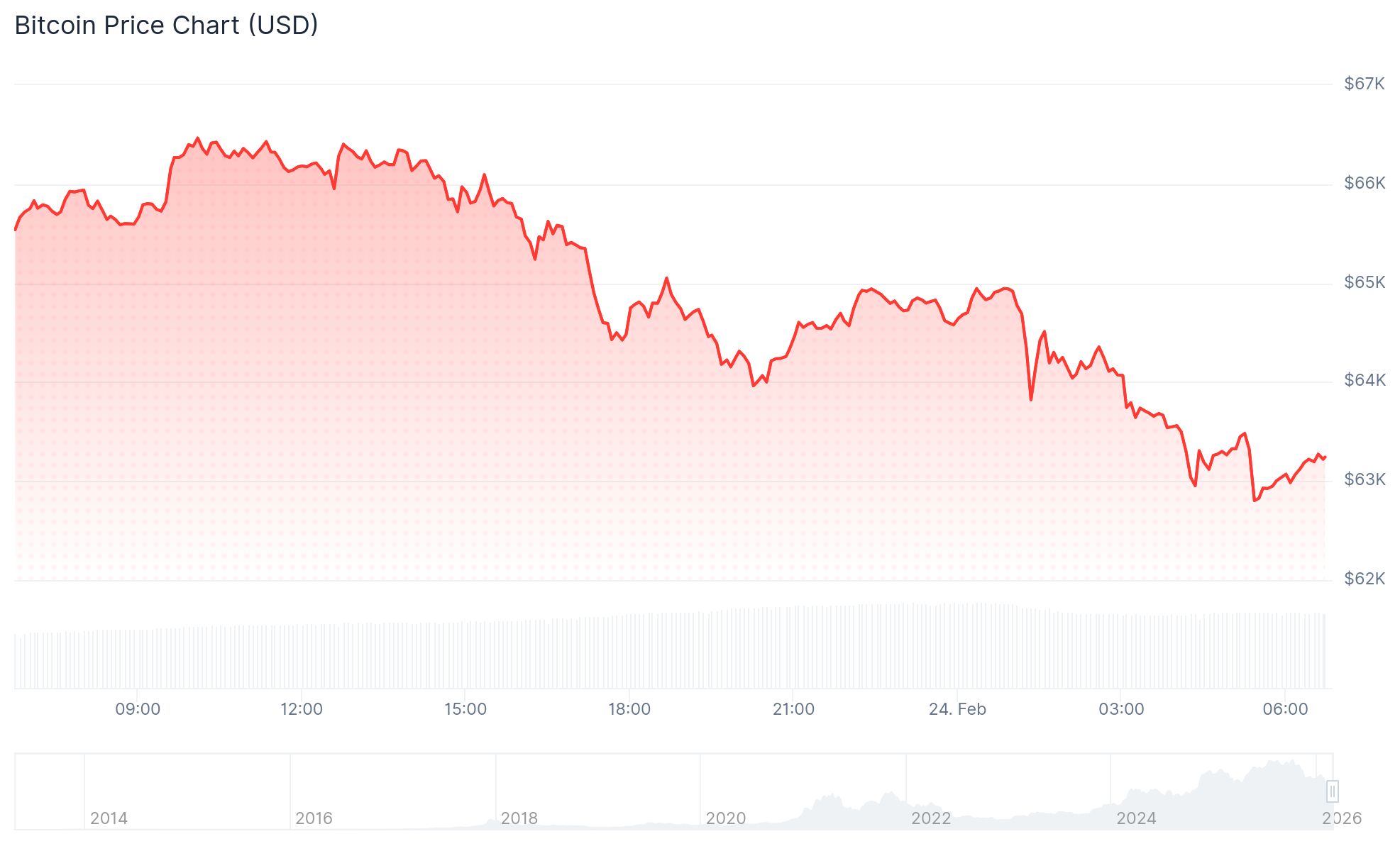 Bitcoin (BTC) Price
The drop brought BTC back to levels last seen in early February, when prices briefly fell under $60,000.
At press time, Bitcoin was trading around $63,285, down roughly 4.5% in 24 hours.
The selling pressure has come from multiple directions at once, making it difficult for buyers to push prices back up.
On-chain data from CryptoQuant showed large Bitcoin holders, known as whales, moving their coins from private wallets onto exchanges.
Transfers like this usually signal an intent to sell, and they increase the available supply of Bitcoin on the market.
At the same time, buying activity across major exchanges has been light, with overall crypto sentiment remaining under pressure.
Tariff Uncertainty Weighs on Markets
President Trump’s tariff policy has been a major driver of the current sell-off.
The U.S. Supreme Court struck down a large portion of his earlier tariff strategy, ruling he had overstepped his authority.
Trump then announced a 10% global tariff on imports, later raising it to 15%, which is the maximum allowed under the relevant law.
The move rattled financial markets broadly, with equities also falling as investors moved toward safer assets like gold, which reclaimed the $5,200 level.
Matt Howells-Barby of Kraken said the situation mirrors tariff-driven market stress seen in April 2025.
He noted that the $60,000 level is being closely watched. “If that level fails to hold, we could potentially see a move into the mid-to-low $50K range,” he said.
The Bitcoin fear and greed index has fallen to 8, its lowest reading in recent memory, reflecting widespread uncertainty in the market.
Over $461 million in crypto positions were liquidated in a 24-hour period, with 93% of those being long positions.
What Historical Patterns Show
Bitcoin’s longer-term technical picture adds more caution to the outlook.
Historically, BTC has not formed a lasting bottom until the 50-week moving average crosses below the 100-week moving average.
 Source: TradingView
That signal has marked the end of every major bear market, including 2018 and 2022.
Currently, the 50-week average remains well above the 100-week, meaning that crossover has not happened yet.
Analyst Rashad Hajiyev has forecast a consolidation around $50,000, with a potential bottom near $30,000 in Q4 2026.
CoinCodex data projects Bitcoin could reach $79,579 by end of 2026 and $166,372 by 2030.
Treasury Secretary Scott Bessent has said BTC could reach new highs once a regulatory clarity bill passes.
The post Bitcoin (BTC) Price: Is $50,000 the Next Stop? What Analysts Are Saying Right Now appeared first on CoinCentral.


You May Also Like

Is Trump Manipulating the Crypto Market?

Robotics Automation Prototyping: Engineering Kinetic Agility into End-Effectors