

Building communities, securing futures
Since its establishment in 2019, the Department of Human Settlements and Urban Development (DHSUD) has emerged as the Philippine government’s central agency for housing. Created through Republic Act No. 11201, the department consolidated key shelter agencies under a unified institutional framework, marking a strategic shift toward coherent, integrated, and people-centered housing governance.
Marking its 7th anniversary this year, the DHSUD has implemented sweeping reforms, launched ambitious housing programs, and introduced regulatory innovations that reshaped the country’s housing and urban development landscape.
As the Philippines continues to grapple with a housing backlog estimated at over 6.5 million units, the DHSUD’s evolving policy architecture reflects both urgency and transformation. From institutional consolidation and regulatory streamlining to the rollout of the flagship Pambansang Pabahay Para sa Pilipino (4PH) Program and its later expansion, the department’s milestones highlight a governance trajectory anchored on inclusivity, efficiency, and sustainability.
Institutional foundations and strategic mandate
The creation of the DHSUD in February 2019 signaled a long-overdue realignment of housing and urban development governance. By merging the Housing and Urban Development Coordinating Council (HUDCC) and the Housing and Land Use Regulatory Board (HLURB), the new department sought to harmonize policy direction, program implementation, and regulatory oversight.
This consolidation addressed long-standing issues of fragmented authority, overlapping mandates, and procedural inefficiencies that had constrained housing delivery and urban planning.
In its early years, the department focused on institutional capacity-building, regulatory restructuring, and stakeholder engagement. These foundational efforts laid groundwork for more expansive reforms under the Marcos administration, which elevated housing as a central pillar of national development through the launch of 4PH in 2022.
The program’s ambition to construct 6 million housing units by 2028 represented one of the most extensive public housing commitments in the Philippine history.
 Human Settlements and Urban Development Secretary Jose Ramon P. Aliling (right) assumed office back in May 2025, succeeding Jose Rizalino Acuzar (left).
4PH Program
At its core, the DHSUD’s reform agenda lies in the 4PH program. Initially designed as a vertical housing initiative to maximize government land use in urban centers, the program aimed to deliver affordable condominium-style housing for low-income families, particularly informal settler households and minimum wage earners.
Early implementation faced structural and procedural challenges, including financing constraints, documentary backlogs, and difficulties within public-private partnerships.
Nevertheless, in 2024, the department had begun turning over completed housing units, signaling the transition from policy vision to tangible delivery.
By early 2026, the DHSUD achieved a major milestone with the turnover of its first horizontal housing units under the expanded framework of 4PH, benefiting over 400 families in Occidental Mindoro.
The recalibration of the 4PH Program into the Expanded Pambansang Pabahay para sa Pilipino Program (Expanded 4PH) in 2025 represented a critical policy inflection point. Recognizing the diverse housing needs across urban and rural contexts, the DHSUD broadened the program to include horizontal housing, rental accommodation, modular shelters, incremental housing, and community mortgage initiatives.
This policy expansion significantly widened program accessibility, encouraged private-sector participation, and enabled localized housing solutions tailored to community needs.
 President Ferdinand R. Marcos, Jr., DHSUD Secretary Jose Ramon Aliling and NHA General Manager Joeben Tai led the inauguration and awarding of new house and lot units to beneficiaries in St. Barts Southville Heights in San Pablo City, Laguna last September.
Regulatory reforms and digital transformation
Parallel to program expansion, the DHSUD pursued an aggressive regulatory reform agenda. Upon assuming office in 2025, Secretary Jose Ramon P. Aliling introduced an 8-point strategic framework focused on transparency, efficiency, and institutional accountability.
Among the department’s most notable achievements was the resolution of over 3,800 backlog cases involving licenses to sell, development permits, and compliance certifications — an unprecedented feat that restored investor confidence and improved service delivery.
Central to this reform drive was the adoption of zero-tolerance policy against corruption, reinforced by internal audits, procedural standardization, and personnel accountability mechanisms.
These governance reforms were complemented by a comprehensive digitalization road map aimed at fully automating the DHSUD’s regulatory and licensing systems by 2028. The initiative seeks to minimize bureaucratic bottlenecks, enhance transaction transparency, and reduce opportunities for discretionary abuse.
To further streamline housing access, the DHSUD simplified application processes through Department Order No. 2025-021, allowing families to apply directly via developers, Pag-IBIG Fund, or the department itself. The reform substantially reduced processing times and democratized access to public housing opportunities, especially for low-income households.
Fiscal and policy innovations
The DHSUD’s reform agenda also extended into fiscal policy and interagency coordination. In partnership with the Department of Finance (DoF) and the Bureau of Internal Revenue (BIR), the department facilitated the issuance of Revenue Memorandum Order No. 048-2025, which standardized tax exemption procedures for socialized housing projects.
The reform significantly lowered development costs, incentivized private sector participation, and accelerated housing project approvals.
Another major breakthrough came with the issuance of Joint Memorandum Circular 2025-001, jointly crafted with the Department of Economy, Planning, and Development (DEPDev). The circular adjusted price ceilings for socialized housing, aligning cost parameters with market realities and construction inflation.
This policy shift enhanced financial viability for developers while safeguarding affordability for beneficiaries.
Community mortgage revival and tenure security
Among the most socially transformative initiatives of the DHSUD is the revitalization of the Community Mortgage Program (CMP), now enhanced under Expanded 4PH framework.
The revival of 34 CMP sites nationwide enabled approximately 5,000 families to acquire land collectively, empowering informal sector communities to secure tenure and invest incrementally in home improvements. This participatory housing model has been widely lauded for fostering community cohesion, financial inclusion, and grassroots empowerment.
Complementing CMP reforms was the distribution of Certificates of Award to families residing on land covered by longstanding presidential proclamations.
By formalizing tenure security, the DHSUD addressed decades-old tenure disputes and provided legal assurance to thousands of households, enhancing residential stability and socioeconomic mobility.
Rental housing and urban inclusivity
Recognizing the rising demand for flexible housing solutions in metropolitan areas, the DHSUD pioneered government-led rental housing initiatives.
A landmark partnership with the University of the Philippines launched the pilot rental housing project at UP Diliman, providing affordable accommodation for informal settler families and university employees.
The model is currently being replicated across regional campuses and local government units, marking a paradigm shift toward diversified housing tenure systems.
These rental housing projects underscore the DHSUD’s broader urban development strategy, emphasizing in-city relocation, transit-oriented development, and socio-spatial integration.
By prioritizing location efficiency and livelihood accessibility, the department aims to mitigate urban sprawl, reduce commuting burdens, and enhance quality of life for marginalized urban residents.
Disaster-responsive housing and Bayanihan Villages
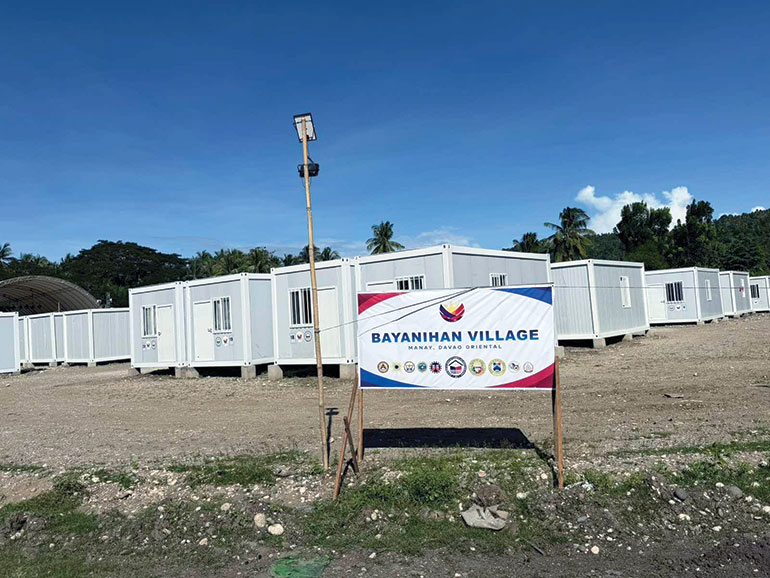 A Bayanihan Village was turned over to the Manay local government unit in Davao Oriental last December. It serves as a temporary refuge for calamity-stricken families.
In response to increasing climate vulnerability and disaster displacement, the DHSUD institutionalized modular shelter systems and launched the Bayanihan Villages initiative.
By 2025, the department had established 20 temporary housing sites across disaster-affected regions, including Cebu and Davao Oriental, offering rapid, dignified shelter solutions for displaced families.
The modular units not only address immediate housing needs but also serve as transitional settlements, supporting community recovery and rehabilitation.
Stakeholder engagement and public trust
The department’s first government-initiated National Housing Expo in 2025 symbolized renewed dynamism within the housing sector. Organized in collaboration with the Pag-IBIG Fund, the expo convened developers, financial institutions, local governments, and civil society groups, fostering multi-sectoral collaboration and public accountability.
The event also facilitated beneficiary enrollment, project matchmaking, and policy dialogue, reinforcing the DHSUD’s commitment to participatory governance.
Beyond institutional partnerships, the DHSUD has strengthened regulatory enforcement mechanisms to protect homebuyers from fraudulent practices, delayed turnovers, and contractual violation.
Enhanced complaint resolution systems and legal mediation frameworks have restored public trust in housing governance, particularly among first-time buyers and vulnerable consumers.
Seven years since its inception, the DHSUD stands at the forefront of transformative housing governance in the Philippines. Through ambitious programmatic expansion, decisive regulatory reforms, and inclusive policy innovations, the department is redefining public housing delivery and urban development planning.
While formidable challenges persist, ranging from financing sustainability and land acquisition constraints to climate resilience and urban density management, the department’s institutional trajectory underscores a resolute commitment to dignified living for all Filipinos.
As the DHSUD enters its next phase, its legacy will be measured not merely in housing units delivered, but in communities strengthened, livelihoods secured, and futures built. — Krystal Anjela H. Gamboa


You May Also Like

Robotics Automation Prototyping: Engineering Kinetic Agility into End-Effectors

Fed Governor Calls For Strong Stablecoin Oversight As CLARITY Act’s Final Text Gets Delayed

XAU/USD Daily Analysis Shows Gold Buyers Defending $4,540 Support



