Hexnode IdP: Unifying Identity, Device Trust, and Zero Trust Security for Modern CX
The launch of Hexnode IdP deserves attention.
Ever watched a new employee wait three days for system access?
HR completes onboarding on day one.
IT provisions the laptop on day two.
Security sends MFA instructions on day three.
Meanwhile, the employee cannot access CRM, payroll, or collaboration tools.
Frustration builds before productivity begins.
This is not only a security issue.
It is a customer experience problem in disguise.
In 2026, identity is the front door to both employee and customer journeys.
When access fails, journeys fragment.
On March 3, 2026, in Chennai, Hexnode, the enterprise software division of Mitsogo, announced the launch of Hexnode IdP.
The move builds on the recent launch of Hexnode XDR and expands its Unified Endpoint Management ecosystem into identity.
For CX and EX leaders battling siloed teams, AI gaps, and journey fragmentation, this launch signals a deeper shift.
Identity is no longer a backend IT layer.
It is becoming a strategic experience control plane.
What Is a Native Identity Layer and Why Do CX Teams Need It?
A native identity layer unifies authentication, device compliance, and policy enforcement into one integrated framework. It eliminates fragmentation between identity systems and endpoint management.
Most enterprises run identity and device management as separate domains.
- HR manages lifecycle data.
- IT manages devices.
- Security manages access.
- CX teams inherit the friction.
This fragmentation creates:
- Delayed onboarding
- Broken SSO flows
- Inconsistent MFA experiences
- Access from risky devices
- Shadow IT workarounds
Hexnode IdP integrates directly into Hexnode UEM, connecting identity to real-time device posture via its proprietary Device Trust Engine.
The strategic implication?
Access decisions now factor in who the user is and the health of their device.
That convergence matters for experience leaders.
Because trust impacts flow.
And flow defines experience.
How Does Device-Aware Access Improve Journey Continuity?
Device-aware access ensures users only authenticate from compliant, secure endpoints—without adding friction for trusted users. It balances security and seamless experience.
Traditional identity providers validate credentials once.
Zero Trust models require continuous validation.
Hexnode IdP introduces:
- Unified Access & Authentication
Centralized login, SSO, and MFA across users and applications. - Compliance-Based Access
Blocks logins from unenrolled or non-compliant devices. - Continuous Zero Trust Enforcement
Instantly revokes access if device risk changes.
For CX teams, this reduces two hidden pain points:
- Customers logging in from compromised devices.
- Employees accessing systems from insecure endpoints.
Security disruptions often cascade into service breakdowns.
Proactive enforcement prevents reactive chaos.
As Apu Pavithran, CEO and Founder of Hexnode, stated:
This reflects a broader trend.
Identity is shifting from static validation to dynamic orchestration.
Why Is Identity Becoming a CX Strategy Lever?
Identity directly shapes onboarding, self-service, personalization, and trust. When identity systems fragment, experiences fracture.
Consider three real-world scenarios:
1. Onboarding Delays
Manual provisioning slows productivity.
Disconnected systems create redundant approvals.
2. AI Experience Gaps
AI copilots rely on identity context.
Poor identity integration limits personalization.
3. Journey Fragmentation
Customers log into separate systems repeatedly.
Employees juggle multiple credentials.
Hexnode IdP addresses these challenges through:
- Federated identity integrations with Microsoft Entra ID and Google Workspace.
- Automated provisioning across the user lifecycle.
- Role-Based Access Control with least-privilege design.
- Built-in reporting for governance visibility.
For CXQuest readers, the strategic takeaway is clear:
Identity architecture now influences emotional outcomes.
When access works invisibly, trust rises.
When it fails, confidence erodes.
What Makes Hexnode IdP Different from Traditional IdPs?
Hexnode IdP differentiates through deep UEM integration and device posture enforcement at the identity layer. It reduces dependency on premium third-party access licenses.
Many enterprises stack:
- Identity provider
- UEM platform
- XDR solution
- Conditional access tool
Each adds licensing costs and integration complexity.
Hexnode aims to unify these layers.
Key differentiators include:
- Native integration with Hexnode UEM.
- Automated threat blocking for rooted or jailbroken devices.
- Enforcement tied to encryption and compliance status.
- Centralized identity governance within one console.
The strategic shift?
Identity becomes part of an integrated ecosystem.
Not another bolt-on tool.
How Can CX and EX Leaders Operationalize Identity Convergence?
Operationalizing identity convergence requires cross-functional governance, journey mapping, and measurable outcomes.
Here is a practical framework for CX leaders.
The Identity-Experience Alignment Framework
1. Map Access Moments
Identify where users authenticate across journeys:
- Onboarding
- Self-service portals
- Partner systems
- AI copilots
Highlight friction points.
2. Assess Device Trust Coverage
Measure:
- Percentage of endpoints enrolled.
- Compliance enforcement rates.
- Access revocation latency.
3. Redesign Lifecycle Automation
Automate:
- User provisioning.
- Group assignments.
- App access approvals.
4. Define Zero Trust Guardrails
Set policies for:
- Device encryption requirements.
- Rooted/jailbroken detection.
- Continuous posture validation.
5. Monitor Emotional Signals
Track:
- First-day productivity time.
- Login failure rates.
- MFA abandonment rates.
Security metrics alone are insufficient.
Experience metrics matter.
Key Insights for CXQuest Leaders
- Identity is infrastructure for trust.
- Device posture must inform access decisions.
- Lifecycle automation reduces emotional friction.
- Unified governance improves visibility.
- Cost reduction can align with experience improvement.
Hexnode’s expansion from UEM to XDR and now IdP reflects a broader market pattern.
Vendors are collapsing silos.
Enterprises must follow.
Common Pitfalls When Integrating Identity and UEM
Even promising platforms can fail without alignment.
Watch for:
- Siloed ownership between IT and CX.
- Overly aggressive MFA policies.
- Poor change communication during migration.
- Ignoring frontline employee feedback.
- Measuring only security KPIs.
Technology alone does not create seamless journeys.
Operational maturity does.
What Outcomes Should Leaders Expect?
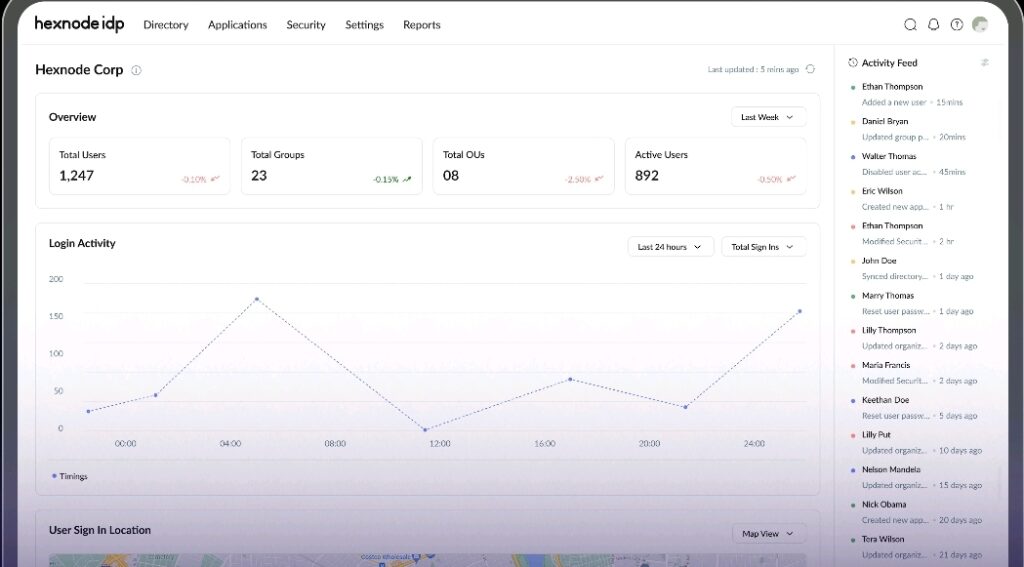
When identity and device intelligence converge, organizations can reduce risk while accelerating productivity and improving trust.
Expected outcomes include:
- Faster onboarding cycles.
- Reduced shadow IT.
- Lower third-party licensing spend.
- Improved compliance reporting.
- Stronger Zero Trust posture.
- Higher employee satisfaction.
For customer-facing businesses, stronger identity controls also protect brand reputation.
Security breaches damage trust.
Proactive architecture preserves it.
Frequently Asked Questions
How does a native IdP differ from a cloud-only identity provider?
A native IdP integrates deeply into endpoint management systems, using device posture for real-time enforcement rather than relying solely on credential validation.
Can identity convergence reduce CX costs?
Yes. Unified platforms reduce licensing overlap and integration overhead while minimizing productivity loss from access delays.
Is Zero Trust practical for mid-sized enterprises?
Modern integrated platforms make Zero Trust scalable. Continuous validation now automates much of the enforcement.
How does identity affect AI-driven customer experiences?
AI personalization depends on trusted identity signals. Fragmented identity limits contextual intelligence.
What metrics should CX leaders monitor during identity transformation?
Track onboarding time, login friction, access revocation speed, MFA success rates, and user satisfaction scores.
The Strategic Implication for 2026
Identity is no longer a backend checkbox.
It is a living, adaptive layer influencing:
- Productivity
- Trust
- Security
- Emotional experience
Hexnode’s launch of Hexnode IdP represents more than product expansion.
It reflects an architectural realignment.
As organizations expand AI, remote work, and digital ecosystems, identity will sit at the center.
Not at the edge.
For CX and EX leaders, this is the moment to engage.
Security teams can no longer own identity alone.
Experience teams must help design it.
Actionable Takeaways for CX Professionals
- Audit all authentication touchpoints across employee and customer journeys.
- Measure onboarding access delays and quantify productivity loss.
- Align IT, Security, and CX governance under a unified identity steering group.
- Evaluate device posture enforcement gaps within current IdP setups.
- Pilot lifecycle automation for provisioning and group management.
- Redesign MFA policies to balance trust and friction.
- Track emotional impact metrics tied to login and access events.
- Engage vendors strategically around ecosystem integration, not feature checklists.
Identity is becoming the experience engine.
Those who design it thoughtfully will not only secure their enterprises.
They will elevate trust at every digital doorway.
The post Hexnode IdP: Unifying Identity, Device Trust, and Zero Trust Security for Modern CX appeared first on CX Quest.


You May Also Like

Lawmaker Demands Polymarket Remove 219 War Bets After Airman Market Controversy – Bitcoin News

Critical USDT0 Response to Drift Hack Exposes Stark Contrast in Stablecoin Security Protocols