The U.S. is about to get its first Dogecoin ETF — and with it, the crypto industry is forced to ask a very uncomfortable question: are we legitimizing a cultural phenomenon, or just dressing up speculation in Wall Street clothes?The U.S. is about to get its first Dogecoin ETF — and with it, the crypto industry is forced to ask a very uncomfortable question: are we legitimizing a cultural phenomenon, or just dressing up speculation in Wall Street clothes?

Dogecoin ETF: A Joke Gone Institutional

The U.S. is about to get its first Dogecoin ETF — and with it, the crypto industry is forced to ask a very uncomfortable question: are we legitimizing a cultural phenomenon, or just dressing up speculation in Wall Street clothes?

On Thursday, the Rex-Osprey Dogecoin ETF (ticker: DOJE) goes live. Unlike Bitcoin spot ETFs, which are approved under the Securities Act of 1933 and simply hold BTC in custody (BlackRock’s version keeps coins parked with Coinbase), this Dogecoin fund had to squirm its way through a very different legal loophole: the Investment Company Act of 1940. That framework was designed for diversified mutual funds — not single-asset gambles — which is why DOJE had to route exposure through a Cayman Islands subsidiary and use derivatives. Translation: Wall Street lawyers earned their retainers.
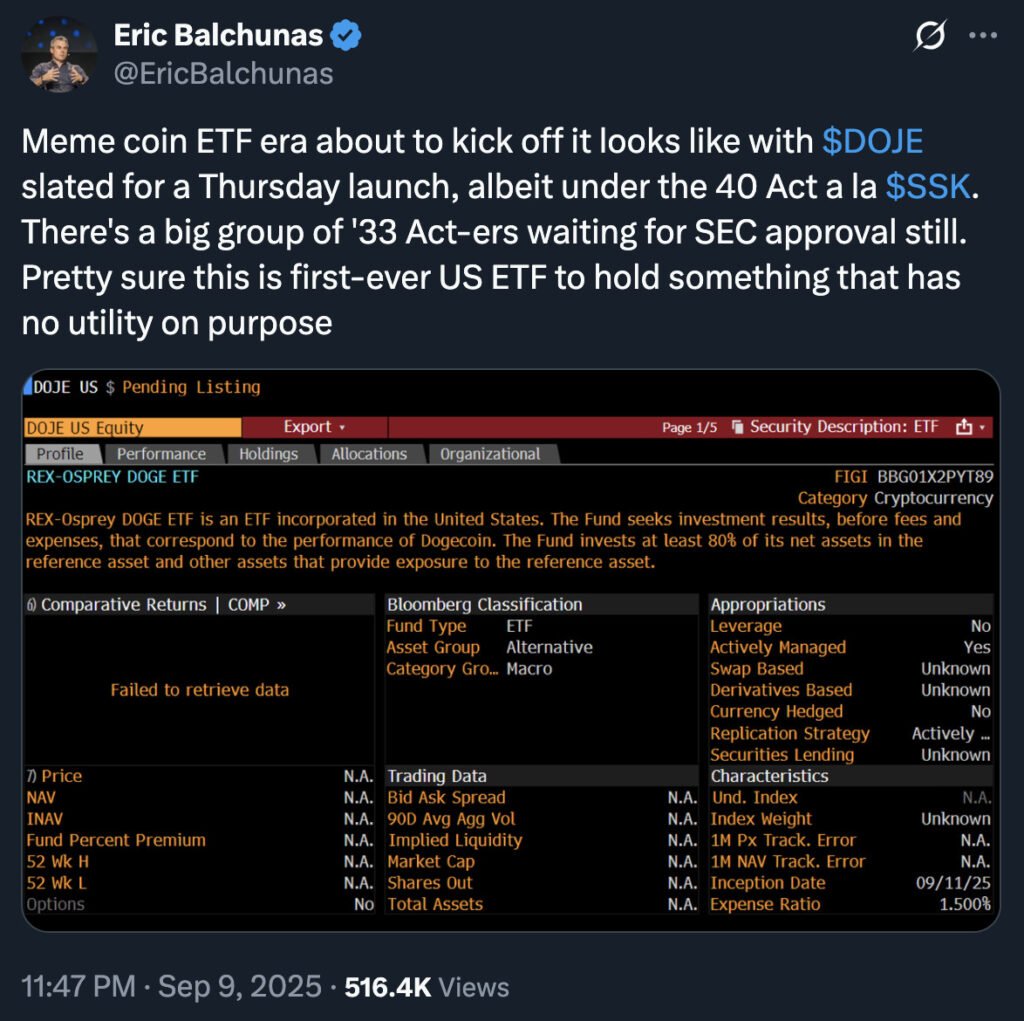
The U.S. is about to get its first Dogecoin ETF — and with it, the crypto industry is forced to ask a very uncomfortable question: are we legitimizing a cultural phenomenon, or just dressing up speculation in Wall Street clothes?

Meme coin ETF begins, source: X

Speculation With a Smile

Crypto loves to celebrate new ETFs as milestones, but this one feels different. Critics argue DOJE institutionalizes pure casino energy. Why pay fund fees when you could just buy Dogecoin directly on Coinbase in five minutes, as Brian Huang of Glider points out? He calls the ETF a “ridiculous” way to wrap a single asset — like packaging Tesla stock into a “diversified fund” with a hefty expense ratio.

And yet, that’s Dogecoin’s magic trick. Born in 2013 as a joke fork of a fork of a fork (Bitcoin → Litecoin → Luckycoin → Dogecoin), it somehow clawed its way into the top 10 by market cap. It spawned the entire memecoin category, a subculture often dismissed as a distraction from “serious” blockchain projects. Its tokenomics mock Bitcoin’s scarcity fetish — instead of a 21M cap, DOGE has unlimited supply, with 10,000 new coins minted every minute (that’s 5 billion a year). Scarcity maxis hate it; Doge holders don’t care.
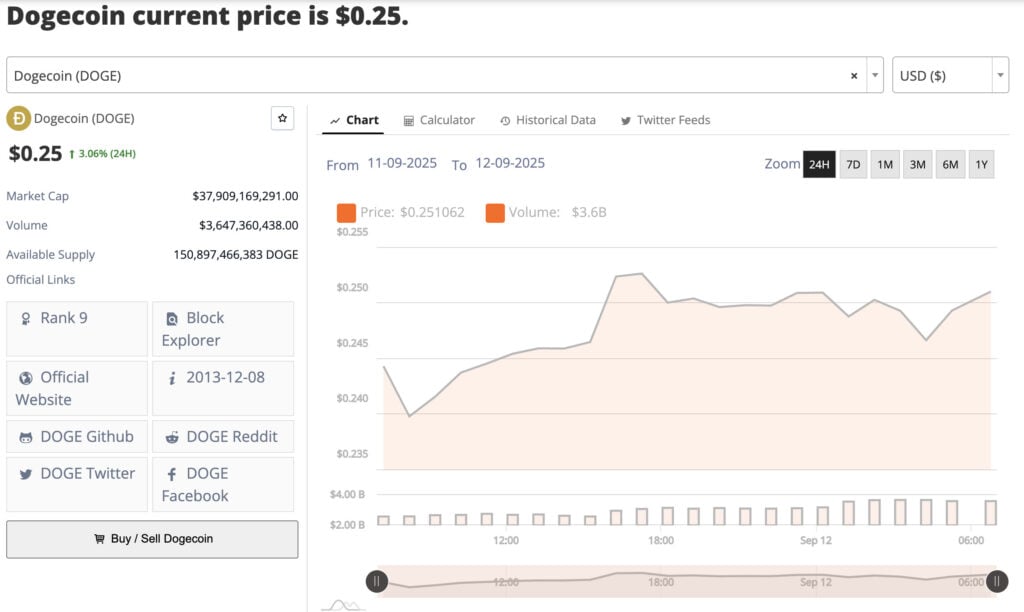
The U.S. is about to get its first Dogecoin ETF — and with it, the crypto industry is forced to ask a very uncomfortable question: are we legitimizing a cultural phenomenon, or just dressing up speculation in Wall Street clothes?

Dogecoin is sitting at 0.25c, Source: BNC

The Bigger Picture

Here’s where it gets interesting. By late August, 92 crypto ETP applications were sitting with the SEC — everything from serious altcoins to joke tokens like Pengu (tied to Pudgy Penguins NFTs). The fact that Dogecoin is cutting the line ahead of more “serious” projects says something brutal about crypto’s reality: cultural capital moves faster than technical capital.

Meme vs. Market

So, do we need a Dogecoin ETF? From a functionality standpoint, no. From a narrative standpoint, maybe. For skeptics, this is Wall Street legitimizing a meme while fleecing investors with fees. For optimists, it’s another bridge between retail culture and institutional money.

Here’s the uncomfortable truth: Dogecoin doesn’t need a use case beyond existing as a mirror to the absurdity of modern markets. In that sense, it’s the most honest token of all. A Dogecoin ETF doesn’t blur the line between meme and market — it obliterates it.

If a memecoin can become a regulated ETF, then anything is on the table. And maybe that’s the point.


 

Market Opportunity
Union Logo
Union Price(U)
$0,002532
$0,002532$0,002532
+4,58%
USD
Union (U) Live Price Chart
Disclaimer: The articles reposted on this site are sourced from public platforms and are provided for informational purposes only. They do not necessarily reflect the views of MEXC. All rights remain with the original authors. If you believe any content infringes on third-party rights, please contact service@support.mexc.com for removal. MEXC makes no guarantees regarding the accuracy, completeness, or timeliness of the content and is not responsible for any actions taken based on the information provided. The content does not constitute financial, legal, or other professional advice, nor should it be considered a recommendation or endorsement by MEXC.

You May Also Like

China Launches Cross-Border QR Code Payment Trial

China Launches Cross-Border QR Code Payment Trial

The post China Launches Cross-Border QR Code Payment Trial appeared on BitcoinEthereumNews.com. Key Points: Main event involves China initiating a cross-border QR code payment trial. Alipay and Ant International are key participants. Impact on financial security and regulatory focus on illicit finance. China’s central bank, led by Deputy Governor Lu Lei, initiated a trial of a unified cross-border QR code payment gateway with Alipay and Ant International as participants. This pilot addresses cross-border fund risks, aiming to enhance financial security amid rising money laundering through digital channels, despite muted crypto market reactions. China’s Cross-Border Payment Gateway Trial with Alipay The trial operation of a unified cross-border QR code payment gateway marks a milestone in China’s financial landscape. Prominent entities such as Alipay and Ant International are at the forefront, participating as the initial institutions in this venture. Lu Lei, Deputy Governor of the People’s Bank of China, highlighted the systemic risks posed by increased cross-border fund flows. Changes are expected in the dynamics of digital transactions, potentially enhancing transaction efficiency while tightening regulations around illicit finance. The initiative underscores China’s commitment to bolstering financial security amidst growing global fund movements. “The scale of cross-border fund flows is expanding, and the frequency is accelerating, providing opportunities for risks such as cross-border money laundering and terrorist financing. Some overseas illegal platforms transfer funds through channels such as virtual currencies and underground banks, creating a ‘resonance’ of risks at home and abroad, posing a challenge to China’s foreign exchange management and financial security.” — Lu Lei, Deputy Governor, People’s Bank of China Bitcoin and Impact of China’s Financial Initiatives Did you know? China’s latest initiative echoes the Payment Connect project of June 2025, furthering real-time cross-boundary remittances and expanding its influence on global financial systems. As of September 17, 2025, Bitcoin (BTC) stands at $115,748.72 with a market cap of $2.31 trillion, showing a 0.97%…
Share
BitcoinEthereumNews2025/09/18 05:28
Gold hits yet another new all-time high of $4,740 as Bitcoin crashes to $91,000

Gold hits yet another new all-time high of $4,740 as Bitcoin crashes to $91,000

The post Gold hits yet another new all-time high of $4,740 as Bitcoin crashes to $91,000 appeared on BitcoinEthereumNews.com. Gold futures pushed to a new all time
Share
BitcoinEthereumNews2026/01/20 14:04
Goddess of Wealth Jailed for $7.2 Billion Crypto Scam Targeting Thousands

Goddess of Wealth Jailed for $7.2 Billion Crypto Scam Targeting Thousands

Zhimin Qian jailed in UK for $7.2B crypto scam targeting 128,000 victims; 61,000 Bitcoin seized in record-breaking operation. Zhimin Qian, also known as Yadi Zhang
Share
LiveBitcoinNews2026/01/20 14:00



