The post Ethereum hits record 12 million daily smart contract calls as traders eye the $5200 ceiling appeared on BitcoinEthereumNews.com. Per CryptoQuant’s second September weekly report, Ethereum’s latest uptrend from about $1,400 in April to a high near $5,000 has unfolded alongside heavier allocations in funds and whale accumulation, a pullback in exchange deposits, and activity peaks across transactions, addresses, and smart-contract calls. Ethereum trades below a realized price band of $5,200 while fund holdings and on-chain use hit records. The report frames the next phase around whether price can clear the realized price upper band that capped prior advances. According to CryptoQuant, Ethereum fund holdings, driven largely by U.S. spot ETFs, have reached 6.7 million ETH, nearly double since April. Addresses holding 10,000 to 100,000 ETH added roughly 6 million ETH over the same period, with this cohort now at 20.6 million ETH, a new high. The “smart money” share embedded in those balances means a material portion of demand is already in place, compressing the room for momentum to do the heavy lifting without fresh flows. The charts on page 2 of the report show both the fund-holding curve and cohort balances making new peaks. Staking has climbed in parallel. The total ETH staked stands at around 36.2 million, up by roughly 2.5 million ETH since May. The rising validator count reduces circulating supply and supports a tighter float, yet it also sequesters capital that would otherwise meet new demand if price drifts or volumes thin out. That mix of lower float and higher commitment from validators helps explain why spot market pressure can ease even when price consolidates. On-chain throughput has expanded. Total daily transactions peaked at about 1.7 million on August 16, and active addresses reached roughly 800,000 on August 5, both new highs, per the network dashboards. Smart-contract calls surpassed 12 million daily for the first time, marking the heaviest programmatic use of the base… The post Ethereum hits record 12 million daily smart contract calls as traders eye the $5200 ceiling appeared on BitcoinEthereumNews.com. Per CryptoQuant’s second September weekly report, Ethereum’s latest uptrend from about $1,400 in April to a high near $5,000 has unfolded alongside heavier allocations in funds and whale accumulation, a pullback in exchange deposits, and activity peaks across transactions, addresses, and smart-contract calls. Ethereum trades below a realized price band of $5,200 while fund holdings and on-chain use hit records. The report frames the next phase around whether price can clear the realized price upper band that capped prior advances. According to CryptoQuant, Ethereum fund holdings, driven largely by U.S. spot ETFs, have reached 6.7 million ETH, nearly double since April. Addresses holding 10,000 to 100,000 ETH added roughly 6 million ETH over the same period, with this cohort now at 20.6 million ETH, a new high. The “smart money” share embedded in those balances means a material portion of demand is already in place, compressing the room for momentum to do the heavy lifting without fresh flows. The charts on page 2 of the report show both the fund-holding curve and cohort balances making new peaks. Staking has climbed in parallel. The total ETH staked stands at around 36.2 million, up by roughly 2.5 million ETH since May. The rising validator count reduces circulating supply and supports a tighter float, yet it also sequesters capital that would otherwise meet new demand if price drifts or volumes thin out. That mix of lower float and higher commitment from validators helps explain why spot market pressure can ease even when price consolidates. On-chain throughput has expanded. Total daily transactions peaked at about 1.7 million on August 16, and active addresses reached roughly 800,000 on August 5, both new highs, per the network dashboards. Smart-contract calls surpassed 12 million daily for the first time, marking the heaviest programmatic use of the base…

Ethereum hits record 12 million daily smart contract calls as traders eye the $5200 ceiling

For feedback or concerns regarding this content, please contact us at crypto.news@mexc.com

Per CryptoQuant’s second September weekly report, Ethereum’s latest uptrend from about $1,400 in April to a high near $5,000 has unfolded alongside heavier allocations in funds and whale accumulation, a pullback in exchange deposits, and activity peaks across transactions, addresses, and smart-contract calls.

Ethereum trades below a realized price band of $5,200 while fund holdings and on-chain use hit records.

The report frames the next phase around whether price can clear the realized price upper band that capped prior advances.

According to CryptoQuant, Ethereum fund holdings, driven largely by U.S. spot ETFs, have reached 6.7 million ETH, nearly double since April. Addresses holding 10,000 to 100,000 ETH added roughly 6 million ETH over the same period, with this cohort now at 20.6 million ETH, a new high.

The “smart money” share embedded in those balances means a material portion of demand is already in place, compressing the room for momentum to do the heavy lifting without fresh flows. The charts on page 2 of the report show both the fund-holding curve and cohort balances making new peaks.

Staking has climbed in parallel.

The total ETH staked stands at around 36.2 million, up by roughly 2.5 million ETH since May. The rising validator count reduces circulating supply and supports a tighter float, yet it also sequesters capital that would otherwise meet new demand if price drifts or volumes thin out.

That mix of lower float and higher commitment from validators helps explain why spot market pressure can ease even when price consolidates.

On-chain throughput has expanded. Total daily transactions peaked at about 1.7 million on August 16, and active addresses reached roughly 800,000 on August 5, both new highs, per the network dashboards. Smart-contract calls surpassed 12 million daily for the first time, marking the heaviest programmatic use of the base layer so far.

Elevated usage across DeFi, stablecoin transfers, and token activity builds fee revenue and reinforces the settlement-layer role that underpins ETH’s cash-flow and utility narratives. If activity cools, volatility often follows as price discovers the correct multiple on lower throughput.

Spot-side supply pressure has eased.

CryptoQuant’s exchange-inflow series shows deposits to centralized venues falling from roughly 1.8 million ETH in mid-August to about 750,000 ETH per day after the early-September price high.

Fewer coins moving to exchanges typically line up with thinner realized selling, which aids stability during retests. Low inflows can also coincide with quieter order books, so prices can travel more on smaller trades if a catalyst lands.

The technical fulcrum is the realized price upper band near $5,200. CryptoQuant plots that level as the region that repelled advances in 2020–2021 and again in early 2024. ETH trades around $4,400 in the report window, so the market sits one step below a threshold with a track record of pausing uptrends.

Clearing that zone would shift trading into territory where realized holders, on average, sit deeper in profit, and where supply forces depend more on whether newer inflows outpace long-dated distribution.

The flow picture offers a simple checklist for the weeks ahead.

Fund holdings are already at a record, so incremental net creations matter more than absolute size. Whale cohorts hold over 20 million ETH, so net additions from this group carry outsized weight versus retail churn.

Staking is at 36 million ETH, so any acceleration or slowdown in validator deposits will change the liquid float at the margin. Exchange inflows are subdued compared with August, so watch whether that series stays compressed or reverts as price revisits prior highs. All four lines are visible across the report’s holdings, staking, network, and inflow charts.

For valuation context, CryptoQuant ties the April-to-September advance to a dual engine of institutional participation and on-chain throughput. That framing pairs the top-down demand capture of ETFs with bottom-up settlement use across DeFi and tokens.

It also leaves room for periods where activity outruns price or vice versa. In those phases, realized bands and exchange-flow gauges help separate consolidation from distribution, especially when positioning is already heavy among large holders.

The near-term setup, therefore, revolves around whether ETH holds its footing into a second attempt at the realized band, with funds, whales, staking, and activity providing most of the signal on whether the cycle keeps its pace or pauses.

According to the report, the realized price upper band near $5,200 remains the level in focus.

Source: https://cryptoslate.com/ethereum-hits-record-12-million-daily-smart-contract-calls-as-traders-eye-the-5200-ceiling/
Market Opportunity
NEAR Logo
NEAR Price(NEAR)
$1.3566
$1.3566$1.3566
+3.80%
USD
NEAR (NEAR) Live Price Chart
Disclaimer: The articles reposted on this site are sourced from public platforms and are provided for informational purposes only. They do not necessarily reflect the views of MEXC. All rights remain with the original authors. If you believe any content infringes on third-party rights, please contact crypto.news@mexc.com for removal. MEXC makes no guarantees regarding the accuracy, completeness, or timeliness of the content and is not responsible for any actions taken based on the information provided. The content does not constitute financial, legal, or other professional advice, nor should it be considered a recommendation or endorsement by MEXC.

You May Also Like

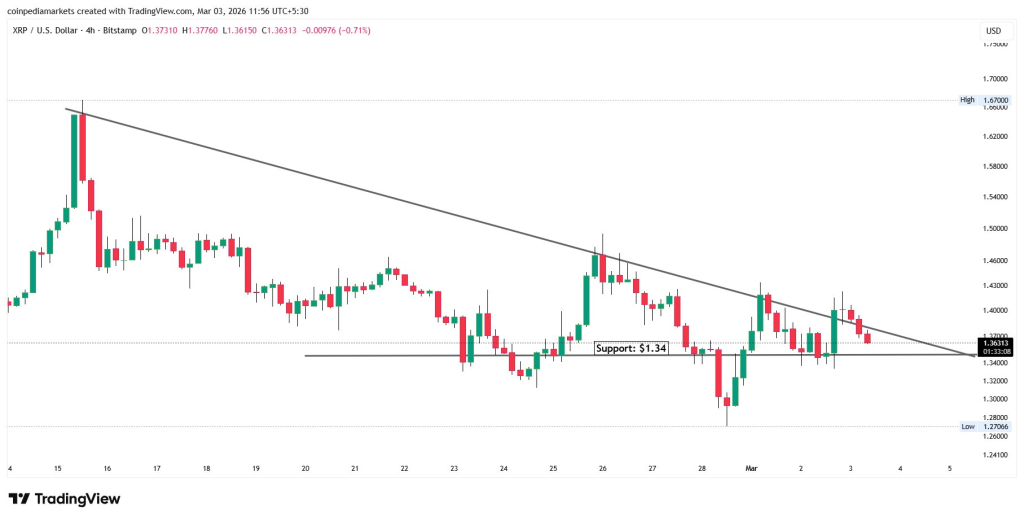
Warning Signs Flash for $XRP as $1.34 Support Gets Tested

Warning Signs Flash for $XRP as $1.34 Support Gets Tested

XRP lagged behind Bitcoin and Ethereum during yesterday’s relief bounce. In fact, BTC and ETH pushed higher over $70K and $2K respectively, but XRP only managed
Share
Captainaltcoin2026/03/03 14:49
PiDex Testnet Launch: What It Means for Pi Network and Picoin Value

PiDex Testnet Launch: What It Means for Pi Network and Picoin Value

Pi Network’s decentralized exchange, PiDex, went live on the testnet, marking a significant technical milestone for the ecosystem. Despite the launch, the m
Share
Hokanews2026/03/03 14:27
UK and US Seal $42 Billion Tech Pact Driving AI and Energy Future

UK and US Seal $42 Billion Tech Pact Driving AI and Energy Future

The post UK and US Seal $42 Billion Tech Pact Driving AI and Energy Future appeared on BitcoinEthereumNews.com. Key Highlights Microsoft and Google pledge billions as part of UK US tech partnership Nvidia to deploy 120,000 GPUs with British firm Nscale in Project Stargate Deal positions UK as an innovation hub rivaling global tech powers UK and US Seal $42 Billion Tech Pact Driving AI and Energy Future The UK and the US have signed a “Technological Prosperity Agreement” that paves the way for joint projects in artificial intelligence, quantum computing, and nuclear energy, according to Reuters. Donald Trump and King Charles review the guard of honour at Windsor Castle, 17 September 2025. Image: Kirsty Wigglesworth/Reuters The agreement was unveiled ahead of U.S. President Donald Trump’s second state visit to the UK, marking a historic moment in transatlantic technology cooperation. Billions Flow Into the UK Tech Sector As part of the deal, major American corporations pledged to invest $42 billion in the UK. Microsoft leads with a $30 billion investment to expand cloud and AI infrastructure, including the construction of a new supercomputer in Loughton. Nvidia will deploy 120,000 GPUs, including up to 60,000 Grace Blackwell Ultra chips—in partnership with the British company Nscale as part of Project Stargate. Google is contributing $6.8 billion to build a data center in Waltham Cross and expand DeepMind research. Other companies are joining as well. CoreWeave announced a $3.4 billion investment in data centers, while Salesforce, Scale AI, BlackRock, Oracle, and AWS confirmed additional investments ranging from hundreds of millions to several billion dollars. UK Positions Itself as a Global Innovation Hub British Prime Minister Keir Starmer said the deal could impact millions of lives across the Atlantic. He stressed that the UK aims to position itself as an investment hub with lighter regulations than the European Union. Nvidia spokesman David Hogan noted the significance of the agreement, saying it would…
Share
BitcoinEthereumNews2025/09/18 02:22