

Read the most recent Bitcoin news and BTC updates with MEXC. Follow breaking stories, price analysis, and expert insights. Start reading BTC news today.Read the most recent Bitcoin news and BTC updates with MEXC. Follow breaking stories, price analysis, and expert insights. Start reading BTC news today.
2026-06-11 Thursday
Bitcoin News
Get the latest Bitcoin insights and market updates.

Bitcoin Correction Mirrors 2022 Pattern Ahead of 8x Surge
Comparing Bitcoin’s Current Correction With the 2022 Pattern According to TARA’s analysis, the 2022 downturn followed a classic ABC corrective structure, with an
Share
Author: The Crypto Updates2026/06/11 09:37

Bitcoin Whale Withdraws Another 618 BTC from OKX, Now Holds Over 2,300 BTC
BitcoinWorld Bitcoin Whale Withdraws Another 618 BTC from OKX, Now Holds Over 2,300 BTC A large, anonymous Bitcoin holder, identified by the wallet address beginning
Share
Author: bitcoinworld2026/06/11 09:15

Bitcoin Suppressed Like Gold? Luke Gromen Says It Can’t Last Forever
Luke Gromen says Bitcoin’s failure to break decisively higher may reflect more than weak spot demand, arguing that paper instruments can temporarily absorb buying
Share
Author: NewsBTC2026/06/11 09:00

BTC/USDT Spot CVD Chart Analysis: Order Book Signals for June 11
BitcoinWorld BTC/USDT Spot CVD Chart Analysis: Order Book Signals for June 11 On June 11 at 0:00 UTC, the BTC/USDT spot pair’s Cumulative Volume Delta (CVD) chart
Share
Author: bitcoinworld2026/06/11 08:15
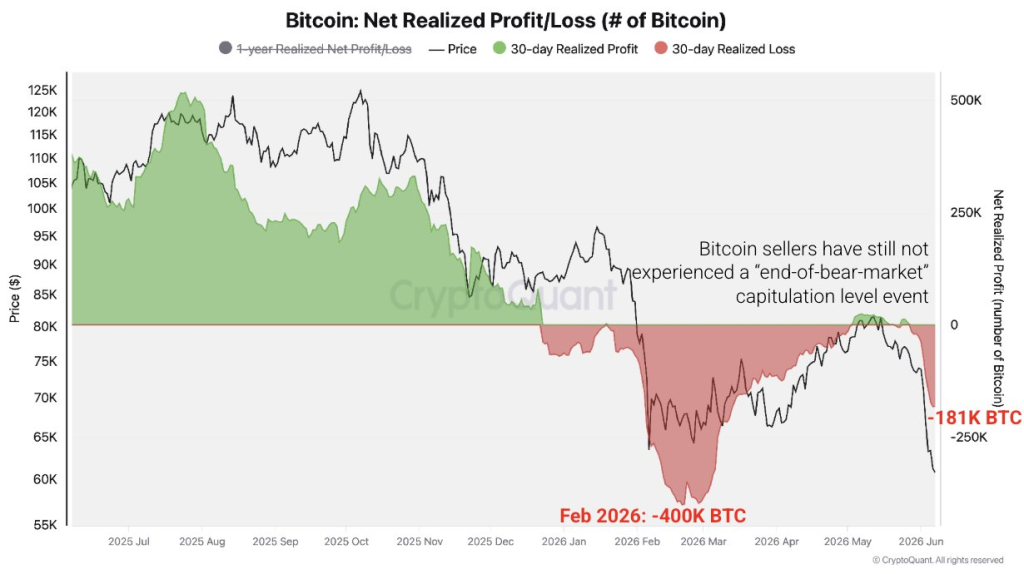
Bitcoin Price Bottom Not Confirmed – ETF Demand Crashes to Worst Level Since Launch
Bitcoin price dropped to a fresh bear market low of $59,000 and now trades near $61,000. BTC is only 9% above its realized price of $53,600 – a valuation level
Share
Author: Captainaltcoin2026/06/11 06:30

Bitcoin mining margins slump to record lows as BTC hovers near $60K
Bitcoin’s mining economics tightened further as on-chain activity cooled and miner revenues hit fresh lows. The Luxor Hashrate Index now estimates the daily return
Share
Author: Crypto Breaking News2026/06/11 05:33

More Pain For Bitcoin? Analyst Explains Why BTC’s Bottom May Be Months Away
As Bitcoin (BTC) hovers near its lowest levels since late 2024, a market observer suggests the flagship crypto may not have finished bottoming yet, with more downside
Share
Author: NewsBTC2026/06/11 05:23

Bitcoin Near Realized Price as ETF Demand Turns Negative
TLDR CryptoQuant identifies $53,600 as Bitcoin’s realized price and a potential bottom zone. Bitcoin traded near $62,150 after falling to around $59,000 last week
Share
Author: Blockonomi2026/06/11 05:22

The Verdict Is In For Bitcoin: Majority Of Investors Say BTC Price Is Headed Lower, Here Are The Numbers
Across prediction markets, on-chain dashboards, and sentiment trackers, a clear majority of Bitcoin investors have positioned themselves for further downside.
Share
Author: Bitcoinist2026/06/11 05:00



Trending News
MoreBitcoin 24/7 Live News
MoreQuick Reads
More
