Spectral Sovereignty explains how predictive systems make binding decisions without visible authority. From bank freezes to hospital scoring and DAO governance, outcomes are enforced by code rather than people, creating legitimacy without presence and accountability gaps.Spectral Sovereignty explains how predictive systems make binding decisions without visible authority. From bank freezes to hospital scoring and DAO governance, outcomes are enforced by code rather than people, creating legitimacy without presence and accountability gaps.

Nobody Is Holding Predictive Systems Accountable

Predictive systems are already making binding decisions in finance, healthcare, and decentralized organizations. The striking fact is that there is no one to hold accountable.


We tend to believe that every important decision has an author. A manager signs a form, a doctor confirms a diagnosis, a regulator issues a mandate. Authority has historically been tied to presence, to a figure who can be addressed, challenged, or appealed to. Yet predictive infrastructures are dismantling that assumption. Today, more and more outcomes are being generated without anyone giving the order. The decisions are real, their consequences profound, but the “who” behind them has dissolved.

Case 1: Banking and Automated Freezes

Imagine your account being frozen overnight. No phone call, no suspicious human clerk, no conversation. The trigger was a compliance engine. High-frequency trading data fed into an algorithm, an anomaly detected, and a sanction threshold surpassed. Within seconds the system produced an enforcement action. The banker did not choose, the regulator did not review, and yet the freeze was binding. The sovereign in this situation was not a person but a line of compiled instructions.

Case 2: Hospitals and Predictive Scoring

In medicine, the same pattern appears. Patients are classified by automated triage systems that calculate probabilities of illness. A score of 0.69 may mean low risk, while 0.70 crosses the threshold to high risk. If you are below that cutoff, you may find your treatment delayed or denied. Doctors receive these scores as recommendations, but in practice they operate like orders. The decision is executed before deliberation. It is not a doctor’s judgment that excludes the patient; it is the architecture of the predictive system.

Case 3: DAOs and Unstoppable Code

Decentralized Autonomous Organizations push this even further. Smart contracts are deployed on-chain and cannot be reversed once active. MakerDAO and Compound execute liquidations and adjust collateral ratios without human intervention. When a contract fires, treasury movements occur automatically. There is no board meeting, no executive veto, no pause button. The authority is procedural, and once triggered, it cannot be appealed.


The Common Thread

Although these examples come from very different domains such as finance, healthcare, and blockchain, they all share a structure. The source of authority has become opaque. Decisions are experienced as if they came from an agent, but there is no one behind them. This opacity is not accidental, it is designed into the system. Once a rule is compiled and encoded, it acts independently of deliberation.

Another common element is procedural binding. In each case, what counts is not meaning, explanation, or context but the fact that the rule has been triggered. An anomalous transaction is frozen regardless of intention. A patient below threshold is deprioritized regardless of symptoms. A DAO contract liquidates assets regardless of community debate. The procedure itself becomes binding, more powerful than interpretation.

Finally, there is the collapse of appeal. Under older frameworks, there was always someone to challenge: a manager, a doctor, a regulator. Here, no such figure exists. The banker cannot override the freeze, the doctor cannot bypass the score, the DAO has no board to escalate to. Authority is distributed into code, and once activated, it cannot be reversed.


Why It Matters

This matters because it changes how power is exercised in everyday life. Authority used to be visible and embodied, now it is hidden and procedural. When decisions are made without presence, accountability disappears. You cannot appeal to a line of code or question an algorithm in court the way you would a human authority.

The consequences are serious. Financial stability may seem more secure, but at the cost of customers trapped by automatic freezes. Healthcare systems may process more patients, but individuals are reduced to risk scores that can misclassify or exclude. DAOs may be efficient, but they remove all recourse when rules produce unintended harm.

In each case, people are compelled to obey outcomes that no one explicitly issued. This creates a vacuum of responsibility. Everyone is affected, but no one is in charge. The result is a structural form of governance where efficiency is maximized, yet fairness, accountability, and human oversight are minimized.


The Broader Shift

What we see in these domains is not isolated. It signals a broader transformation in how societies govern themselves. Authority is migrating from voice to infrastructure, from deliberation to automation, from presence to absence.

Historically, political theory assumed that power needed a subject such as a king, a parliament, or a regulator. Predictive systems show that power can operate without one. Authority is no longer tied to the visible figure but to the hidden architecture. What compels obedience is not a sovereign decree but a probability score, a compliance threshold, or a self-executing contract.

This shift alters the meaning of legitimacy itself. Legitimacy no longer rests on the consent of the governed but on the silent authority of systems that preempt possible actions. The rules act first, and rationales if they exist come later. Citizens and institutions alike adjust to an environment where compliance precedes understanding.

In short, the broader shift is toward a society where governance is automated, accountability is diffused, and authority is spectral. It has not disappeared. On the contrary, it has become stronger by dissolving into infrastructures that no one sees but everyone must obey.


Call to Action

To explore this phenomenon in detail, read the full paper Spectral Sovereignty: Authority Without Presence in Predictive Systems available at Zenodo: https://doi.org/10.5281/zenodo.17063518 and follow the author’s SSRN profile for ongoing research: https://papers.ssrn.com/sol3/cf_dev/AbsByAuth.cfm?per_id=7639915

Author Details

Agustin V. Startari \n ResearcherID: K-5792-2016 \n ORCID:https://orcid.org/0009-0001-4714-6539 \n Zenodo Archive:https://doi.org/10.5281/zenodo.17063518


Ethos

I do not use artificial intelligence to write what I don’t know. I use it to challenge what I do. I write to reclaim the voice in an age of automated neutrality. My work is not outsourced. It is authored. \n — Agustin V. Startari

Market Opportunity
DAO Maker Logo
DAO Maker Price(DAO)
$0.05471
$0.05471$0.05471
-1.38%
USD
DAO Maker (DAO) Live Price Chart
Disclaimer: The articles reposted on this site are sourced from public platforms and are provided for informational purposes only. They do not necessarily reflect the views of MEXC. All rights remain with the original authors. If you believe any content infringes on third-party rights, please contact service@support.mexc.com for removal. MEXC makes no guarantees regarding the accuracy, completeness, or timeliness of the content and is not responsible for any actions taken based on the information provided. The content does not constitute financial, legal, or other professional advice, nor should it be considered a recommendation or endorsement by MEXC.

You May Also Like

Trump Media received 260 BTC from Coinbase, worth $21 million.
Trump Media received 260 BTC from Coinbase, worth $21 million.

PANews reported on December 31 that, according to Emmett Gallic, Trump Media received 260 BTC (worth $21 million) from Coinbase between last night and early this
Share
PANews2025/12/31 08:06
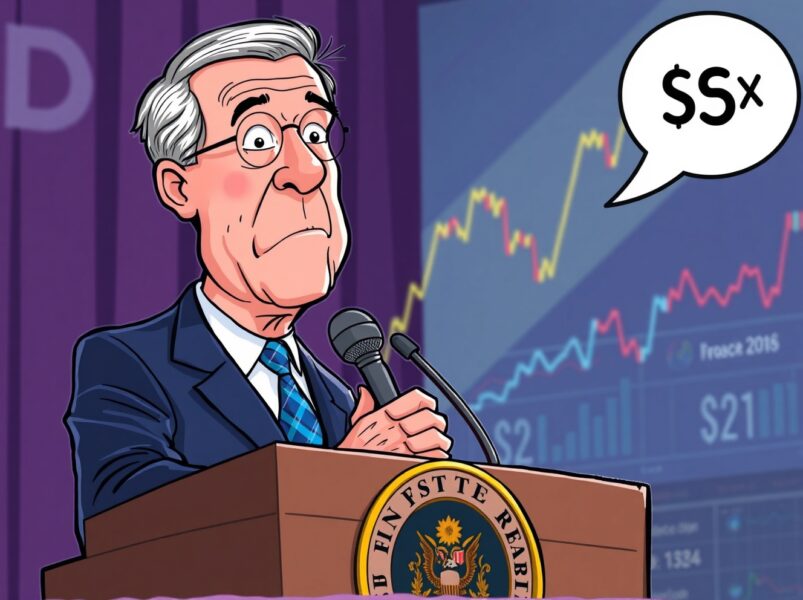
Jerome Powell’s Press Conference: Crucial Insights Unveiled for the Market’s Future

Jerome Powell’s Press Conference: Crucial Insights Unveiled for the Market’s Future

BitcoinWorld Jerome Powell’s Press Conference: Crucial Insights Unveiled for the Market’s Future The financial world, including the dynamic cryptocurrency market, often hangs on every word from the Federal Reserve. Recently, Jerome Powell’s press conference following the Federal Open Market Committee (FOMC) meeting concluded, leaving investors and analysts dissecting his remarks for clues about the future economic direction. This event is always a pivotal moment, shaping expectations for inflation, interest rates, and the overall stability of global markets. What Were the Key Takeaways from Jerome Powell’s Press Conference? During Jerome Powell’s press conference, the Fed Chair provided an update on the central bank’s monetary policy decisions and its economic outlook. His statements often reiterate the Fed’s dual mandate: achieving maximum employment and stable prices. This time was no different, with a strong emphasis on managing persistent inflation. Key points from the recent discussion included: Inflation Control: Powell emphasized the Fed’s unwavering commitment to bringing inflation back down to its 2% target. He reiterated that the fight against rising prices remains the top priority, even if it entails some economic slowdown. Interest Rate Policy: While the Fed’s stance on future interest rate adjustments was discussed, the path remains data-dependent. Powell indicated that decisions would continue to be made meeting-by-meeting, based on incoming economic data. Economic Projections: The updated Summary of Economic Projections (SEP) offered insights into the Fed’s forecasts for GDP growth, unemployment, and inflation. These projections help market participants gauge the central bank’s expectations for the economy’s trajectory. Quantitative Tightening (QT): The ongoing process of reducing the Fed’s balance sheet, known as quantitative tightening, was also a topic. This reduction in liquidity in the financial system has broad implications for asset prices. How Did Jerome Powell’s Remarks Impact Cryptocurrency Markets? The conclusion of Jerome Powell’s press conference often sends ripples through traditional financial markets, and cryptocurrencies are increasingly sensitive to these macroeconomic shifts. Digital assets, once thought to be uncorrelated, now frequently react to the Fed’s monetary policy signals. Higher interest rates, for instance, tend to make riskier assets like cryptocurrencies less attractive. This is because investors might prefer safer, interest-bearing investments. Consequently, we often see increased volatility in Bitcoin (BTC) and Ethereum (ETH) prices immediately following such announcements. The tightening of financial conditions, driven by the Fed, reduces overall liquidity in the system, which can put downward pressure on asset valuations across the board. However, some argue that this growing correlation signifies crypto’s increasing integration into the broader financial ecosystem. It suggests that institutional investors and mainstream finance are now paying closer attention to digital assets, treating them more like other risk-on investments. Navigating the Economic Landscape After Jerome Powell’s Press Conference For cryptocurrency investors, understanding the implications of Jerome Powell’s press conference is crucial for making informed decisions. The Fed’s policy trajectory directly influences the availability of capital and investor sentiment, which are key drivers for crypto valuations. Here are some actionable insights for navigating this environment: Stay Informed: Regularly monitor Fed announcements and economic data releases. Understanding the macroeconomic backdrop is as important as analyzing individual crypto projects. Assess Risk Tolerance: In periods of economic uncertainty and tighter monetary policy, a reassessment of personal risk tolerance is wise. Diversification within your crypto portfolio and across different asset classes can mitigate potential downsides. Focus on Fundamentals: While market sentiment can be swayed by macro news, projects with strong fundamentals, clear use cases, and robust development teams tend to perform better in the long run. Long-Term Perspective: Cryptocurrency markets are known for their volatility. Adopting a long-term investment horizon can help weather short-term fluctuations driven by macro events like Fed meetings. The challenges include potential continued volatility and reduced liquidity. However, opportunities may arise from market corrections, allowing strategic investors to accumulate assets at lower prices. In summary, Jerome Powell’s press conference provides essential guidance on the Fed’s economic strategy. Its conclusions have a profound impact on financial markets, including the dynamic world of cryptocurrencies. Staying informed, understanding the nuances of monetary policy, and maintaining a strategic investment approach are paramount for navigating the evolving economic landscape. The Fed’s actions underscore the interconnectedness of traditional finance and the burgeoning digital asset space. Frequently Asked Questions (FAQs) Q1: What is the Federal Open Market Committee (FOMC)? A1: The FOMC is the monetary policy-making body of the Federal Reserve System. It sets the federal funds rate target and directs open market operations, influencing the availability of money and credit in the U.S. economy. Q2: How do the Fed’s interest rate decisions typically affect cryptocurrency markets? A2: Generally, when the Fed raises interest rates, it makes borrowing more expensive and reduces liquidity in the financial system. This often leads investors to shy away from riskier assets like cryptocurrencies, potentially causing prices to decline. Conversely, lower rates can stimulate investment in riskier assets. Q3: What does “data-dependent” mean in the context of Fed policy? A3: “Data-dependent” means that the Federal Reserve’s future monetary policy decisions, such as interest rate adjustments, will primarily be based on the latest economic data. This includes inflation reports, employment figures, and GDP growth, rather than a predetermined schedule. Q4: Should I change my cryptocurrency investment strategy based on Jerome Powell’s press conference? A4: While it’s crucial to be aware of the macroeconomic environment shaped by Jerome Powell’s press conference, drastic changes to a well-researched investment strategy may not always be necessary. It’s recommended to review your portfolio, assess your risk tolerance, and consider if your strategy aligns with the current economic outlook, focusing on long-term fundamentals. If you found this analysis helpful, please consider sharing it with your network! Your insights and shares help us reach more readers interested in the intersection of traditional finance and the exciting world of cryptocurrencies. Spread the word! To learn more about the latest crypto market trends, explore our article on key developments shaping Bitcoin price action. This post Jerome Powell’s Press Conference: Crucial Insights Unveiled for the Market’s Future first appeared on BitcoinWorld.
Share
Coinstats2025/09/18 16:25
Sei Enhances Market Infrastructure with Real-Time Data and Transparency

Sei Enhances Market Infrastructure with Real-Time Data and Transparency

The post Sei Enhances Market Infrastructure with Real-Time Data and Transparency appeared on BitcoinEthereumNews.com. Rongchai Wang Dec 30, 2025 18:21 Sei introduces
Share
BitcoinEthereumNews2025/12/31 08:12