

Pound Sterling Plummets: Escalating Middle East Tensions Fuel Market Anxiety
BitcoinWorld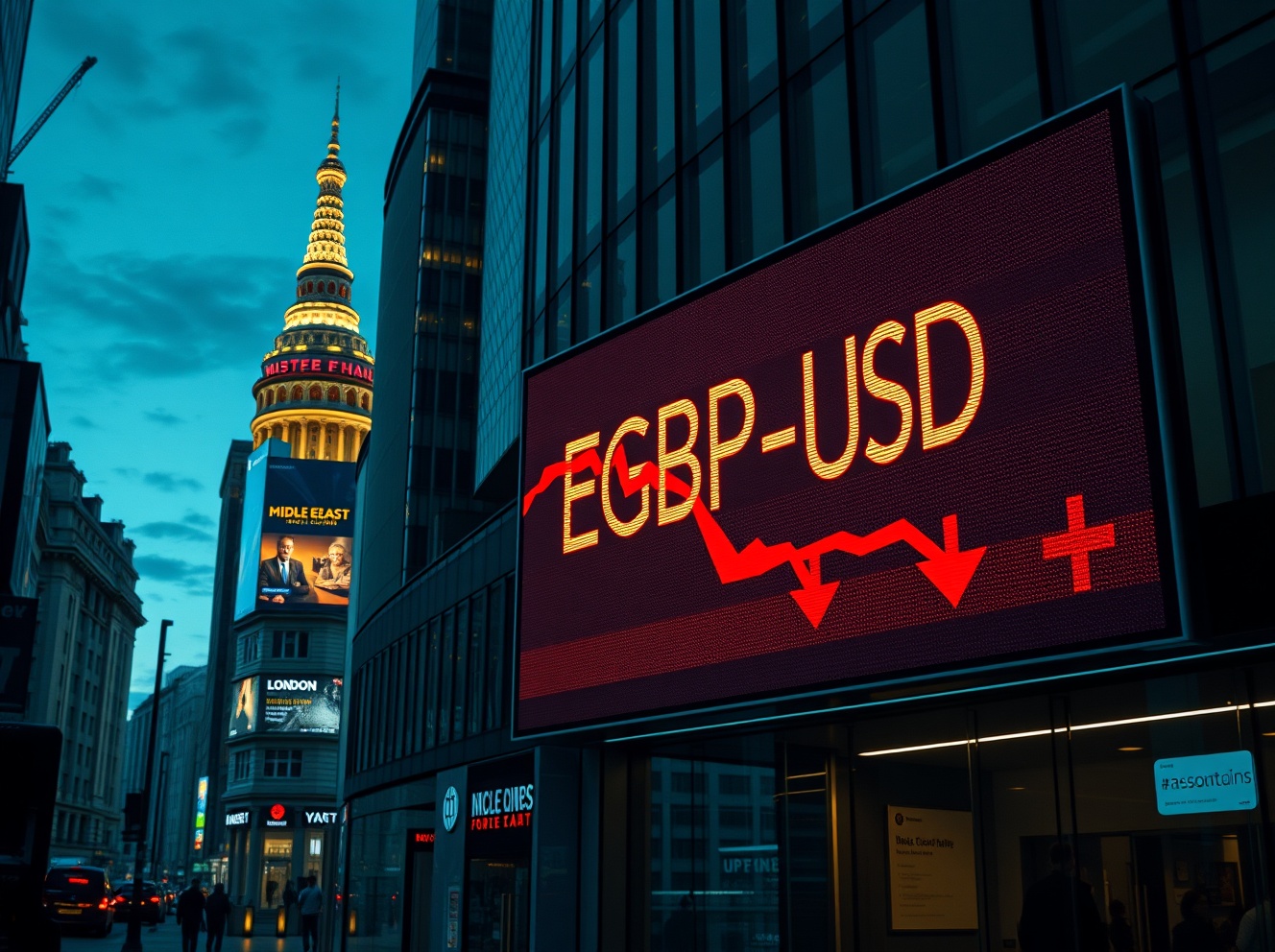
Pound Sterling Plummets: Escalating Middle East Tensions Fuel Market Anxiety
LONDON, April 2025 – The Pound Sterling continues its descent into negative territory this week, as renewed geopolitical instability in the Middle East triggers a pronounced flight to safety among global investors. Consequently, the British currency faces sustained selling pressure against major counterparts like the US Dollar and Swiss Franc. Market analysts now point to a complex interplay of risk aversion and fundamental economic concerns that are currently dictating sterling’s trajectory.
Pound Sterling Under Pressure from Geopolitical Headwinds
Forex markets have reacted sharply to the latest developments in the Middle East. Specifically, reports of escalating regional conflicts have directly increased demand for traditional safe-haven assets. As a result, the US Dollar Index (DXY) has rallied to multi-week highs. Meanwhile, the Pound Sterling, often viewed as a risk-sensitive currency, has borne the brunt of the sell-off. Data from the London trading session shows GBP/USD breaching key technical support levels, a clear signal of prevailing bearish sentiment.
Furthermore, this geopolitical premium is exacerbating existing domestic concerns for the UK economy. Notably, recent inflation data has shown stubborn persistence, complicating the Bank of England’s policy path. Investors are therefore weighing the dual threats of external shocks and internal stagflation risks. This combination creates a uniquely challenging environment for sterling valuation.
Historical Context and Market Impact Analysis
Historically, the Pound Sterling exhibits significant sensitivity to global risk sentiment. A comparative analysis of past geopolitical crises reveals a consistent pattern of underperformance during periods of heightened uncertainty. For instance, during similar periods of Middle East tension, sterling has typically weakened by an average of 3-5% against the dollar within a fortnight.
The current market mechanics involve several key flows:
- Capital Flight: International investors are reducing exposure to UK assets.
- Commodity Volatility: Oil price spikes threaten the UK’s import bill.
- Policy Divergence: Markets anticipate a more cautious BoE amid global turmoil.
The table below illustrates the recent performance of major currency pairs:
| Currency Pair | Weekly Change | Primary Driver |
|---|---|---|
| GBP/USD | -1.8% | Geopolitical Risk |
| GBP/JPY | -2.1% | Carry Trade Unwind |
| GBP/CHF | -1.5% | Safe-Haven Demand |
| EUR/GBP | +0.9% | Relative Stability Perception |
Expert Insight on Currency Correlations
Senior analysts from major financial institutions highlight the strengthened correlation between oil prices and sterling weakness during Middle East crises. “When Brent crude sustains levels above $95, it historically translates to a 200-pip headwind for GBP/USD,” notes a lead strategist at a global investment bank. This relationship stems from the UK’s status as a net energy importer, where higher prices worsen the trade deficit and inflation outlook. Additionally, experts reference the volatility index (VIX) as a reliable contemporaneous indicator for sterling selling pressure.
The Broader Economic Consequences for the UK
Prolonged sterling depreciation carries significant implications beyond the forex market. Firstly, a weaker pound increases the cost of imported goods, potentially reigniting inflationary pressures that the Bank of England has struggled to contain. Secondly, it raises the government’s borrowing costs, as reflected in rising gilt yields. However, there is a potential offset for export-oriented sectors, which may gain competitiveness.
Monetary policy expectations have shifted demonstrably. Money market pricing now indicates a reduced probability of further Bank of England rate hikes in the near term. Traders reason that the central bank may prioritize financial stability over inflation fighting if external shocks intensify. This recalibration of expectations itself becomes a driver for further sterling softness, creating a feedback loop.
Technical Outlook and Key Levels to Watch
From a chart perspective, the technical structure for GBP/USD has turned decisively bearish. The pair has broken below its 100-day moving average and a crucial support zone around 1.2500. Market technicians identify the next significant support level near 1.2300, a area that held during the market stress of late 2024. A breach below this level could open the path for a test of 1.2100.
Conversely, any de-escalation in geopolitical tensions would likely trigger a short-covering rally. Resistance is now firmly established in the 1.2600-1.2650 region. For a sustained recovery, the pound would need to reconquer this zone, a move that currently seems contingent on a material improvement in the global risk backdrop.
Conclusion
The Pound Sterling remains firmly trapped in negative territory, with its fate currently tied more to geopolitical developments in the Middle East than to domestic economic data. The currency’s weakness reflects a broad-based flight to safety and a reassessment of UK risk assets. While a technically oversold condition may prompt temporary rebounds, the underlying trend appears bearish until clear signs of regional de-escalation emerge. Market participants will monitor diplomatic channels closely, as headlines from the Middle East will continue to dictate short-term directional moves for the Pound Sterling.
FAQs
Q1: Why does the Pound Sterling fall when Middle East tensions rise?
The Pound Sterling is considered a “risk-sensitive” currency. During global uncertainty, investors sell riskier assets and buy safe-havens like the US Dollar and Swiss Franc, leading to GBP selling pressure.
Q2: What is the main channel through which Middle East conflicts affect the UK economy?
The primary channel is through higher global oil prices. The UK is a net importer of energy, so rising oil costs worsen its trade deficit, fuel inflation, and hurt economic growth prospects, undermining sterling.
Q3: Could a weak Pound Sterling benefit any part of the UK economy?
Yes, a weaker pound can benefit export-oriented sectors like manufacturing and services by making UK goods and services cheaper for foreign buyers, potentially boosting overseas sales.
Q4: How does this situation affect the Bank of England’s interest rate decisions?
Geopolitical instability and the resulting market volatility may make the Bank of England more cautious about raising interest rates further, as it balances inflation risks against risks to financial stability and economic growth.
Q5: What key price level are traders watching for GBP/USD?
Traders are closely watching the 1.2300 support level. A sustained break below this technical area could signal a deeper decline toward 1.2100, while holding above it might suggest a period of consolidation.
This post Pound Sterling Plummets: Escalating Middle East Tensions Fuel Market Anxiety first appeared on BitcoinWorld.


Ayrıca Şunları da Beğenebilirsiniz

Top 3 Crypto Presales 2026: Solo Miner Bags $210K BTC Reward While Pepeto Hints Explosive Potential and Outpaces Every Competitor

Critical Security Upgrade Halts Cardano Transactions




