This section defines a new, practical Instance-Incremental Learning (IIL) problem setting focused on cost-effective model promotion in deployed systems.This section defines a new, practical Instance-Incremental Learning (IIL) problem setting focused on cost-effective model promotion in deployed systems.

New IIL Setting: Enhancing Deployed Models with Only New Data

2025/11/05 23:00

Abstract and 1 Introduction

  1. Related works

  2. Problem setting

  3. Methodology

    4.1. Decision boundary-aware distillation

    4.2. Knowledge consolidation

  4. Experimental results and 5.1. Experiment Setup

    5.2. Comparison with SOTA methods

    5.3. Ablation study

  5. Conclusion and future work and References

    \

Supplementary Material

  1. Details of the theoretical analysis on KCEMA mechanism in IIL
  2. Algorithm overview
  3. Dataset details
  4. Implementation details
  5. Visualization of dusted input images
  6. More experimental results

3. Problem setting

Illustration of the proposed IIL setting is shown in Fig. 1. As can be seen, data is generated continually and unpredictably in the data stream. Generally in real application, people incline to collect enough data first and train a strong model M0 for deployment. No matter how strong the model is, it inevitably will encounter out-of-distribution data and fail on it. These failed cases and other low-score new observations will be annotated to train the model from time to time. Retraining the model with all cumulate data every time leads to higher and higher cost in time and resource. Therefore, the new IIL aims to enhance the existing model with only the new data each time.

\
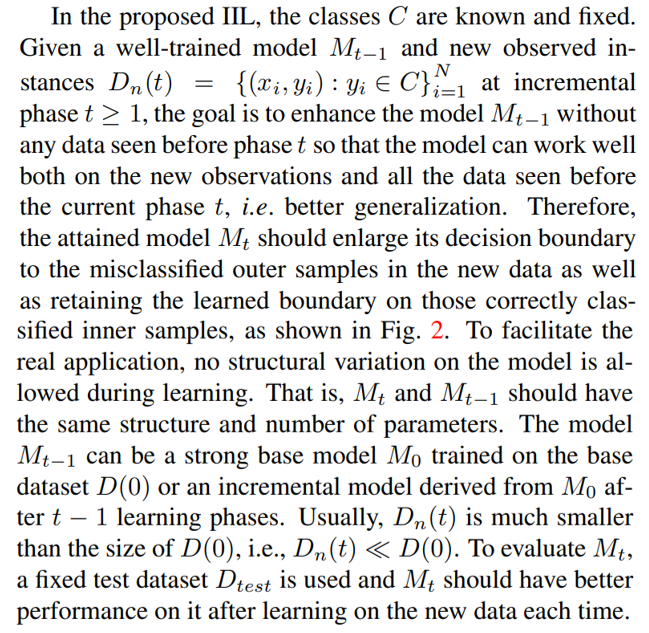
\ Figure 2. Decision boundaries (DB): (a) DB learned from old data and new data, respectively. With respect to the old DB, new data can be categorized into inner samples and outer samples. (b) ideal DB by jointly training on the old data and new data. (c) fine-tuning the model on the new data with one-hot labels suffers to CF. (d) learning with distillation on prototype exemplars causes overfitting to these exemplars and DB collapsing. (e) the DB achieved using our decision boundary-aware distillation (DBD).
\

:::info Authors:

(1) Qiang Nie, Hong Kong University of Science and Technology (Guangzhou);

(2) Weifu Fu, Tencent Youtu Lab;

(3) Yuhuan Lin, Tencent Youtu Lab;

(4) Jialin Li, Tencent Youtu Lab;

(5) Yifeng Zhou, Tencent Youtu Lab;

(6) Yong Liu, Tencent Youtu Lab;

(7) Qiang Nie, Hong Kong University of Science and Technology (Guangzhou);

(8) Chengjie Wang, Tencent Youtu Lab.

:::


:::info This paper is available on arxiv under CC BY-NC-ND 4.0 Deed (Attribution-Noncommercial-Noderivs 4.0 International) license.

:::

\

Sorumluluk Reddi: Bu sitede yeniden yayınlanan makaleler, halka açık platformlardan alınmıştır ve yalnızca bilgilendirme amaçlıdır. MEXC'nin görüşlerini yansıtmayabilir. Tüm hakları telif sahiplerine aittir. Herhangi bir içeriğin üçüncü taraf haklarını ihlal ettiğini düşünüyorsanız, kaldırılması için lütfen service@support.mexc.com ile iletişime geçin. MEXC, içeriğin doğruluğu, eksiksizliği veya güncelliği konusunda hiçbir garanti vermez ve sağlanan bilgilere dayalı olarak alınan herhangi bir eylemden sorumlu değildir. İçerik, finansal, yasal veya diğer profesyonel tavsiye niteliğinde değildir ve MEXC tarafından bir tavsiye veya onay olarak değerlendirilmemelidir.

Ayrıca Şunları da Beğenebilirsiniz

SEC issues investor guide on crypto wallets and custody risks

SEC issues investor guide on crypto wallets and custody risks

The SEC released a guide on crypto wallets and custody for investors.
Paylaş
Cryptopolitan2025/12/14 08:38
UK Looks to US to Adopt More Crypto-Friendly Approach

UK Looks to US to Adopt More Crypto-Friendly Approach

The post UK Looks to US to Adopt More Crypto-Friendly Approach appeared on BitcoinEthereumNews.com. The UK and US are reportedly preparing to deepen cooperation on digital assets, with Britain looking to copy the Trump administration’s crypto-friendly stance in a bid to boost innovation.  UK Chancellor Rachel Reeves and US Treasury Secretary Scott Bessent discussed on Tuesday how the two nations could strengthen their coordination on crypto, the Financial Times reported on Tuesday, citing people familiar with the matter.  The discussions also involved representatives from crypto companies, including Coinbase, Circle Internet Group and Ripple, with executives from the Bank of America, Barclays and Citi also attending, according to the report. The agreement was made “last-minute” after crypto advocacy groups urged the UK government on Thursday to adopt a more open stance toward the industry, claiming its cautious approach to the sector has left the country lagging in innovation and policy.  Source: Rachel Reeves Deal to include stablecoins, look to unlock adoption Any deal between the countries is likely to include stablecoins, the Financial Times reported, an area of crypto that US President Donald Trump made a policy priority and in which his family has significant business interests. The Financial Times reported on Monday that UK crypto advocacy groups also slammed the Bank of England’s proposal to limit individual stablecoin holdings to between 10,000 British pounds ($13,650) and 20,000 pounds ($27,300), claiming it would be difficult and expensive to implement. UK banks appear to have slowed adoption too, with around 40% of 2,000 recently surveyed crypto investors saying that their banks had either blocked or delayed a payment to a crypto provider.  Many of these actions have been linked to concerns over volatility, fraud and scams. The UK has made some progress on crypto regulation recently, proposing a framework in May that would see crypto exchanges, dealers, and agents treated similarly to traditional finance firms, with…
Paylaş
BitcoinEthereumNews2025/09/18 02:21