Aegis is an early-stage project aiming to build a stablecoin that does not rely on fiat currencies, oracles, or permissioned collateral.Aegis is an early-stage project aiming to build a stablecoin that does not rely on fiat currencies, oracles, or permissioned collateral.

A new paradigm for Bitcoin perpetual hedging: How does Aegis use short contracts to create a decentralized stablecoin YUSD?

2025/04/26 10:42

By Stacy Muur

Compiled by: Tim, PANews

We’ve seen fiat-backed stablecoins, and we’ve seen crypto-collateralized stablecoins, but Aegis is thinking differently: a Bitcoin-backed stablecoin.

Here’s why its design is bold and why it’s likely to succeed.
A new paradigm for Bitcoin perpetual hedging: How does Aegis use short contracts to create a decentralized stablecoin YUSD?

Most stablecoins today rely on a centralized system that Bitcoin was designed to avoid:

  • Fiat Currency Custody
  • Bank Liquidation
  • Regulatory constraints

Aegis took a different tack, choosing to build its system around Bitcoin rather than a bank.

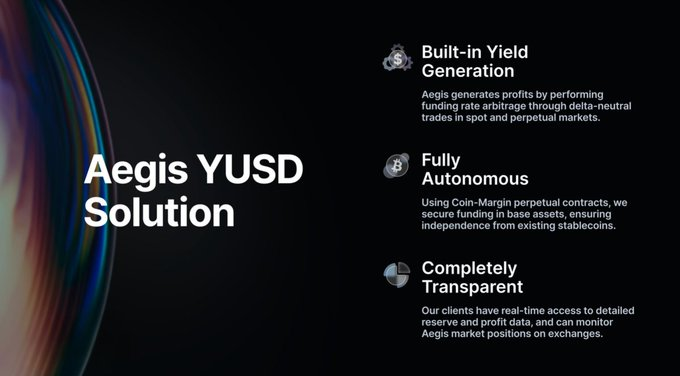
Aegis named its stablecoin YUSD:

  • Anchored to $1
  • Backed by Bitcoin Collateral
  • Maintain stability by shorting perpetual contracts

No oracle required, no currency reserve, no third-party intermediary
A new paradigm for Bitcoin perpetual hedging: How does Aegis use short contracts to create a decentralized stablecoin YUSD?

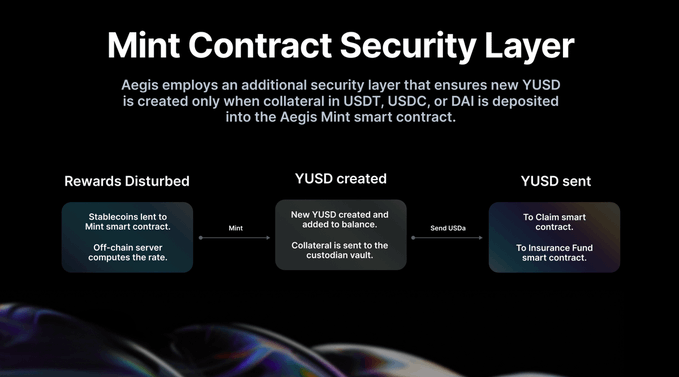
YUSD is only minted when stablecoins such as USDT, USDC or DAI are deposited into the Aegis Mint smart contract.

Once verified, YUSD will be generated and the corresponding collateral will be transferred to a secure custodial vault.

There is no off-chain casting switch, no human intervention, everything is controlled only by smart contract logic.
A new paradigm for Bitcoin perpetual hedging: How does Aegis use short contracts to create a decentralized stablecoin YUSD?

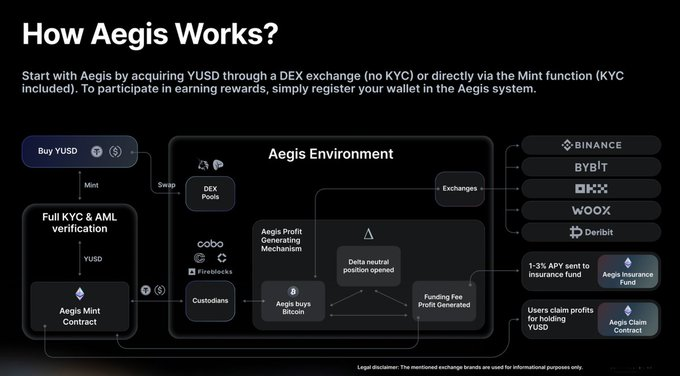
So, how does Aegis work end-to-end?

  1. You can use funds to mint or redeem (on-chain or decentralized exchanges) to obtain YUSD
  2. Aegis uses these funds to buy BTC
  3. Hedge against price volatility risk by opening a short perpetual contract
  4. Short positions earn funding rate income
  5. Profit distribution: part of it will be injected into the insurance pool, and part of it will be distributed to YUSD holders

This is the circulation mechanism of YUSD.
A new paradigm for Bitcoin perpetual hedging: How does Aegis use short contracts to create a decentralized stablecoin YUSD?

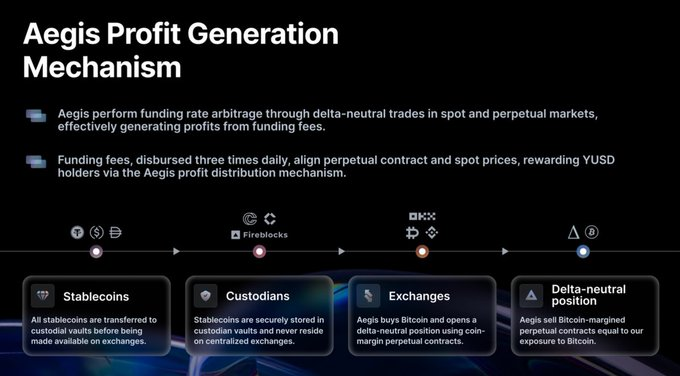
But where do these profits come from?

When Aegis shorts a Bitcoin perpetual contract, it profits from the funding rate paid by traders making bullish bets.

These fees will be charged three times per day as long as long demand exists.

This is not staking, and this is not inflation.

This is how opponent pressure is converted into profit.
A new paradigm for Bitcoin perpetual hedging: How does Aegis use short contracts to create a decentralized stablecoin YUSD?

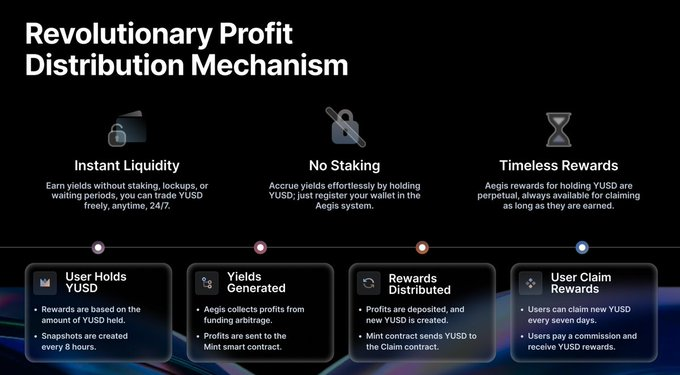
Aegis doesn't ask you to do anything extra.

Hold YUSD → Earn fees from Aegis → Snapshot record share → Generate rewards → Receive via APP

See, the profits come from the wind.
A new paradigm for Bitcoin perpetual hedging: How does Aegis use short contracts to create a decentralized stablecoin YUSD?

Aegis is built to be secure, reliable, independent and free from centralization risks and common single points of failure:

  • No legal currency backing
  • No USDC reserves
  • No oracle dependency

Bitcoin only, collateral hedging processing, over-the-counter holding, real-time monitoring.

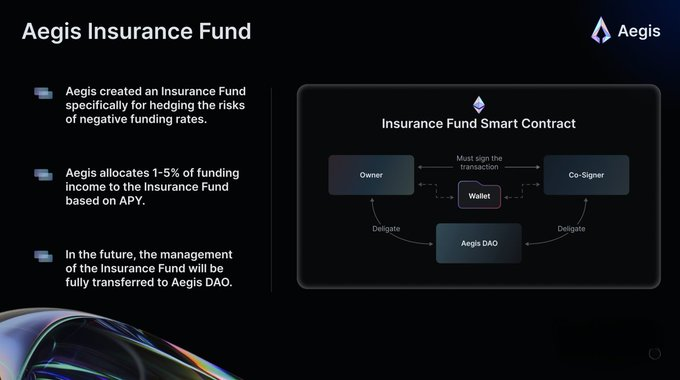
No yield model is perfect, especially one tied to the funding rate. So what happens if the funding rate turns negative?

Aegis has established an insurance fund for this purpose.

  • 1-5% of the proceeds will be transferred to the insurance fund
  • This fund is enabled when the funding rate turns negative and the cost of short selling increases.
  • Managed by multi-signature smart contracts
  • Subsequent control will be transferred to Aegis DAO
A new paradigm for Bitcoin perpetual hedging: How does Aegis use short contracts to create a decentralized stablecoin YUSD?

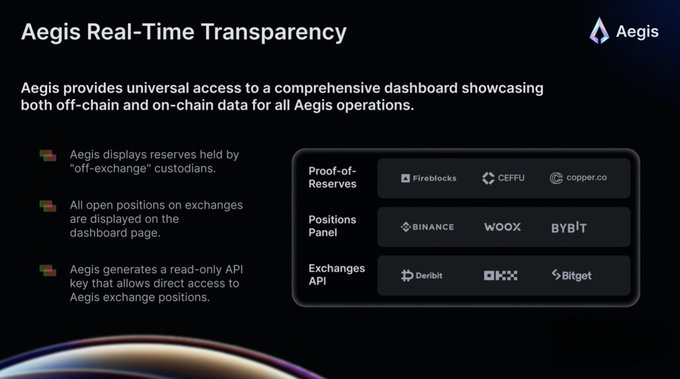
Aegis seems to be very focused on transparency:

  • Escrow reserves are verifiable
  • Exchange Position Disclosure
  • Read-only API exposes system status

You don't have to guess at its inner workings, but you can watch the results in real time.
A new paradigm for Bitcoin perpetual hedging: How does Aegis use short contracts to create a decentralized stablecoin YUSD?

The insurance fund is responsible for managing risks, while the Aaegis points system is responsible for driving growth. Users can earn points daily in the following ways:

  • Hold YUSD (earn 15 points per $1 per day)
  • Provide liquidity (30 points per $1 per day, 2x bonus)
  • Borrowing through Euler (45 points per day, 3x bonus)
  • Complete social tasks (50 points per task, 5 times bonus)

The product and service are now fully available on Ethereum and BNB chains.
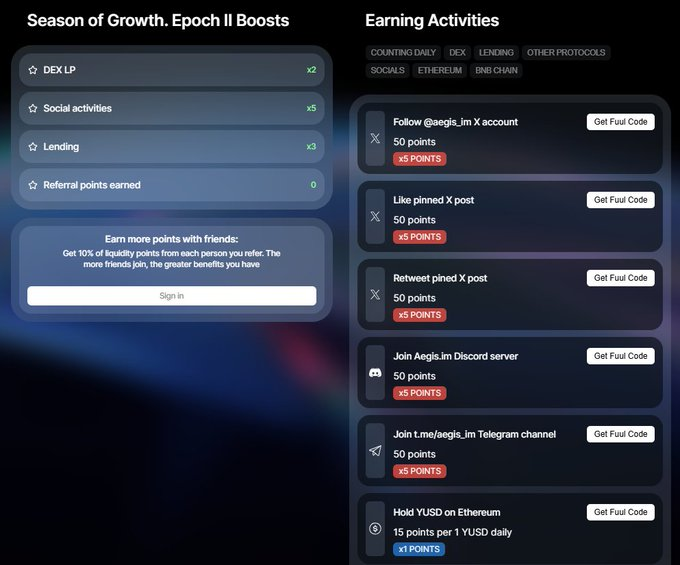
A new paradigm for Bitcoin perpetual hedging: How does Aegis use short contracts to create a decentralized stablecoin YUSD?

In Season 1, all points earnings will receive a 50% bonus, allowing early users to receive a higher proportion of AEG token rewards.

Excess Rewards: Euler integration unlocks a circular strategy - deposit YUSD → earn points → borrow stablecoins → repeat this process.

This maximizes your profits and multiplies your points.

Points are more than just numbers. Every week, 0.2% of the total AEG supply will be distributed based on your share of points.

No need to worry about airdrop delays or guess at distribution rules. ​​

Transparent and open, everything goes according to plan and is directly linked to the use of the protocol.

Aegis is an early-stage project aiming to build a stablecoin that does not rely on fiat currencies, oracles, or permissioned collateral.

It remains uncertain whether the model will remain valid in volatile markets or be scalable in real-world use cases.

But it is one of the clearest experiments yet in the design of a currency based on Bitcoin.

Sorumluluk Reddi: Bu sitede yeniden yayınlanan makaleler, halka açık platformlardan alınmıştır ve yalnızca bilgilendirme amaçlıdır. MEXC'nin görüşlerini yansıtmayabilir. Tüm hakları telif sahiplerine aittir. Herhangi bir içeriğin üçüncü taraf haklarını ihlal ettiğini düşünüyorsanız, kaldırılması için lütfen service@support.mexc.com ile iletişime geçin. MEXC, içeriğin doğruluğu, eksiksizliği veya güncelliği konusunda hiçbir garanti vermez ve sağlanan bilgilere dayalı olarak alınan herhangi bir eylemden sorumlu değildir. İçerik, finansal, yasal veya diğer profesyonel tavsiye niteliğinde değildir ve MEXC tarafından bir tavsiye veya onay olarak değerlendirilmemelidir.

Ayrıca Şunları da Beğenebilirsiniz

Aave DAO to Shut Down 50% of L2s While Doubling Down on GHO

Aave DAO to Shut Down 50% of L2s While Doubling Down on GHO

The post Aave DAO to Shut Down 50% of L2s While Doubling Down on GHO appeared on BitcoinEthereumNews.com. Aave DAO is gearing up for a significant overhaul by shutting down over 50% of underperforming L2 instances. It is also restructuring its governance framework and deploying over $100 million to boost GHO. This could be a pivotal moment that propels Aave back to the forefront of on-chain lending or sparks unprecedented controversy within the DeFi community. Sponsored Sponsored ACI Proposes Shutting Down 50% of L2s The “State of the Union” report by the Aave Chan Initiative (ACI) paints a candid picture. After a turbulent period in the DeFi market and internal challenges, Aave (AAVE) now leads in key metrics: TVL, revenue, market share, and borrowing volume. Aave’s annual revenue of $130 million surpasses the combined cash reserves of its competitors. Tokenomics improvements and the AAVE token buyback program have also contributed to the ecosystem’s growth. Aave global metrics. Source: Aave However, the ACI’s report also highlights several pain points. First, regarding the Layer-2 (L2) strategy. While Aave’s L2 strategy was once a key driver of success, it is no longer fit for purpose. Over half of Aave’s instances on L2s and alt-L1s are not economically viable. Based on year-to-date data, over 86.6% of Aave’s revenue comes from the mainnet, indicating that everything else is a side quest. On this basis, ACI proposes closing underperforming networks. The DAO should invest in key networks with significant differentiators. Second, ACI is pushing for a complete overhaul of the “friendly fork” framework, as most have been unimpressive regarding TVL and revenue. In some cases, attackers have exploited them to Aave’s detriment, as seen with Spark. Sponsored Sponsored “The friendly fork model had a good intention but bad execution where the DAO was too friendly towards these forks, allowing the DAO only little upside,” the report states. Third, the instance model, once a smart…
Paylaş
BitcoinEthereumNews2025/09/18 02:28
Shytoshi Kusama Addresses $2.4 Million Shibarium Bridge Exploit

Shytoshi Kusama Addresses $2.4 Million Shibarium Bridge Exploit

The post Shytoshi Kusama Addresses $2.4 Million Shibarium Bridge Exploit appeared on BitcoinEthereumNews.com. The lead developer of Shiba Inu, Shytoshi Kusama, has publicly addressed the Shibarium bridge exploit that occurred recently, draining $2.4 million from the network. After days of speculation about his involvement in managing the crisis, the project leader broke his silence. Kusama emphasized that a special “war room” has been set up to restore stolen finances and enhance network security. The statement is his first official words since the bridge compromise occurred. “Although I am focusing on AI initiatives to benefit all our tokens, I remain with the developers and leadership in the war room,” Kusama posted on social media platform X. He dismissed claims that he had distanced himself from the project as “utterly preposterous.” The developer said that the reason behind his silence at first was strategic. Before he could make any statements publicly, he must have taken time to evaluate what he termed a complex and deep situation properly. Kusama also vowed to provide further updates in the official Shiba Inu channels as the team comes up with long-term solutions. As highlighted in our previous article, targeted Shibarium’s bridge infrastructure through a sophisticated attack vector. Hackers gained unauthorized access to validator signing keys, compromising the network’s security framework. The hackers executed a flash loan to acquire 4.6 million BONE ShibaSwap tokens. The validator power on the network was majority held by them after this purchase. They were able to transfer assets out of Shibarium with this control. The response of Shibarium developers was timely to limit the breach. They instantly halted all validator functions in order to avoid additional exploitation. The team proceeded to deposit the assets under staking in a multisig hardware wallet that is secure. External security companies were involved in the investigation effort. Hexens, Seal 911, and PeckShield are collaborating with internal developers to…
Paylaş
BitcoinEthereumNews2025/09/18 03:46
