South Korean crypto investors sent ₩160 trillion (about $110 billion) to overseas exchanges during 2025, keeping trading activity high, according to a joint reportSouth Korean crypto investors sent ₩160 trillion (about $110 billion) to overseas exchanges during 2025, keeping trading activity high, according to a joint report

South Korean crypto traders sent $110 billion to overseas exchanges in 2025

South Korean crypto investors sent ₩160 trillion (about $110 billion) to overseas exchanges during 2025, keeping trading activity high, according to a joint report by CoinGecko and Tiger Research.

More than 10 million people in South Korea trade crypto, a small difference from the 14 million stock investors and equal to roughly 20% of the country’s entire population.

CoinGecko claims that Korean won-based trades often match or even surpass U.S. dollar volumes among global fiat pairs, an unusual and highly impressive position for a single national currency.
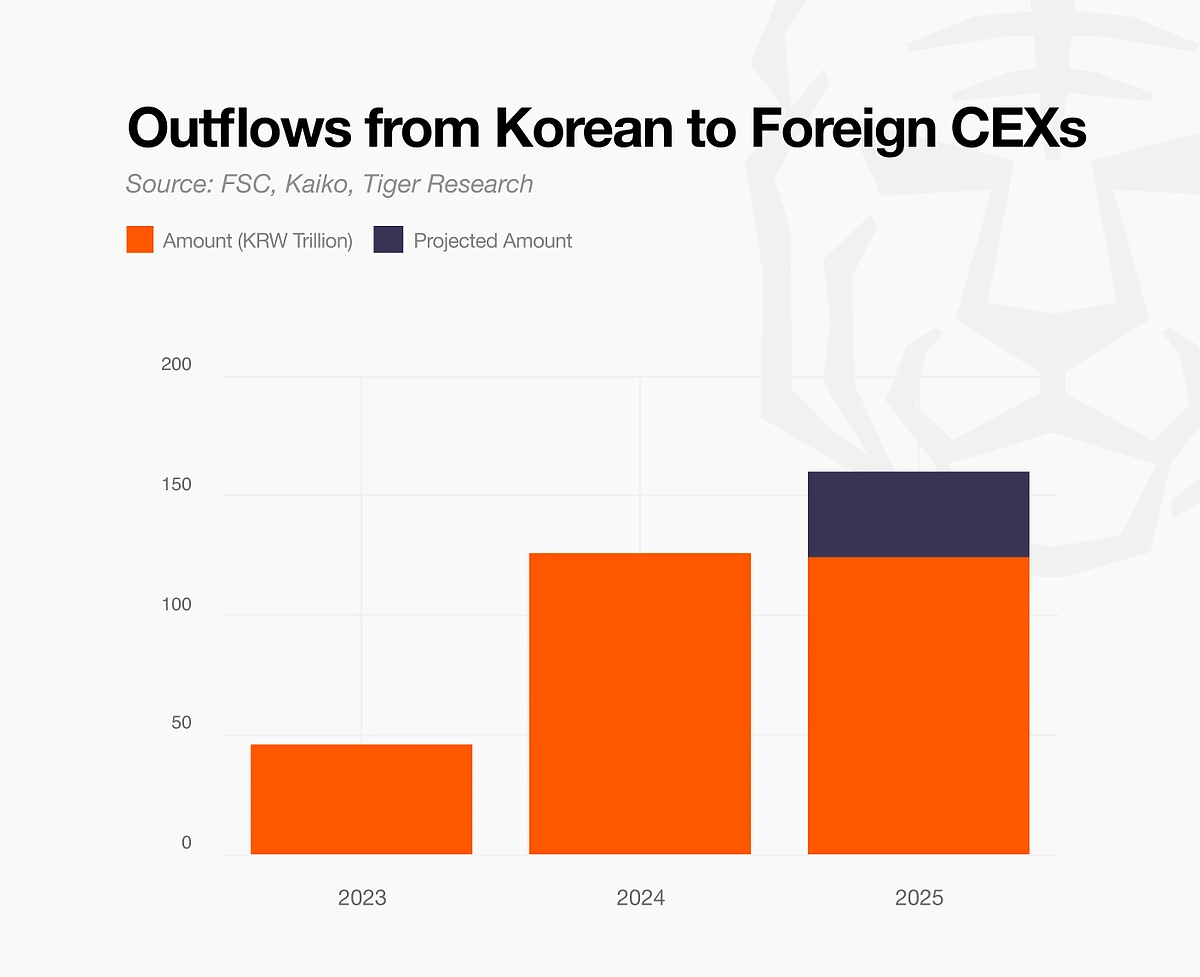
South Korean crypto investors send KRW 160 trillion ($110B) to overseas exchanges in 2025Source: Kaiko

Why are Korean investors redirecting trading activity from domestic exchanges to global platforms?

Between January and September 2025, around ₩124 trillion flowed out of Korean exchanges to overseas ones, nearly three times the outflows seen in 2023. According to the report, total outflows for the year were estimated at ₩160 trillion.

Moreover, the estimated 2025 fee income tied to Korean users reached about ₩2.73 trillion at Binance, ₩1.12 trillion at Bybit, ₩580 billion at OKX, ₩270 billion at Bitget, and ₩70 billion at Huobi, cumulatively making ₩4.77 trillion, or $3.36 billion, from Korean traders.

That sum equals 2.7 times the combined operating revenue of Upbit, Bithumb, Coinone, Korbit, and Gopax last year, which is ₩1.78 trillion, according to the report.

South Korean regulators have been increasing pressure on crypto markets

Regardless of the government’s restrictions, South Koreans moved ₩2.7 trillion from exchanges to personal wallets like MetaMask in the first half of 2025.

CoinGecko said:-

The report claims that its researchers combined exchange trading records with Arkham Intelligence and Dune, using both top-down and bottom-up methods. One approach allegedly relied on a benchmark showing Korean traders made up 13 percent of Binance volume in 2023, mostly in futures.

With Binance’s 2025 futures volume at $27.5 trillion, an average fee of 0.035 percent, and an exchange rate of ₩1,420, estimated annual fees ranged from ₩2.05 trillion under conservative assumptions to ₩3.417 trillion under aggressive ones.

The second method tracked real fund flows. About 57.7 percent of the ₩160 trillion outflow went to Binance, around ₩92.3 trillion. Korean investors held about ₩98.9 trillion in assets and traded roughly twice their holdings each month, or 24 times a year.

Futures trades on Binance occurred 2.3 times more often than spot trades and were 1.5 times larger, lifting volume by 3.52 times. Applying these figures produced an annual fee estimate of ₩2.73 trillion, according to CoinGecko.

The crypto market in South Korea has long leaned toward altcoins, which make up for 70% to 80% of domestic trading volume, far above the global average near 50%. Traders once made money buying small, volatile tokens early, even after their token generation events.

Join a premium crypto trading community free for 30 days - normally $100/mo.

Piyasa Fırsatı
Moonveil Logosu
Moonveil Fiyatı(MORE)
$0.002732
$0.002732$0.002732
-1.93%
USD
Moonveil (MORE) Canlı Fiyat Grafiği
Sorumluluk Reddi: Bu sitede yeniden yayınlanan makaleler, halka açık platformlardan alınmıştır ve yalnızca bilgilendirme amaçlıdır. MEXC'nin görüşlerini yansıtmayabilir. Tüm hakları telif sahiplerine aittir. Herhangi bir içeriğin üçüncü taraf haklarını ihlal ettiğini düşünüyorsanız, kaldırılması için lütfen service@support.mexc.com ile iletişime geçin. MEXC, içeriğin doğruluğu, eksiksizliği veya güncelliği konusunda hiçbir garanti vermez ve sağlanan bilgilere dayalı olarak alınan herhangi bir eylemden sorumlu değildir. İçerik, finansal, yasal veya diğer profesyonel tavsiye niteliğinde değildir ve MEXC tarafından bir tavsiye veya onay olarak değerlendirilmemelidir.

Ayrıca Şunları da Beğenebilirsiniz

The Channel Factories We’ve Been Waiting For

The Channel Factories We’ve Been Waiting For

The post The Channel Factories We’ve Been Waiting For appeared on BitcoinEthereumNews.com. Visions of future technology are often prescient about the broad strokes while flubbing the details. The tablets in “2001: A Space Odyssey” do indeed look like iPads, but you never see the astronauts paying for subscriptions or wasting hours on Candy Crush.  Channel factories are one vision that arose early in the history of the Lightning Network to address some challenges that Lightning has faced from the beginning. Despite having grown to become Bitcoin’s most successful layer-2 scaling solution, with instant and low-fee payments, Lightning’s scale is limited by its reliance on payment channels. Although Lightning shifts most transactions off-chain, each payment channel still requires an on-chain transaction to open and (usually) another to close. As adoption grows, pressure on the blockchain grows with it. The need for a more scalable approach to managing channels is clear. Channel factories were supposed to meet this need, but where are they? In 2025, subnetworks are emerging that revive the impetus of channel factories with some new details that vastly increase their potential. They are natively interoperable with Lightning and achieve greater scale by allowing a group of participants to open a shared multisig UTXO and create multiple bilateral channels, which reduces the number of on-chain transactions and improves capital efficiency. Achieving greater scale by reducing complexity, Ark and Spark perform the same function as traditional channel factories with new designs and additional capabilities based on shared UTXOs.  Channel Factories 101 Channel factories have been around since the inception of Lightning. A factory is a multiparty contract where multiple users (not just two, as in a Dryja-Poon channel) cooperatively lock funds in a single multisig UTXO. They can open, close and update channels off-chain without updating the blockchain for each operation. Only when participants leave or the factory dissolves is an on-chain transaction…
Paylaş
BitcoinEthereumNews2025/09/18 00:09
WHAT NOT TO MISS AT CES 2026

WHAT NOT TO MISS AT CES 2026

Innovators Show Up for the World’s Most Powerful Tech Event Returning to Las Vegas January 6-9 ARLINGTON, Va., Jan. 2, 2026 /PRNewswire/ — CES® 2026, the world’
Paylaş
AI Journal2026/01/03 02:31
The Role of Reference Points in Achieving Equilibrium Efficiency in Fair and Socially Just Economies

The Role of Reference Points in Achieving Equilibrium Efficiency in Fair and Socially Just Economies

This article explores how a simple change in the reference point can achieve a Pareto-efficient equilibrium in both free and fair economies and those with social justice.
Paylaş
Hackernoon2025/09/17 22:30