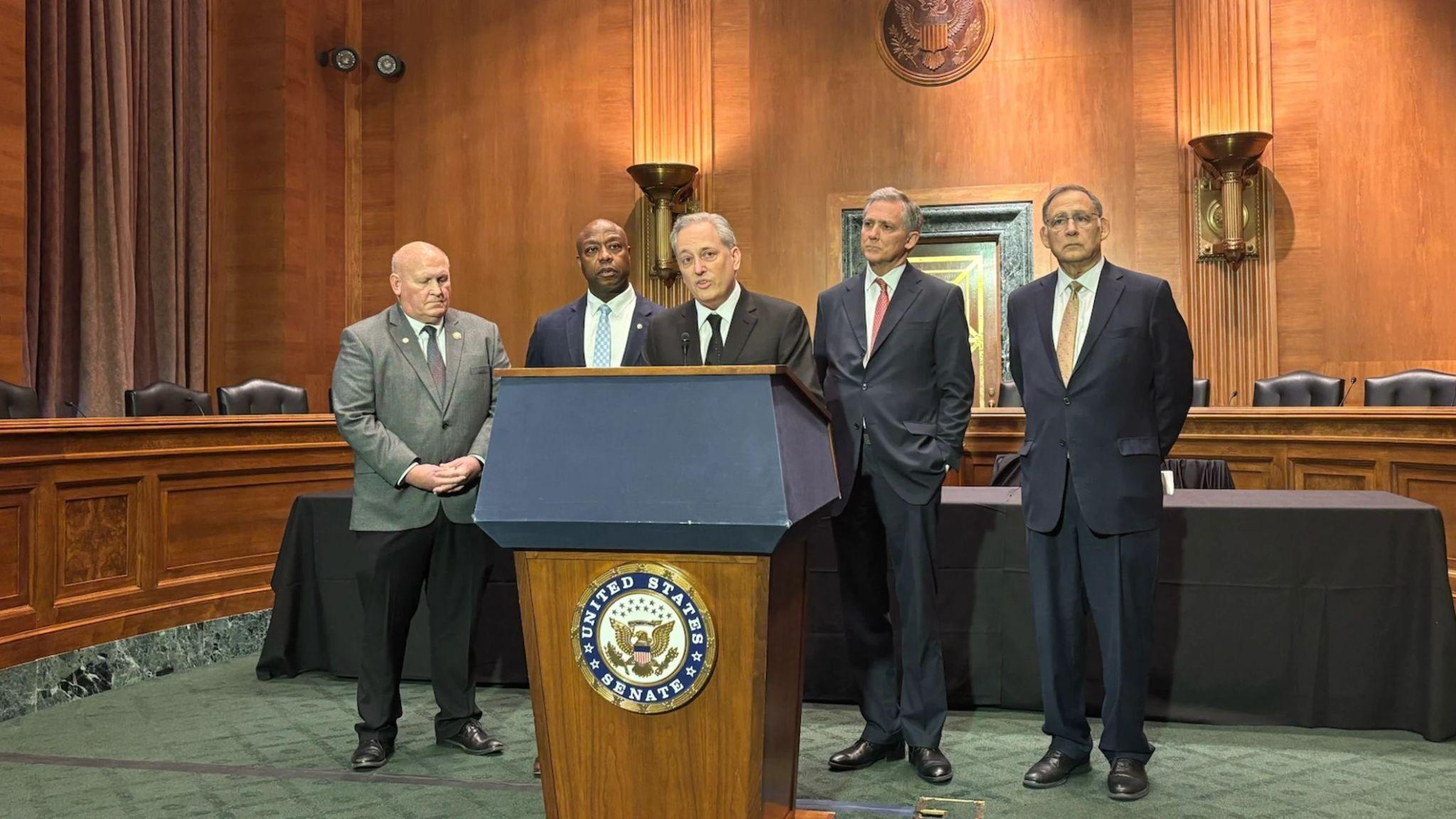
In the early morning of February 5, David Sacks, the White House artificial intelligence and cryptocurrency director, held the first press conference on digital assets with several U.S. congressional lawmakers on Capitol Hill, detailing the White House and Congress' latest plans to develop digital assets in the United States. Sacks said at the meeting that he looks forward to working with congressional lawmakers to "create a golden age for digital assets." He revealed that the Bitcoin reserve proposal is being evaluated, although it is still in its early stages.In the early morning of February 5, David Sacks, the White House artificial intelligence and cryptocurrency director, held the first press conference on digital assets with several U.S. congressional lawmakers on Capitol Hill, detailing the White House and Congress' latest plans to develop digital assets in the United States. Sacks said at the meeting that he looks forward to working with congressional lawmakers to "create a golden age for digital assets." He revealed that the Bitcoin reserve proposal is being evaluated, although it is still in its early stages.

Highlights of the first digital asset conference of the US "Crypto Tsar": Promoting market structure and stablecoin bills, and evaluating Bitcoin reserves
2025/02/05 19:57

Highlights of the first digital asset conference of the US "Crypto Tsar": Promoting market structure and stablecoin bills, and evaluating Bitcoin reserves

Author: Weilin, PANews

In the early morning of February 5th, Beijing time, David Sacks, the White House director of artificial intelligence and cryptocurrency, and several U.S. congressional lawmakers held their first press conference on digital assets on Capitol Hill, detailing the latest plans of the White House and Congress to implement the development of digital assets in the United States.

Sacks said at the meeting that he looks forward to working with congressional lawmakers to "create a golden age of digital assets." He revealed that the Bitcoin reserve proposal is being evaluated, although it is still in its early stages.

On the Securities and Exchange Commission (SEC), there are reports that the commission is reducing the team that was responsible for cryptocurrency enforcement actions and reassigning some lawyers, a move that marks a shift in the SEC's cryptocurrency regulation. At the same time, the SEC has launched a website for the cryptocurrency task force, and the head of the task force, Hester Peirce, has listed ten priority tasks, focusing on the classification and regulation of crypto assets.

David Sacks: Looking forward to "creating a golden age of digital assets" and evaluating Bitcoin reserve proposals

Sacks stressed at the launch event that he looks forward to working with Congress to “create a golden age for digital assets.” The event also featured Senate Banking Committee Chairman Tim Scott, Senate Agriculture Committee Chairman John Boozman, House Financial Services Committee Chairman French Hill, and House Agriculture Committee Chairman GT Thompson.

The committees are forming a bicameral committee to lead cryptocurrency regulation, planning to build on the market structure legislation "FIT21" bill passed by the House Financial Services Committee last year, and combine it with the new stablecoin bill released by Senator Bill Hagerty on February 4 to promote a new round of legislation. Senate Banking Committee Chairman Tim Scott said he plans to "do his best to actively" push these bills through the Senate within the first 100 days.

Sacks also confirmed that the President’s Digital Asset Task Force, established by Trump’s executive order, will first look at the feasibility of a Bitcoin reserve, but he noted that the initiative is still in its early stages as some members of the task force have yet to be confirmed.

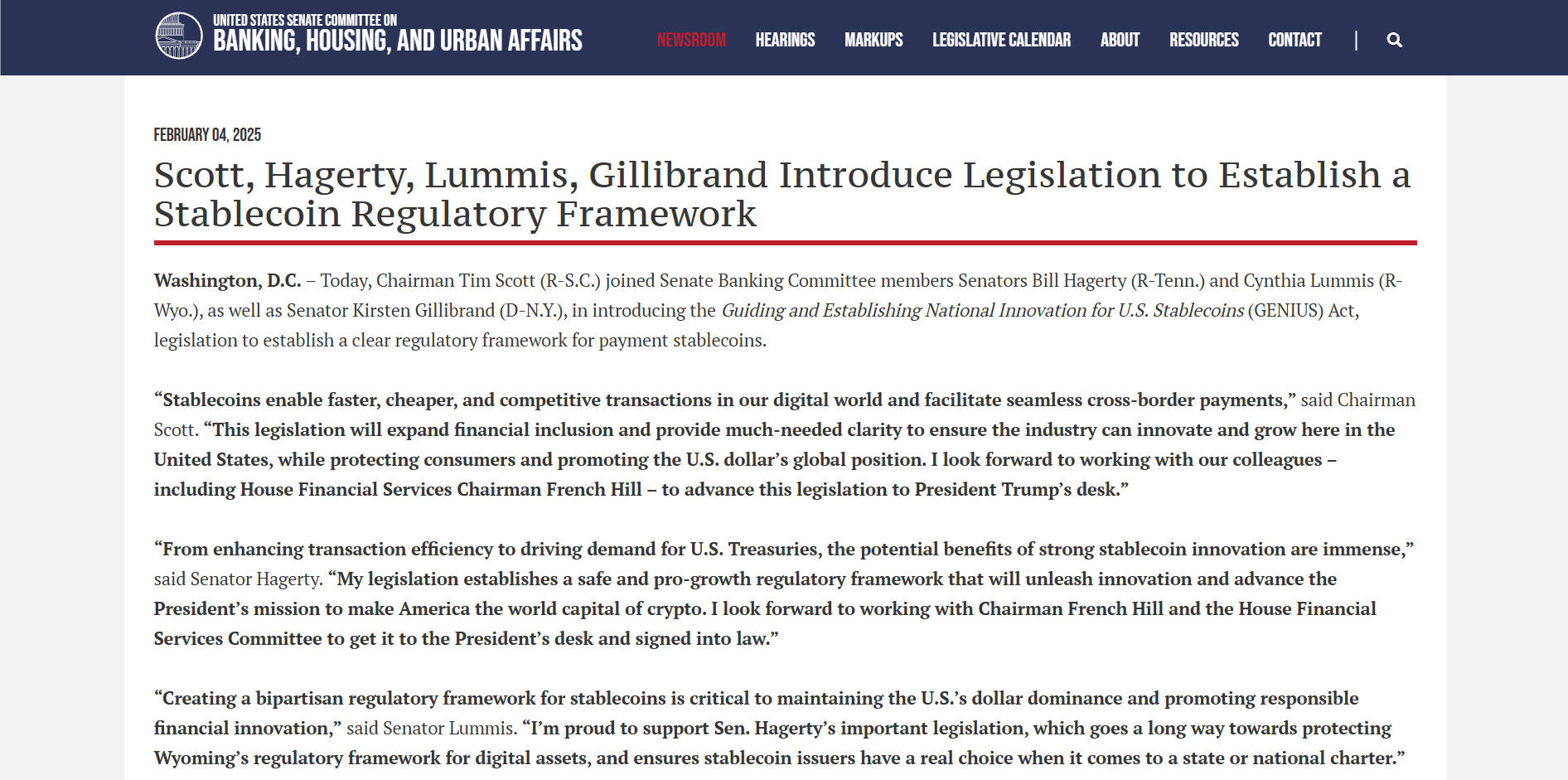
Senator Bill Hagerty Introduces New Stablecoin Bill GENIUS
Highlights of the first digital asset conference of the US "Crypto Tsar": Promoting market structure and stablecoin bills, and evaluating Bitcoin reserves

As mentioned above, on February 4, U.S. Senator Bill Hagerty proposed a bill to create a regulatory framework for stablecoins and bring tokens such as Tether and USDC under the Federal Reserve’s regulatory rules.

The stablecoin bill aims to create “a safe and pro-growth regulatory framework that unleashes the potential of innovation” and advance President Trump’s pledge to make the United States the “world capital of cryptocurrency.”

Hagerty’s “Guiding and Establishing a National Innovation for a United States Stablecoin (GENIUS) Act” is supported by Sen. Tim Scott, Sen. Kirsten Gillibrand, and Sen. Cynthia Lummis.

Hagerty added on the X platform that he looks forward to working with Rep. French Hill and the House Financial Services Committee to "get it to the president's desk and sign it into law."

Hagerty’s stablecoin bill revolves around a discussion draft he submitted for former Rep. Patrick McHenry’s Clarity for Payment Stablecoins Act, which he submitted last October.

The main contents of the GENIUS Act include:

  • Defines a payment stablecoin as a digital asset used for payment or settlement that is pegged to a fixed monetary value;
  • Establish clear procedures for institutions seeking licenses to issue stablecoins;
  • Implement reserve requirements for stablecoin issuers and set lightweight, tailored regulatory standards;
  • Adopt the Federal Reserve’s regulatory framework for depository institutions and the Office of the Comptroller of the Currency’s framework for non-bank issuers for stablecoin issuers with more than $10 billion in issuance;
  • Allowing state regulation of issuers with a market capitalization of less than $10 billion and providing an exemption process for issuers above that threshold to continue to be regulated by the state;
  • Establish a regulatory, inspection and enforcement mechanism with clear limits.

Tether (USDT) and Circle’s USD Coin (USDC) are the only two stablecoins with a market cap of more than $10 billion, according to data from CoinGecko.

Stablecoin issuers are also required to provide audited reserve reports on a monthly basis, and submitting false information could result in criminal penalties.

SEC launches crypto task force website to adjust regulatory strategy

On February 5, the New York Times reported that five people familiar with the matter revealed that the SEC has reduced a special team of more than 50 lawyers and staff members who were responsible for cryptocurrency enforcement actions. This move is one of the first concrete measures taken by Trump and his administration to reduce regulation of cryptocurrencies and other digital assets. One of Trump's first executive orders aims to promote the development of cryptocurrencies and "eliminate excessive regulation of digital assets."

Some lawyers on the cryptocurrency group are being assigned to other parts of the SEC, according to people familiar with the matter. A senior lawyer on the group was transferred out of the enforcement division.

Current SEC Acting Chairman Mark T. Uyeda made a series of appointments while reshuffling other top positions at the SEC. One of the first things Uyeda did upon taking office was to form a group to review the SEC’s approach to digital assets. The working group is led by SEC Commissioner and outspoken cryptocurrency supporter Hester Peirce.
Highlights of the first digital asset conference of the US "Crypto Tsar": Promoting market structure and stablecoin bills, and evaluating Bitcoin reserves

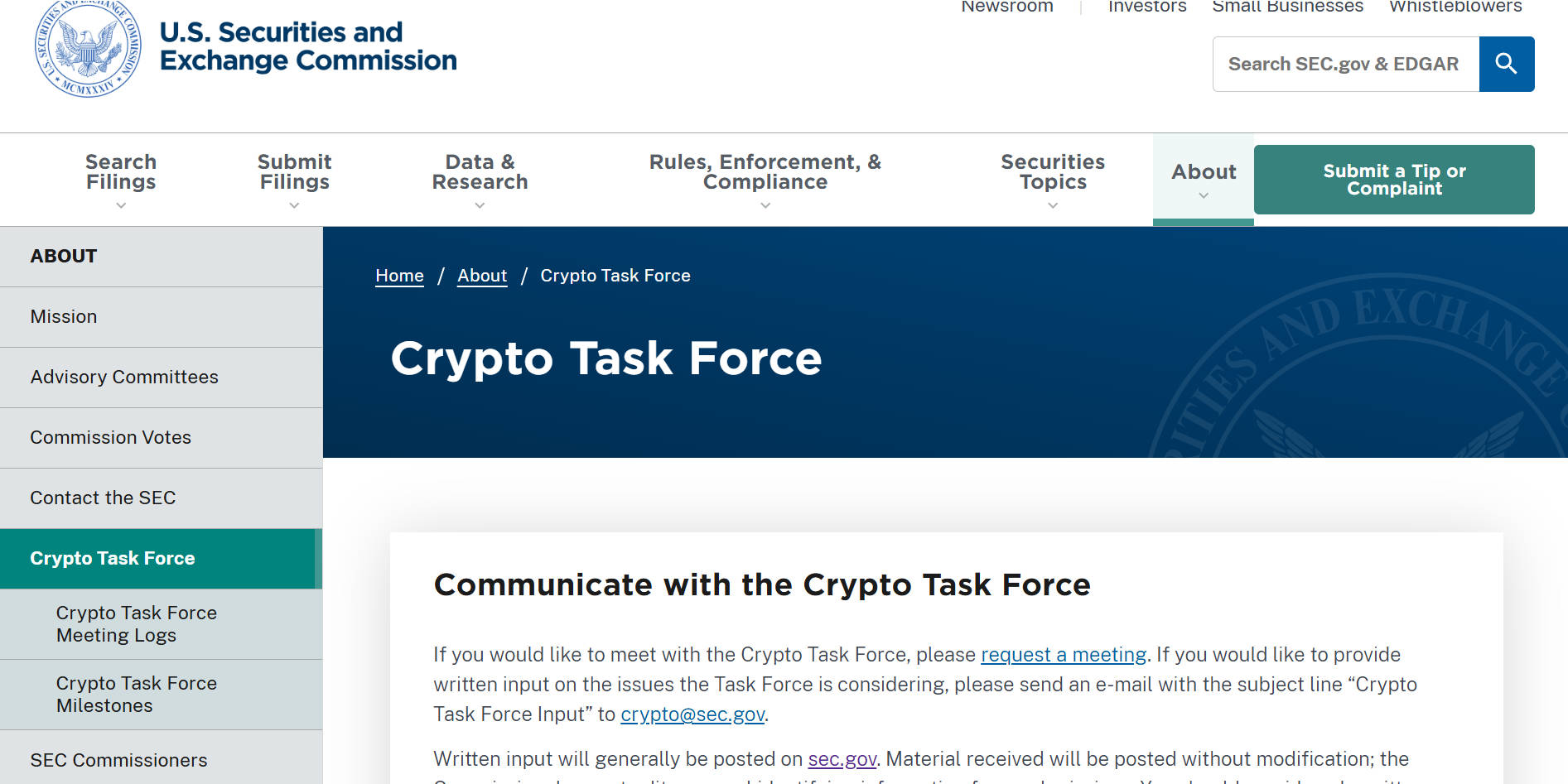
On February 4th local time, the U.S. Securities and Exchange Commission (SEC) launched the website page of the Cryptocurrency Task Force, listing the group's 10 priorities, including resolving the issue of what kind of cryptocurrencies are classified as securities rather than commodities, and creating a more "feasible" registration path by modifying the existing registration path of the U.S. Securities and Exchange Commission (SEC).

Other priorities include “clarifying whether crypto lending and staking programs are regulated by securities laws” and deciding which parts of the market fall outside the SEC’s jurisdiction.

At present, as the White House and the U.S. Congress work closely together to promote the development of digital assets, the legislative process of the United States in terms of cryptocurrency and stablecoin regulation is gradually accelerating. Although many proposals are still in the early stages, the framework around Bitcoin reserves and stablecoins is gradually taking shape. With the gradual adjustment of the SEC's crypto task force, whether the United States can lead crypto innovation globally is worth continuing to pay attention to.

Piyasa Fırsatı
Whiterock Logosu
Whiterock Fiyatı(WHITE)
$0.0001284
$0.0001284$0.0001284
-0.15%
USD
Whiterock (WHITE) Canlı Fiyat Grafiği
Sorumluluk Reddi: Bu sitede yeniden yayınlanan makaleler, halka açık platformlardan alınmıştır ve yalnızca bilgilendirme amaçlıdır. MEXC'nin görüşlerini yansıtmayabilir. Tüm hakları telif sahiplerine aittir. Herhangi bir içeriğin üçüncü taraf haklarını ihlal ettiğini düşünüyorsanız, kaldırılması için lütfen service@support.mexc.com ile iletişime geçin. MEXC, içeriğin doğruluğu, eksiksizliği veya güncelliği konusunda hiçbir garanti vermez ve sağlanan bilgilere dayalı olarak alınan herhangi bir eylemden sorumlu değildir. İçerik, finansal, yasal veya diğer profesyonel tavsiye niteliğinde değildir ve MEXC tarafından bir tavsiye veya onay olarak değerlendirilmemelidir.

Ayrıca Şunları da Beğenebilirsiniz

The Role of Blockchain in Building Safer Web3 Gaming Ecosystems

The Role of Blockchain in Building Safer Web3 Gaming Ecosystems

The gaming industry is in the midst of a historic shift, driven by the rise of Web3. Unlike traditional games, where developers and publishers control assets and dictate in-game economies, Web3 gaming empowers players with ownership and influence. Built on blockchain technology, these ecosystems are decentralized by design, enabling true digital asset ownership, transparent economies, and a future where players help shape the games they play. However, as Web3 gaming grows, security becomes a focal point. The range of security concerns, from hacking to asset theft to vulnerabilities in smart contracts, is a significant issue that will undermine or erode trust in this ecosystem, limiting or stopping adoption. Blockchain technology could be used to create security processes around secure, transparent, and fair Web3 gaming ecosystems. We will explore how security is increasing within gaming ecosystems, which challenges are being overcome, and what the future of security looks like. Why is Security Important in Web3 Gaming? Web3 gaming differs from traditional gaming in that players engage with both the game and assets with real value attached. Players own in-game assets that exist as tokens or NFTs (Non-Fungible Tokens), and can trade and sell them. These game assets usually represent significant financial value, meaning security failure could represent real monetary loss. In essence, without security, the promises of owning “something” in Web3, decentralized economies within games, and all that comes with the term “fair” gameplay can easily be eroded by fraud, hacking, and exploitation. This is precisely why the uniqueness of blockchain should be emphasized in securing Web3 gaming. How Blockchain Ensures Security in Web3 Gaming?
  1. Immutable Ownership of Assets Blockchain records can be manipulated by anyone. If a player owns a sword, skin, or plot of land as an NFT, it is verifiably in their ownership, and it cannot be altered or deleted by the developer or even hacked. This has created a proven track record of ownership, providing control back to the players, unlike any centralised gaming platform where assets can be revoked.
  2. Decentralized Infrastructure Blockchain networks also have a distributed architecture where game data is stored in a worldwide network of nodes, making them much less susceptible to centralised points of failure and attacks. This decentralised approach makes it exponentially more difficult to hijack systems or even shut off the game’s economy.
  3. Secure Transactions with Cryptography Whether a player buys an NFT or trades their in-game tokens for other items or tokens, the transactions are enforced by cryptographic algorithms, ensuring secure, verifiable, and irreversible transactions and eliminating the risks of double-spending or fraudulent trades.
  4. Smart Contract Automation Smart contracts automate the enforcement of game rules and players’ economic exchanges for the developer, eliminating the need for intermediaries or middlemen, and trust for the developer. For example, if a player completes a quest that promises a reward, the smart contract will execute and distribute what was promised.
  5. Anti-Cheating and Fair Gameplay The naturally transparent nature of blockchain makes it extremely simple for anyone to examine a specific instance of gameplay and verify the economic outcomes from that play. Furthermore, multi-player games that enforce smart contracts on things like loot sharing or win sharing can automate and measure trustlessness and avoid cheating, manipulations, and fraud by developers.
  6. Cross-Platform Security Many Web3 games feature asset interoperability across platforms. This interoperability is made viable by blockchain, which guarantees ownership is maintained whenever assets transition from one game or marketplace to another, thereby offering protection to players who rely on transfers for security against fraud. Key Security Dangers in Web3 Gaming Although blockchain provides sound first principles of security, the Web3 gaming ecosystem is susceptible to threats. Some of the most serious threats include:
Smart Contract Vulnerabilities: Smart contracts that are poorly written or lack auditing will leave openings for exploitation and thereby result in asset loss. Phishing Attacks: Unintentionally exposing or revealing private keys or signing transactions that are not possible to reverse, under the assumption they were genuine transaction requests. Bridge Hacks: Cross-chain bridges, which allow players to move their assets between their respective blockchains, continually face hacks, requiring vigilance from players and developers. Scams and Rug Pulls: Rug pulls occur when a game project raises money and leaves, leaving player assets worthless. Regulatory Ambiguity: Global regulations remain unclear; risks exist for players and developers alike. While blockchain alone won’t resolve every issue, it remediates the responsibility of the first principles, more so when joined by processes such as auditing, education, and the right governance, which can improve their contribution to the security landscapes in game ecosystems. Real Life Examples of Blockchain Security in Web3 Gaming Axie Infinity (Ronin Hack): The Axie Infinity game and several projects suffered one of the biggest hacks thus far on its Ronin bridge; however, it demonstrated the effectiveness of multi-sig security and the effective utilization of decentralization. The industry benefited through learning and reflection, thus, as projects have implemented changes to reduce the risks of future hacks or misappropriation. Immutable X: This Ethereum scaling solution aims to ensure secure NFT transactions for gaming, allowing players to trade an asset without the burden of exorbitant fees and fears of being a victim of fraud. Enjin: Enjin is providing a trusted infrastructure for Web3 games, offering secure NFT creation and transfer while reiterating that ownership and an asset securely belong to the player. These examples indubitably illustrate that despite challenges to overcome, blockchain remains the foundational layer on which to build more secure Web3 gaming environments. Benefits of Blockchain Security for Players and Developers For Players: Confidence in true ownership of assets Transparency in in-game economies Protection against nefarious trades/scams For Developers: More trust between players and the platform Less reliance on centralized infrastructure Ability to attract wealth and players based on provable fairness By incorporating blockchain security within the mechanics of game design, developers can create and enforce resilient ecosystems where players feel reassured in investing time, money, and ownership within virtual worlds. The Future of Secure Web3 Gaming Ecosystems As the wisdom of blockchain technology and industry knowledge improves, the future for secure Web3 gaming looks bright. New growing trends include: Zero-Knowledge Proofs (ZKPs): A new wave of protocols that enable private transactions and secure smart contracts while managing user privacy with an element of transparency. Decentralized Identity Solutions (DID): Helping players control their identities and decrease account theft risks. AI-Enhanced Security: Identifying irregularities in user interactions by sampling pattern anomalies to avert hacks and fraud by time-stamping critical events. Interoperable Security Standards: Allowing secured and seamless asset transfers across blockchains and games. With these innovations, blockchain will not only secure gaming assets but also enhance the overall trust and longevity of Web3 gaming ecosystems. Conclusion Blockchain is more than a buzzword in Web3; it is the only way to host security, fairness, and transparency. With blockchain, players confirm immutable ownership of digital assets, there is a decentralized infrastructure, and finally, it supports smart contracts to automate code that protects players and developers from the challenges of digital economies. The threats, vulnerabilities, and scams that come from smart contracts still persist, but the industry is maturing with better security practices, cross-chain solutions, and increased formal cryptographic tools. In the coming years, blockchain will remain the base to digital economies and drive Web3 gaming environments that allow players to safely own, trade, and enjoy their digital experiences free from fraud and exploitation. While blockchain and gaming alone entertain, we will usher in an era of secure digital worlds where trust complements innovation. The Role of Blockchain in Building Safer Web3 Gaming Ecosystems was originally published in Coinmonks on Medium, where people are continuing the conversation by highlighting and responding to this story
Paylaş
Medium2025/09/18 14:40
Will XRP Price Increase In September 2025?

Will XRP Price Increase In September 2025?

Ripple XRP is a cryptocurrency that primarily focuses on building a decentralised payments network to facilitate low-cost and cross-border transactions. It’s a native digital currency of the Ripple network, which works as a blockchain called the XRP Ledger (XRPL). It utilised a shared, distributed ledger to track account balances and transactions. What Do XRP Charts Reveal? […]
Paylaş
Tronweekly2025/09/18 00:00
Gold continues to hit new highs. How to invest in gold in the crypto market?

Gold continues to hit new highs. How to invest in gold in the crypto market?

As Bitcoin encounters a "value winter", real-world gold is recasting the iron curtain of value on the blockchain.
Paylaş
PANews2025/04/14 17:12