Unlock trillions with RWA tokenization in 2026: Explore real world assets on-chain, top platforms, and institutional-driven growth.Unlock trillions with RWA tokenization in 2026: Explore real world assets on-chain, top platforms, and institutional-driven growth.

How RWA Tokenization Is Bringing Trillions On-Chain in 2026
2026/01/13 15:15
Okuma süresi: 5 dk
How RWA Tokenization Is Bringing Trillions On-Chain in 2026

Trillions in traditional finance are shifting to blockchain in 2026, turning illiquid real world assets into highly tradable digital tokens. This is the power of RWA tokenization. With institutions leading the charge, tokenized assets are unlocking global liquidity like never before.

This is why tokenized RWAs are a growing market segment in the digital asset industry, with an increasing number of projects looking to tokenize a wide variety of assets, including cash, commodities, real estate, and much more.

Table of Content

  • What is RWA Tokenization?
  • Why RWA Tokenization Matters in 2026
  • Use Cases of RWA Tokenization
  • Top RWA Platforms and Projects in 2026
  • How RWA Tokenization Works
  • Common Questions about RWA Tokenization
  • Final Thoughts
  • About Onfinality

What is RWA Tokenization?

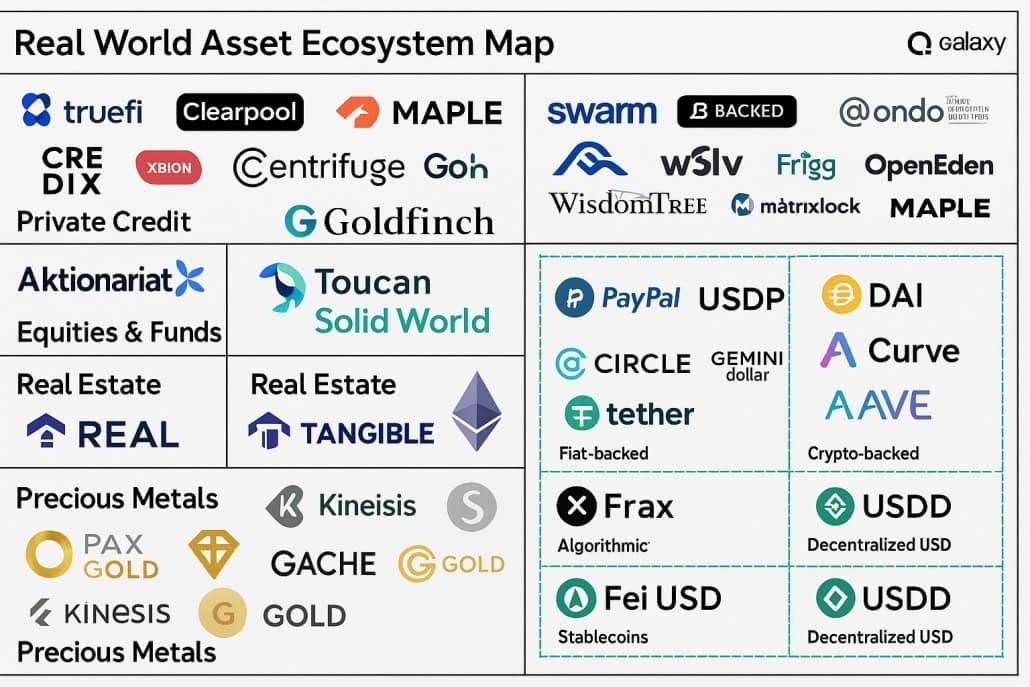
RWA tokenization is the process of representing real world assets, such as treasuries, real estate, private credit, or commodities, as digital tokens on a blockchain. These tokenized assets enable fractional ownership, instant transfers, and seamless DeFi integration while maintaining ties to off-chain legal frameworks.

In essence, on-chain tokenization bridges traditional finance with blockchain, making high-value assets accessible to a global audience without intermediaries.
How RWA Tokenization Is Bringing Trillions On-Chain in 2026Source: https://www.adventuresincre.com/real-estate-tokenization-part-ii-from-concept-to-execution/

Why RWA Tokenization Matters in 2026

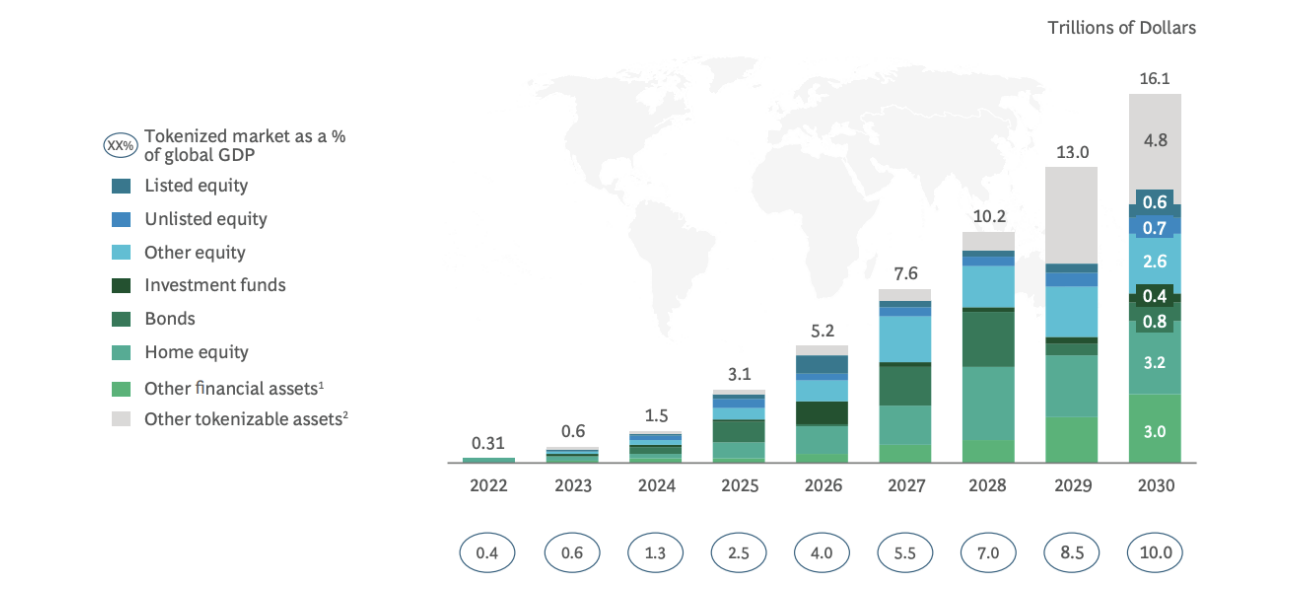
The market for tokenized assets is rapidly expanding. According to Binance Research, RWAs constitute the eighth-largest sector in decentralized finance (DeFi), with a Total Value Locked (TVL) of $1.3 billion as of September 2023. Moreover, the Boston Consulting Group projects that tokenized assets could represent a US$18.9 trillion market by 2033. Despite this promising growth, tokenized assets will still be a small fraction of the current global asset value, estimated at US$900 trillion. This projection underscores the immense potential for growth in the tokenization of RWAs, highlighting the importance of addressing existing challenges to fully capitalize on this emerging market. Despite their significant value globally, RWAs face challenges such as liquidity fragmentation, regulatory complexity, interoperability issues, and security concerns within traditional financial systems.
How RWA Tokenization Is Bringing Trillions On-Chain in 2026Source: https://mantrachain.io/resources/learn/rwa-tokenization-explained-why-it-matters-and-mantras-essential-role

Use Cases of RWA Tokenization

RWA tokenization transforms real world assets with:

  • Global Liquidity: 24/7 trading for traditionally locked assets.
  • Fractional Ownership: Invest in premium tokenized assets with minimal capital.
  • Transparency & Efficiency: Blockchain immutability plus DeFi yields.
  • Risk Mitigation: Enhanced by ratings from providers like Particula.

Popular use cases: 

  • Tokenized U.S. Treasuries (e.g., BlackRock's BUIDL, Ondo Finance).
  • Private credit and invoices (Centrifuge).
  • Emerging programs like Solana-based tokenization with risk ratings from Particula.
  • Fractional ownership of properties

Top RWA Platforms and Projects in 2026

The RWA market growth is powered by innovative platforms tokenizing diverse assets. Here are leading players:

  • Six network: Focuses on regulated asset tokenization infrastructure, particularly for compliant issuance and lifecycle management of RWAs.
  • Xcavate: Enables tokenized real estate and infrastructure assets, making traditionally illiquid property investments accessible on chain.
  • BlackRock's BUIDL: Dominant in tokenized Treasuries, with over $2 billion in AUM for institutional yields.
  • Ondo Finance: Leader in yield-bearing tokenized assets like U.S. Treasuries and bonds.
  • Centrifuge: Specializes in private credit and real-world invoices for DeFi lending.
  • Securitize: Institutional-grade tokenization for funds and equities.
  • Maple Finance: Undercollateralized lending with tokenized real-world credit.
  • Mantra: Compliant platform for tokenized securities and RWAs.
  • RealT: Focuses on tokenized real estate for fractional property ownership.
  • Particula: Provides independent risk ratings and monitoring, partnering on major initiatives like Solana tokenization programs.

These projects drive on-chain tokenization across treasuries, credit, real estate, and more. Track live data at RWA.xyz.

How RWA Tokenization Works

On-chain tokenization typically follows these steps:

  1. Asset Origination: Identify and legally structure the real world asset (e.g., via SPV).
  2. Token Minting: Issue blockchain tokens representing shares.
  3. Oracle & Data Integration: Use providers like Chainlink for pricing.
  4. Compliance & Rating: Add KYC and risk assessments (e.g., Particula's framework).
  5. Distribution: Launch on platforms for trading and DeFi use.

Examples: BlackRock's BUIDL tokenizes Treasuries for institutional yields; Centrifuge brings SME credit on-chain; RealT enables fractional real estate investment. Scalable networks are crucial. 

Common Questions about RWA Tokenization

What Are the Biggest Risks in Tokenized Assets?
Regulatory shifts, oracle failures, and counterparty risks. Platforms mitigate this with audited code and tools like Particula's real-time monitoring.

Where can I buy RWA tokens?
Some of the top Institutional Platforms for RWA Tokenization are Securitize, , RealT., Ondo, Centrifuge, Maple Finance, Franklin Templeton Benji Investments.

Always do your own research and due diligence before investing in any RWA assets.

Are tokenized assets legal and regulated?
The legality depends heavily on the jurisdiction and the nature of the underlying asset.

Final Thoughts 

RWA tokenization is fueling trillions on-chain through tokenized assets, with explosive RWA market growth and adoption of it by big institutions. 2026 is going to be a pivotal for RWA tokenization with regulations becoming clear across different geographies.

About Onfinality

OnFinality is a blockchain infrastructure platform that serves hundreds of billions of API requests monthly across more than 130 networks, including Avalanche, BNB Chain, Cosmos, Polkadot, Ethereum, and Polygon. It provides scalable APIs, RPC endpoints, node hosting, and indexing tools to help developers launch and grow blockchain networks efficiently. OnFinality’s mission is to make Web3 infrastructure effortless so developers can focus on building the future of decentralised applications.

App | Website | Twitter | Telegram | LinkedIn | YouTube

Sorumluluk Reddi: Bu sitede yeniden yayınlanan makaleler, halka açık platformlardan alınmıştır ve yalnızca bilgilendirme amaçlıdır. MEXC'nin görüşlerini yansıtmayabilir. Tüm hakları telif sahiplerine aittir. Herhangi bir içeriğin üçüncü taraf haklarını ihlal ettiğini düşünüyorsanız, kaldırılması için lütfen service@support.mexc.com ile iletişime geçin. MEXC, içeriğin doğruluğu, eksiksizliği veya güncelliği konusunda hiçbir garanti vermez ve sağlanan bilgilere dayalı olarak alınan herhangi bir eylemden sorumlu değildir. İçerik, finansal, yasal veya diğer profesyonel tavsiye niteliğinde değildir ve MEXC tarafından bir tavsiye veya onay olarak değerlendirilmemelidir.

Ayrıca Şunları da Beğenebilirsiniz

Facts Vs. Hype: Analyst Examines XRP Supply Shock Theory

Facts Vs. Hype: Analyst Examines XRP Supply Shock Theory

Prominent analyst Cheeky Crypto (203,000 followers on YouTube) set out to verify a fast-spreading claim that XRP’s circulating supply could “vanish overnight,” and his conclusion is more nuanced than the headline suggests: nothing in the ledger disappears, but the amount of XRP that is truly liquid could be far smaller than most dashboards imply—small enough, in his view, to set the stage for an abrupt liquidity squeeze if demand spikes. XRP Supply Shock? The video opens with the host acknowledging his own skepticism—“I woke up to a rumor that XRP supply could vanish overnight. Sounds crazy, right?”—before committing to test the thesis rather than dismiss it. He frames the exercise as an attempt to reconcile a long-standing critique (“XRP’s supply is too large for high prices”) with a rival view taking hold among prominent community voices: that much of the supply counted as “circulating” is effectively unavailable to trade. His first step is a straightforward data check. Pulling public figures, he finds CoinMarketCap showing roughly 59.6 billion XRP as circulating, while XRPScan reports about 64.7 billion. The divergence prompts what becomes the video’s key methodological point: different sources count “circulating” differently. Related Reading: Analyst Sounds Major XRP Warning: Last Chance To Get In As Accumulation Balloons As he explains it, the higher on-ledger number likely includes balances that aggregators exclude or treat as restricted, most notably Ripple’s programmatic escrow. He highlights that Ripple still “holds a chunk of XRP in escrow, about 35.3 billion XRP locked up across multiple wallets, with a nominal schedule of up to 1 billion released per month and unused portions commonly re-escrowed. Those coins exist and are accounted for on-ledger, but “they aren’t actually sitting on exchanges” and are not immediately available to buyers. In his words, “for all intents and purposes, that escrow stash is effectively off of the market.” From there, the analysis moves from headline “circulating supply” to the subtler concept of effective float. Beyond escrow, he argues that large strategic holders—banks, fintechs, or other whales—may sit on material balances without supplying order books. When you strip out escrow and these non-selling stashes, he says, “the effective circulating supply… is actually way smaller than the 59 or even 64 billion figure.” He cites community estimates in the “20 or 30 billion” range for what might be truly liquid at any given moment, while emphasizing that nobody has a precise number. That effective-float framing underpins the crux of his thesis: a potential supply shock if demand accelerates faster than fresh sell-side supply appears. “Price is a dance between supply and demand,” he says; if institutional or sovereign-scale users suddenly need XRP and “the market finds that there isn’t enough XRP readily available,” order books could thin out and prices could “shoot on up, sometimes violently.” His phrase “circulating supply could collapse overnight” is presented not as a claim that tokens are destroyed or removed from the ledger, but as a market-structure scenario in which available inventory to sell dries up quickly because holders won’t part with it. How Could The XRP Supply Shock Happen? On the demand side, he anchors the hypothetical to tokenization. He points to the “very early stages of something huge in finance”—on-chain tokenization of debt, stablecoins, CBDCs and even gold—and argues the XRP Ledger aims to be “the settlement layer” for those assets.He references Ripple CTO David Schwartz’s earlier comments about an XRPL pivot toward tokenized assets and notes that an institutional research shop (Bitwise) has framed XRP as a way to play the tokenization theme. In his construction, if “trillions of dollars in value” begin settling across XRPL rails, working inventories of XRP for bridging, liquidity and settlement could rise sharply, tightening effective float. Related Reading: XRP Bearish Signal: Whales Offload $486 Million In Asset To illustrate, he offers two analogies. First, the “concert tickets” model: you think there are 100,000 tickets (100B supply), but 50,000 are held by the promoter (escrow) and 30,000 by corporate buyers (whales), leaving only 20,000 for the public; if a million people want in, prices explode. Second, a comparison to Bitcoin’s halving: while XRP has no programmatic halving, he proposes that a sudden adoption wave could function like a de facto halving of available supply—“XRP’s version of a halving could actually be the adoption event.” He also updates the narrative context that long dogged XRP. Once derided for “too much supply,” he argues the script has “totally flipped.” He cites the current cycle’s optics—“XRP is sitting above $3 with a market cap north of around $180 billion”—as evidence that raw supply counts did not cap price as tightly as critics claimed, and as a backdrop for why a scarcity narrative is gaining traction. Still, he declines to publish targets or timelines, repeatedly stressing uncertainty and risk. “I’m not a financial adviser… cryptocurrencies are highly volatile,” he reminds viewers, adding that tokenization could take off “on some other platform,” unfold more slowly than enthusiasts expect, or fail to get to “sudden shock” scale. The verdict he offers is deliberately bound. The theory that “XRP supply could vanish overnight” is imprecise on its face; the ledger will not erase coins. But after examining dashboard methodologies, escrow mechanics and the behavior of large holders, he concludes that the effective float could be meaningfully smaller than headline supply figures, and that a fast-developing tokenization use case could, under the right conditions, stress that float. “Overnight is a dramatic way to put it,” he concedes. “The change could actually be very sudden when it comes.” At press time, XRP traded at $3.0198. Featured image created with DALL.E, chart from TradingView.com
Paylaş
NewsBTC2025/09/18 11:00
US and UK Set to Seal Landmark Crypto Cooperation Deal

US and UK Set to Seal Landmark Crypto Cooperation Deal

The United States and the United Kingdom are preparing to announce a new agreement on digital assets, with a focus on stablecoins, following high-level talks between senior officials and major industry players.
Paylaş
Cryptodaily2025/09/18 00:49
Dogecoin ETF Set to Go Live Today

Dogecoin ETF Set to Go Live Today

The post Dogecoin ETF Set to Go Live Today appeared on BitcoinEthereumNews.com. Altcoins 18 September 2025 | 09:35 The U.S. market is about to see a first-of-its-kind moment in crypto investing. Beginning September 18, investors are expected to be able to buy exchange-traded funds (ETFs) tied directly to XRP and Dogecoin, bringing two of the most recognizable digital assets into mainstream brokerage accounts. The products — the REX-Osprey XRP ETF (XRPR) and REX-Osprey Dogecoin ETF (DOJE) — are being launched through a partnership between REX Shares and Osprey Funds. It marks the first time spot XRP and spot DOGE exposure will be available in ETF form for U.S. traders, a move that analysts describe as historic for the broader digital asset space. Industry voices quickly highlighted the importance of the rollout. ETF Store President Nate Geraci noted that the launch not only introduces the first Dogecoin ETF but also finally delivers spot XRP access for traditional investors. Bloomberg ETF analysts Eric Balchunas and James Seyffart confirmed that trading will begin September 18, following a brief delay from the original timeline. Both ETFs are housed under a single prospectus that also covers planned funds for TRUMP and BONK, though those launches have yet to receive confirmed dates. By wrapping these tokens in an ETF structure, investors will no longer need to navigate crypto exchanges or wallets to gain exposure — instead, access will be as simple as purchasing shares through a brokerage account. The arrival of these products could set the stage for a wave of new altcoin-based ETFs, expanding the landscape beyond Bitcoin and Ethereum and opening the door to mainstream adoption of other popular tokens. Author Alexander Zdravkov is a person who always looks for the logic behind things. He is fluent in German and has more than 3 years of experience in the crypto space, where he skillfully identifies new…
Paylaş
BitcoinEthereumNews2025/09/18 14:38