Explore how a Web3 neobank with a crypto payment card unlocks onchain payments, stablecoin spending, and defi yield accounts for everyday users.Explore how a Web3 neobank with a crypto payment card unlocks onchain payments, stablecoin spending, and defi yield accounts for everyday users.

The Rise of the Web3 Neobank: A New Narrative for Crypto Payment Cards
2025/11/19 21:54
Okuma süresi: 6 dk

The Rise of the Web3 Neobank: A New Narrative for Crypto Payment Cards

Crypto finance is entering a new phase where banking looks nothing like traditional systems. The shift toward a Web3 neobank model is making everyday spending with a crypto payment card as effortless as online banking. These platforms fuse digital assets and fiat into one seamless interface, letting users manage crypto, stablecoins, and fiat side by side. These platforms also enable a global experience where users can have the same banking experience no matter where they are.

Table of Contents

  • What Is Web3 Neobanking?
  • How Are Web3 Neobanks Different?
  • Key Features and Use Cases
  • How Crypto Payment Cards Work
  • Leading Examples of Web3 Neobanks
  • Common Questions About Web3 Neobanks
  • Summary
  • About OnFinality

What Is Web3 Neobanking?

A neobank is a digital-only bank that operates entirely online without physical branches, offering services through apps and websites. They provide a range of financial services like accounts, loans, and payments, often with a focus on convenience, lower fees, and faster service compared to traditional banks. Web3 neobanks take this further by being crypto native. They often offer non custodial wallets, smooth fiat on ramps and off ramps, and instant spending backed by your on-chain funds.

Users can hold, spend, and earn with crypto inside one app. Many platforms integrate non custodial wallet options or multi sig setups so users keep control of their own keys. Others connect crypto balances directly to debit cards, allowing instant conversion at the point of sale.

The Web3 neobank experience includes:

  • Stablecoin deposits
  • Crypto and fiat accounts in one place
  • Yield earning options
  • Crypto payment cards for daily spending
  • Wallet integration for on-chain activities

This model blends fintech convenience with Web3 freedom.

How are Web3 Neobanks different?

The demand for a crypto first banking experience is rising fast. There are many factors, some of them being:

  1. Control over assets: Web3 Neobanks helps users by giving them the options to manage their funds on their own. They can have funds in their own wallets and choose to spend without having restrictions on their account.
  2. Rise of Stablecoins: Stablecoins like USDC and USDT continue to dominate global crypto settlements and cross border payments. Their increasing adoption enables stablecoin debit cards that let users spend value instantly without bank intermediaries. This is specially beneficial for people present in unstable economies.
  3. Global Demand for Multi Currency Access: Remote work, cross border freelancing, and global business networks have created demand for multi currency crypto wallets with instant conversion and low fees.
  4. Ease of Banking: Users get the benefit of DeFi yield accounts integrated directly into their everyday spending enabling them to earn on their deposits. Also, Visa and Mastercard have expanded partnerships with Web3 providers, enabling millions of merchants worldwide to accept payments funded by crypto.

Key Features and Use Cases

Core Features

  • Web3 wallet access for full asset control
  • Stablecoin debit cards for global spending
  • Fiat plus crypto balances in the same dashboard
  • Defi yield accounts to earn on idle funds
  • Multi currency crypto wallets with instant swaps
  • Onchain payments through Visa or Mastercard integrations
  • Cross chain transfers across supported networks

Use Cases

  • Pay rent or groceries using a crypto payment card
  • Earn staking rewards while maintaining liquidity for spending
  • Receive payments in stablecoins but spend in local currency
  • Borrow against crypto collateral and load spending balance instantly
  • Run Web3 businesses with multi user corporate cards

How Crypto Payment Cards Work?

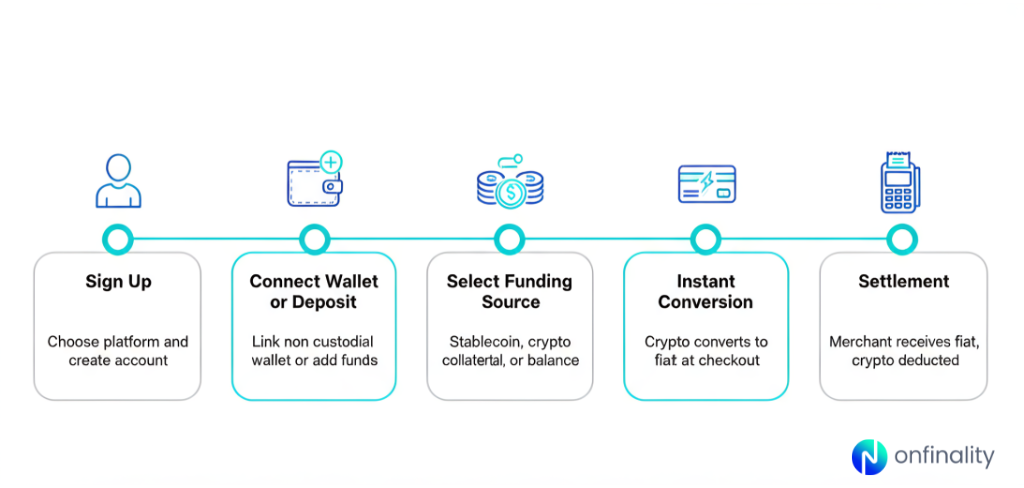
While each platform differs slightly, most Web3 neobanks follow a simple flow:

Step 1: Choose your NeoBank

Choose your banking provider and create and account and do KYC(depends on the platform)

Step 2: Connect Wallet or Deposit Funds

Connect a non custodial wallet or deposit fiat or stablecoins.

Step 3: Select Funding Source

Choose which asset funds the card: stablecoin, crypto collateral, or a pre-loaded balance.

Step 4: Payment Conversion

When users swipe their card, the platform instantly converts on-hain assets into fiat at the point of sale.

Step 5: Settlement and Fees

Merchants receive fiat and users see the crypto equivalent deducted from their wallet or vault.

Optional Features

  • Borrowing against crypto without selling (Ether.fi, Moonwell)
  • Auto reload from defi vaults
  • ATM withdrawals using stablecoins
The Rise of the Web3 Neobank: A New Narrative for Crypto Payment Cards

Leading Examples of Web3 Neobanks

Below is your existing content reorganised and lightly refined.

KAST

KAST offers stablecoin based accounts with virtual and physical cards for instant global spending. Users deposit USDC or other stablecoins and use the card like a normal Visa card. It also provides multi chain wallets and decentralized ID login.

Ether.fi

Ether.fi has expanded from Ethereum staking to a full DeFi neobank with a Visa card funded by crypto collateral. Users keep their ETH staked while spending in fiat.

Revolut

Revolut has evolved from a fintech neobank into a crypto friendly super app. Users can buy, sell, or hold over 130 assets and spend them instantly via debit card.

Crypto.com

Crypto.com provides debit cards with up to 5 percent cashback for users who stake CRO tokens. It supports 19 cryptocurrencies and over 20 fiat currencies for spending.

CypherHQ

Cypher is a non custodial wallet plus debit card that supports 500 plus tokens across 18 blockchains. Users remain in full control of funds while spending at over 40 million merchants.

Moonwell Card

Moonwell Card enables users to borrow against their crypto and spend globally without selling assets. It works with Apple Pay and Google Pay.

Common Questions about Web3 Neobanks

Are Web3 neobanks safe to use?

Most platforms use audited smart contracts, custodial and non custodial wallets, and regulatory compliance. Always review custody models and licenses.

Can I make onchain payments anywhere?

If the platform supports Visa or Mastercard, you can pay at most global merchants even though the value originates from crypto.

Do crypto payment cards trigger taxes?

Spending crypto may count as a disposal event in some countries. Users should check local tax rules.

Summary

A Web3 neobank blends the familiarity of a digital bank with the power of blockchain. With tools like crypto payment cards, stablecoin debit cards, defi yield accounts, and non custodial wallet access, users can spend, save, and earn entirely on-chain.

This financial model is unlocking a future where banking is global, open, and crypto native.

About OnFinality

OnFinality is a blockchain infrastructure platform that serves hundreds of billions of API requests monthly across more than 130 networks, including Avalanche, BNB Chain, Cosmos, Polkadot, Ethereum, and Polygon. It provides scalable APIs, RPC endpoints, node hosting, and indexing tools to help developers launch and grow blockchain networks efficiently. OnFinality’s mission is to make Web3 infrastructure effortless so developers can focus on building the future of decentralised applications.

App | Website | Twitter | Telegram | LinkedIn | YouTube

Sorumluluk Reddi: Bu sitede yeniden yayınlanan makaleler, halka açık platformlardan alınmıştır ve yalnızca bilgilendirme amaçlıdır. MEXC'nin görüşlerini yansıtmayabilir. Tüm hakları telif sahiplerine aittir. Herhangi bir içeriğin üçüncü taraf haklarını ihlal ettiğini düşünüyorsanız, kaldırılması için lütfen service@support.mexc.com ile iletişime geçin. MEXC, içeriğin doğruluğu, eksiksizliği veya güncelliği konusunda hiçbir garanti vermez ve sağlanan bilgilere dayalı olarak alınan herhangi bir eylemden sorumlu değildir. İçerik, finansal, yasal veya diğer profesyonel tavsiye niteliğinde değildir ve MEXC tarafından bir tavsiye veya onay olarak değerlendirilmemelidir.

Ayrıca Şunları da Beğenebilirsiniz

Facts Vs. Hype: Analyst Examines XRP Supply Shock Theory

Facts Vs. Hype: Analyst Examines XRP Supply Shock Theory

Prominent analyst Cheeky Crypto (203,000 followers on YouTube) set out to verify a fast-spreading claim that XRP’s circulating supply could “vanish overnight,” and his conclusion is more nuanced than the headline suggests: nothing in the ledger disappears, but the amount of XRP that is truly liquid could be far smaller than most dashboards imply—small enough, in his view, to set the stage for an abrupt liquidity squeeze if demand spikes. XRP Supply Shock? The video opens with the host acknowledging his own skepticism—“I woke up to a rumor that XRP supply could vanish overnight. Sounds crazy, right?”—before committing to test the thesis rather than dismiss it. He frames the exercise as an attempt to reconcile a long-standing critique (“XRP’s supply is too large for high prices”) with a rival view taking hold among prominent community voices: that much of the supply counted as “circulating” is effectively unavailable to trade. His first step is a straightforward data check. Pulling public figures, he finds CoinMarketCap showing roughly 59.6 billion XRP as circulating, while XRPScan reports about 64.7 billion. The divergence prompts what becomes the video’s key methodological point: different sources count “circulating” differently. Related Reading: Analyst Sounds Major XRP Warning: Last Chance To Get In As Accumulation Balloons As he explains it, the higher on-ledger number likely includes balances that aggregators exclude or treat as restricted, most notably Ripple’s programmatic escrow. He highlights that Ripple still “holds a chunk of XRP in escrow, about 35.3 billion XRP locked up across multiple wallets, with a nominal schedule of up to 1 billion released per month and unused portions commonly re-escrowed. Those coins exist and are accounted for on-ledger, but “they aren’t actually sitting on exchanges” and are not immediately available to buyers. In his words, “for all intents and purposes, that escrow stash is effectively off of the market.” From there, the analysis moves from headline “circulating supply” to the subtler concept of effective float. Beyond escrow, he argues that large strategic holders—banks, fintechs, or other whales—may sit on material balances without supplying order books. When you strip out escrow and these non-selling stashes, he says, “the effective circulating supply… is actually way smaller than the 59 or even 64 billion figure.” He cites community estimates in the “20 or 30 billion” range for what might be truly liquid at any given moment, while emphasizing that nobody has a precise number. That effective-float framing underpins the crux of his thesis: a potential supply shock if demand accelerates faster than fresh sell-side supply appears. “Price is a dance between supply and demand,” he says; if institutional or sovereign-scale users suddenly need XRP and “the market finds that there isn’t enough XRP readily available,” order books could thin out and prices could “shoot on up, sometimes violently.” His phrase “circulating supply could collapse overnight” is presented not as a claim that tokens are destroyed or removed from the ledger, but as a market-structure scenario in which available inventory to sell dries up quickly because holders won’t part with it. How Could The XRP Supply Shock Happen? On the demand side, he anchors the hypothetical to tokenization. He points to the “very early stages of something huge in finance”—on-chain tokenization of debt, stablecoins, CBDCs and even gold—and argues the XRP Ledger aims to be “the settlement layer” for those assets.He references Ripple CTO David Schwartz’s earlier comments about an XRPL pivot toward tokenized assets and notes that an institutional research shop (Bitwise) has framed XRP as a way to play the tokenization theme. In his construction, if “trillions of dollars in value” begin settling across XRPL rails, working inventories of XRP for bridging, liquidity and settlement could rise sharply, tightening effective float. Related Reading: XRP Bearish Signal: Whales Offload $486 Million In Asset To illustrate, he offers two analogies. First, the “concert tickets” model: you think there are 100,000 tickets (100B supply), but 50,000 are held by the promoter (escrow) and 30,000 by corporate buyers (whales), leaving only 20,000 for the public; if a million people want in, prices explode. Second, a comparison to Bitcoin’s halving: while XRP has no programmatic halving, he proposes that a sudden adoption wave could function like a de facto halving of available supply—“XRP’s version of a halving could actually be the adoption event.” He also updates the narrative context that long dogged XRP. Once derided for “too much supply,” he argues the script has “totally flipped.” He cites the current cycle’s optics—“XRP is sitting above $3 with a market cap north of around $180 billion”—as evidence that raw supply counts did not cap price as tightly as critics claimed, and as a backdrop for why a scarcity narrative is gaining traction. Still, he declines to publish targets or timelines, repeatedly stressing uncertainty and risk. “I’m not a financial adviser… cryptocurrencies are highly volatile,” he reminds viewers, adding that tokenization could take off “on some other platform,” unfold more slowly than enthusiasts expect, or fail to get to “sudden shock” scale. The verdict he offers is deliberately bound. The theory that “XRP supply could vanish overnight” is imprecise on its face; the ledger will not erase coins. But after examining dashboard methodologies, escrow mechanics and the behavior of large holders, he concludes that the effective float could be meaningfully smaller than headline supply figures, and that a fast-developing tokenization use case could, under the right conditions, stress that float. “Overnight is a dramatic way to put it,” he concedes. “The change could actually be very sudden when it comes.” At press time, XRP traded at $3.0198. Featured image created with DALL.E, chart from TradingView.com
Paylaş
NewsBTC2025/09/18 11:00
US and UK Set to Seal Landmark Crypto Cooperation Deal

US and UK Set to Seal Landmark Crypto Cooperation Deal

The United States and the United Kingdom are preparing to announce a new agreement on digital assets, with a focus on stablecoins, following high-level talks between senior officials and major industry players.
Paylaş
Cryptodaily2025/09/18 00:49
Dogecoin ETF Set to Go Live Today

Dogecoin ETF Set to Go Live Today

The post Dogecoin ETF Set to Go Live Today appeared on BitcoinEthereumNews.com. Altcoins 18 September 2025 | 09:35 The U.S. market is about to see a first-of-its-kind moment in crypto investing. Beginning September 18, investors are expected to be able to buy exchange-traded funds (ETFs) tied directly to XRP and Dogecoin, bringing two of the most recognizable digital assets into mainstream brokerage accounts. The products — the REX-Osprey XRP ETF (XRPR) and REX-Osprey Dogecoin ETF (DOJE) — are being launched through a partnership between REX Shares and Osprey Funds. It marks the first time spot XRP and spot DOGE exposure will be available in ETF form for U.S. traders, a move that analysts describe as historic for the broader digital asset space. Industry voices quickly highlighted the importance of the rollout. ETF Store President Nate Geraci noted that the launch not only introduces the first Dogecoin ETF but also finally delivers spot XRP access for traditional investors. Bloomberg ETF analysts Eric Balchunas and James Seyffart confirmed that trading will begin September 18, following a brief delay from the original timeline. Both ETFs are housed under a single prospectus that also covers planned funds for TRUMP and BONK, though those launches have yet to receive confirmed dates. By wrapping these tokens in an ETF structure, investors will no longer need to navigate crypto exchanges or wallets to gain exposure — instead, access will be as simple as purchasing shares through a brokerage account. The arrival of these products could set the stage for a wave of new altcoin-based ETFs, expanding the landscape beyond Bitcoin and Ethereum and opening the door to mainstream adoption of other popular tokens. Author Alexander Zdravkov is a person who always looks for the logic behind things. He is fluent in German and has more than 3 years of experience in the crypto space, where he skillfully identifies new…
Paylaş
BitcoinEthereumNews2025/09/18 14:38