

KuCoin Token (KCS) Price Prediction 2026, 2027-2030: Technical Analysis and Long-Term Forecast
The post KuCoin Token (KCS) Price Prediction 2026, 2027-2030: Technical Analysis and Long-Term Forecast appeared first on Coinpedia Fintech News
Story Highlights
- The live price of the KCS crypto is $ 8.39008781.
- KCS trades above key support, with a breakout above $15 potentially opening the path toward $35 in 2026.
- KuCoin Token shows accumulation signs; long-term outlook suggests possible $100 target by 2030.
- If exchange growth and market momentum improve, KCS could shift from consolidation to expansion phase.
KuCoin Token (KCS) is gradually re-entering the spotlight as exchange-based assets begin to stabilize alongside improving liquidity conditions across the broader crypto market. After months of consolidation near a historically significant demand zone, KCS now appears to be forming a technical base that could define its trajectory for the remainder of this cycle. With volatility compressing and price structure tightening, traders are closely watching whether this accumulation phase transitions into a breakout that could propel KCS toward $35 in 2026 and potentially $100 by 2030.
KuCoin Token Price Today
| Cryptocurrency | KuCoin Token |
| Token | KCS |
| Price | $8.3901  4.51% 4.51% |
| Market Cap | $ 1,108,792,237.40 |
| 24h Volume | $ 2,952,267.0371 |
| Circulating Supply | 132,155,021.7356 |
| Total Supply | 142,155,021.7356 |
| All-Time High | $ 28.7952 on 01 December 2021 |
| All-Time Low | $ 0.3365 on 31 January 2019 |
Table of contents
- KuCoin (KCS) Price February 2026 Outlook
- KuCoin (KCS) Price Prediction 2026
- KuCoin Crypto Price Prediction 2026 – 2030
- KuCoin (KCS) Price Prediction 2026
- KuCoin Price Prediction 2027
- KCS Price Prediction 2028
- KuCoin Price Prediction 2029
- KuCoin (KCS) Price Prediction 2030
- KuCoin Price Prediction 2031, 2032, 2033, 2040, 2050
- KuCoin (KCS) Price Prediction: Market Analysis?
- CoinPedia’s KuCoin Price Prediction
- FAQs
KuCoin (KCS) Price February 2026 Outlook
As February 2026 progresses, KCS price continues to trade within a compressed range above long-term horizontal support. On the daily timeframe, the price remains below the 50-day and 100-day moving averages, while the 200-day moving average is flattening, a signal that bearish momentum may be losing strength. Immediate resistance is positioned near the $10–$12 range. A decisive break and sustained close above this zone could shift short-term sentiment and open room toward $15–$18. Conversely, failure to hold above $8 may invite temporary downside pressure toward deeper demand zones. Volume patterns suggest that selling intensity has declined compared to previous distribution phases, indicating potential accumulation. If February concludes with higher lows forming above $9, it would strengthen the case for a medium-term recovery phase heading into Q2.
KuCoin (KCS) Price Prediction 2026
With 2026 already underway, KCS token is exhibiting early signs of structural stabilization. The daily chart highlights a base formation developing along a long-term support band that previously triggered strong upside impulses. Lower highs are flattening, and price compression beneath resistance often precedes expansion phases. Should KCS reclaim the $15 level with sustained momentum and increasing volume participation, the next resistance corridor sits between $22 and $25.
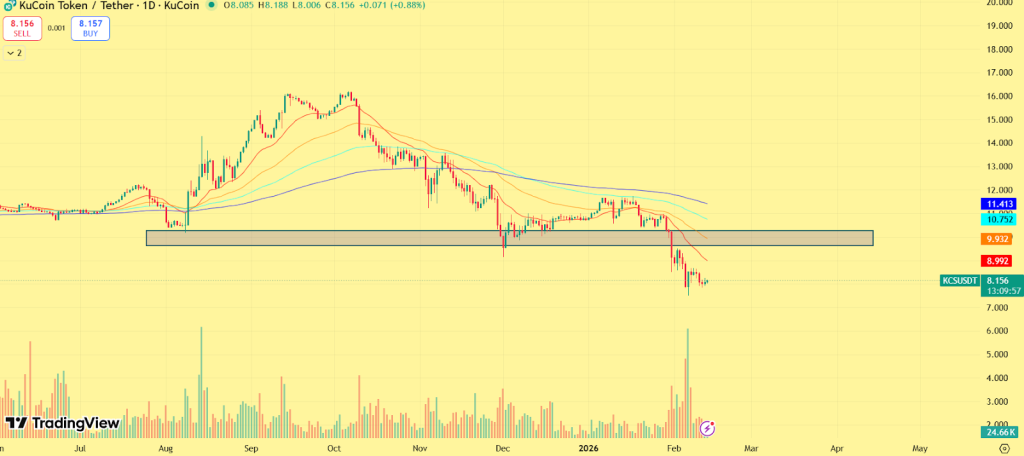
Breaking above this supply cluster would position the token for a move toward the psychological $30 threshold. If broader crypto market conditions remain constructive and exchange-related tokens benefit from renewed trading activity, KCS could gradually advance toward the projected $35 high by late 2026.
KuCoin Crypto Price Prediction 2026 – 2030
| Year | Potential Low ($) | Potential Average ($ | Potential High ($) |
| 2026 | 8.00 | 20.50 | 35.00 |
| 2027 | 18.00 | 32.00 | 45.00 |
| 2028 | 22.00 | 24.00 | 60.00 |
| 2029 | 42.00 | 55.00 | 75.00 |
| 2030 | 38.00 | 60.00 | 100.00 |
KuCoin (KCS) Price Prediction 2026
In 2026, KuCoin price could project a low price of $8.00, an average price of $20.50, and a high of $35.0.
KuCoin Price Prediction 2027
As per the KuCoin Price Prediction 2027, KuCoin may see a potential low price of $18.00. The potential high for KuCoin price in 2027 is estimated to reach $45.00.
KCS Price Prediction 2028
In 2028, KuCoin price is forecasted to potentially reach a low price of $22.00 and a high price of $60.00.
KuCoin Price Prediction 2029
Thereafter, the KuCoin (KuCoin) price for the year 2029 could range between $42.00 and $75.00.
KuCoin (KCS) Price Prediction 2030
Finally, in 2030, the price of KuCoin is predicted to maintain a steady positive. It may trade between $38.00 and $100.00.
KuCoin Price Prediction 2031, 2032, 2033, 2040, 2050
The long-term projection assumes KuCoin sustains relevance in enterprise blockchain use cases, with growth moderating over time as the asset matures.
| Year | Potential Low ($) | Potential Average ($) | Potential High ($) |
| 2031 | 60.00 | 70.00 | 115.00 |
| 2032 | 75.00 | 95.00 | 130.00 |
| 2033 | 90.00 | 120.00 | 150.00 |
| 2040 | 120.00 | 250.00 | 400.00 |
| 2050 | 300.00 | 500.00 | 600.00 |
KuCoin (KCS) Price Prediction: Market Analysis?
| Year | 2026 | 2027 | 2030 |
| Changelly | $28.00 | $38 | $50 |
| CoinCodex | $32.00 | $40 | $60 |
| WalletInvestor | $35.00 | $45 | $65 |
CoinPedia’s KuCoin Price Prediction
KuCoin token price is currently forming a long-term accumulation base. A breakout above $15–$18 could initiate a broader expansion phase targeting $25, $30, and eventually $35 in 2026. Looking further ahead, if ecosystem growth and trading activity strengthen, KCS may approach $100 by 2030, with longer-term potential extending beyond that horizon.
| Year | Potential Low ($) | Potential Average ($) | Potential High ($) |
| 2026 | 8.00 | 20.50 | 35.00 |
Never Miss a Beat in the Crypto World!
Stay ahead with breaking news, expert analysis, and real-time updates on the latest trends in Bitcoin, altcoins, DeFi, NFTs, and more.
 Subscribe to Price Prediction
FAQs
KCS could trade between $8 and $35 in 2026, with $20 as a mid-range estimate if market sentiment and exchange activity improve steadily.
KuCoin price prediction 2030 suggests KCS could trade between $38 and $100, depending on exchange growth and overall crypto market strength.
By 2040, KCS could potentially reach $250–$400 if adoption expands, utility increases, and long-term crypto demand remains strong.
Key drivers include exchange trading volume, token utility, market cycles, liquidity conditions, and overall crypto investor sentiment.
KCS may offer long-term potential if KuCoin expands globally and maintains strong utility, but it remains subject to crypto market volatility.
Ayrıca Şunları da Beğenebilirsiniz

The Role of Blockchain in Building Safer Web3 Gaming Ecosystems
- Immutable Ownership of Assets Blockchain records can be manipulated by anyone. If a player owns a sword, skin, or plot of land as an NFT, it is verifiably in their ownership, and it cannot be altered or deleted by the developer or even hacked. This has created a proven track record of ownership, providing control back to the players, unlike any centralised gaming platform where assets can be revoked.
- Decentralized Infrastructure Blockchain networks also have a distributed architecture where game data is stored in a worldwide network of nodes, making them much less susceptible to centralised points of failure and attacks. This decentralised approach makes it exponentially more difficult to hijack systems or even shut off the game’s economy.
- Secure Transactions with Cryptography Whether a player buys an NFT or trades their in-game tokens for other items or tokens, the transactions are enforced by cryptographic algorithms, ensuring secure, verifiable, and irreversible transactions and eliminating the risks of double-spending or fraudulent trades.
- Smart Contract Automation Smart contracts automate the enforcement of game rules and players’ economic exchanges for the developer, eliminating the need for intermediaries or middlemen, and trust for the developer. For example, if a player completes a quest that promises a reward, the smart contract will execute and distribute what was promised.
- Anti-Cheating and Fair Gameplay The naturally transparent nature of blockchain makes it extremely simple for anyone to examine a specific instance of gameplay and verify the economic outcomes from that play. Furthermore, multi-player games that enforce smart contracts on things like loot sharing or win sharing can automate and measure trustlessness and avoid cheating, manipulations, and fraud by developers.
- Cross-Platform Security Many Web3 games feature asset interoperability across platforms. This interoperability is made viable by blockchain, which guarantees ownership is maintained whenever assets transition from one game or marketplace to another, thereby offering protection to players who rely on transfers for security against fraud. Key Security Dangers in Web3 Gaming Although blockchain provides sound first principles of security, the Web3 gaming ecosystem is susceptible to threats. Some of the most serious threats include:

Knocking Bitcoin's lack of yield shows your ‘Western financial privilege’
Macro analyst Luke Gromen’s comments come amid an ongoing debate over whether Bitcoin or Ether is the more attractive long-term option for traditional investors. Macro analyst Luke Gromen says the fact that Bitcoin doesn’t natively earn yield isn’t a weakness; it’s what makes it a safer store of value.“If you’re earning a yield, you are taking a risk,” Gromen told Natalie Brunell on the Coin Stories podcast on Wednesday, responding to a question about critics who dismiss Bitcoin (BTC) because they prefer yield-earning assets.“Anyone who says that is showing their Western financial privilege,” he added.Read more
