'For each of his many roles, Bob gave everything to his characters and to the truth of the human spirit they represented,' says Duvall's wife Luciana'For each of his many roles, Bob gave everything to his characters and to the truth of the human spirit they represented,' says Duvall's wife Luciana

Robert Duvall, ‘Tender Mercies’ Oscar winner, dies at 95

2026/02/17 07:57
Okuma süresi: 4 dk

Oscar winner Robert Duvall, a versatile actor who made lasting impressions in a range of parts from starring to supporting roles like the napalm-loving colonel of “Apocalypse Now” or the spectral Boo Radley in “To Kill a Mockingbird,” has died at age 95, his wife said in a Facebook post.

The actor, who played Tom Hagen, a lawyer for the Corleone family, in “The Godfather” and its first sequel, and starred in the TV miniseries “Lonesome Dove,” died peacefully on Sunday, according to the statement, which did not give a cause of death.

“For each of his many roles, Bob gave everything to his characters and to the truth of the human spirit they represented,” Luciana Duvall said in the post.

Duvall played forceful leaders such as Lieutenant Colonel Bull Meechum in “The Great Santini” and the title character in “Stalin,” as well as broken-down and fallen characters in “Tender Mercies” and “The Apostle.” He won awards for both types of roles.

Duvall, the son of a Navy admiral and an amateur actress, grew up in Annapolis, Maryland. After graduating from Principia College in Illinois and serving in the US Army, he moved to New York, where he roomed with Dustin Hoffman and befriended Gene Hackman when the three were struggling acting students.

After working on a variety of television shows, Duvall made a strong impression even in small roles, such as his first movie part as the mysterious recluse Boo Radley in “To Kill a Mockingbird.”

Duvall got the part at the suggestion of the film’s screenwriter, Horton Foote, who had liked Duvall’s work in one of his plays.

Foote later wrote “Tender Mercies,” a 1983 film for which Duvall won the Academy Award for best actor as a washed-up country singer.

7 Oscar nominations

Perhaps Duvall’s most memorable role came in Frances Ford Coppola’s 1979 Vietnam epic “Apocalypse Now,” playing the off-kilter, surfing-obsessed Lieutenant Colonel Bill Kilgore.

Duvall only received a few minutes of screen time but almost stole the film as his character swaggered around a battlefield after a successful attack and exuberantly proclaimed, “I love the smell of napalm in the morning.” It smelled “like victory,” Kilgore said.

The role brought Duvall one of his seven Academy Award nominations. Another was for Best Supporting Actor for Coppola’s “The Godfather,” playing Tom Hagen, consigliere to the Corleone Mafia family. Duvall appeared in the second “Godfather” film but rejected the third because he considered the salary offer inadequate.

Duvall also was nominated for Oscars for “The Great Santini,” “The Apostle,” “A Civil Action” and “The Judge” in 2014. In all, he appeared in almost 100 movies.

Duvall had a knack for playing cowboys. He won an Emmy for the television mini-series “Broken Trail,” appeared opposite John Wayne in “True Grit,” and picked up an Emmy nomination for the mini-series “Lonesome Dove.” He often said his portrayal of the genial lawman-turned-cowboy Gus McRae in “Lonesome Dove” was his favorite role.

“I think I nailed a very specific individual guy who represents something important in our history of the Western movement,” Duvall told the New York Times. “After that, I felt I could retire, that’d I’d done something.”

When he grew weary of Hollywood, Duvall made his own movies. He wrote, directed and won an Oscar acting nomination for “The Apostle,” the story of a conflicted preacher.

Duvall did the same with “Assassination Tango,” a movie that allowed him to exhibit his passion for the tango and Argentina, where he met his fourth wife, Luciana Pedraza. They were both born on January 5 but 41 years apart.

Duvall split his time between Los Angeles, Argentina and a 146-hectare farm in Virginia, where he converted the barn into a tango dance hall. – Rappler.com

Piyasa Fırsatı
BOB Logosu
BOB Fiyatı(BOB)
$0.006317
$0.006317$0.006317
-0.56%
USD
BOB (BOB) Canlı Fiyat Grafiği
Sorumluluk Reddi: Bu sitede yeniden yayınlanan makaleler, halka açık platformlardan alınmıştır ve yalnızca bilgilendirme amaçlıdır. MEXC'nin görüşlerini yansıtmayabilir. Tüm hakları telif sahiplerine aittir. Herhangi bir içeriğin üçüncü taraf haklarını ihlal ettiğini düşünüyorsanız, kaldırılması için lütfen service@support.mexc.com ile iletişime geçin. MEXC, içeriğin doğruluğu, eksiksizliği veya güncelliği konusunda hiçbir garanti vermez ve sağlanan bilgilere dayalı olarak alınan herhangi bir eylemden sorumlu değildir. İçerik, finansal, yasal veya diğer profesyonel tavsiye niteliğinde değildir ve MEXC tarafından bir tavsiye veya onay olarak değerlendirilmemelidir.

Ayrıca Şunları da Beğenebilirsiniz

Yunfeng Financial appoints Jiang Guofei as Chairman of Web3 Development Committee
Yunfeng Financial appoints Jiang Guofei as Chairman of Web3 Development Committee

PANews reported on September 19th that the South China Morning Post reported that Jack Ma-backed Yunfeng Financial Group has appointed former Ant Group executive Geoff Jiang Guofei as Chairman of its Web3 Development Committee, further clarifying its strategic layout in the Web3 space. Jiang Guofei previously led Ant Group's blockchain project, Trusple , and served as Director of the DAMO Academy's Fintech Lab. Yunfeng recently completed its first real-world asset ( RWA ) tokenization project and purchased 10,000 Ethereum (ETH) for $ 44 million as a strategic reserve, with plans to promote tokenized solutions across multiple asset classes.
Paylaş
PANews2025/09/19 18:01
Crucial ETH Unstaking Period: Vitalik Buterin’s Unwavering Defense for Network Security

Crucial ETH Unstaking Period: Vitalik Buterin’s Unwavering Defense for Network Security

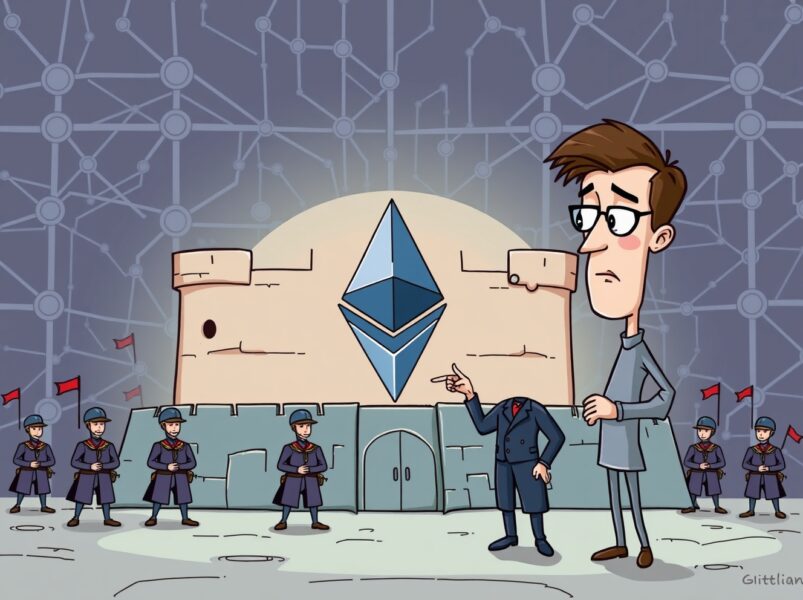
BitcoinWorld Crucial ETH Unstaking Period: Vitalik Buterin’s Unwavering Defense for Network Security Ever wondered why withdrawing your staked Ethereum (ETH) isn’t an instant process? It’s a question that often sparks debate within the crypto community. Ethereum founder Vitalik Buterin recently stepped forward to defend the network’s approximately 45-day ETH unstaking period, asserting its crucial role in safeguarding the network’s integrity. This lengthy waiting time, while sometimes seen as an inconvenience, is a deliberate design choice with profound implications for security. Why is the ETH Unstaking Period a Vital Security Measure? Vitalik Buterin’s defense comes amidst comparisons to other networks, like Solana, which boast significantly shorter unstaking times. He drew a compelling parallel to military operations, explaining that an army cannot function effectively if its soldiers can simply abandon their posts at a moment’s notice. Similarly, a blockchain network requires a stable and committed validator set to maintain its security. The current ETH unstaking period isn’t merely an arbitrary delay. It acts as a critical buffer, providing the network with sufficient time to detect and respond to potential malicious activities. If validators could instantly exit, it would open doors for sophisticated attacks, jeopardizing the entire system. Currently, Ethereum boasts over one million active validators, collectively staking approximately 35.6 million ETH, representing about 30% of the total supply. This massive commitment underpins the network’s robust security model, and the unstaking period helps preserve this stability. Network Security: Ethereum’s Paramount Concern A shorter ETH unstaking period might seem appealing for liquidity, but it introduces significant risks. Imagine a scenario where a large number of validators, potentially colluding, could quickly withdraw their stake after committing a malicious act. Without a substantial delay, the network would have limited time to penalize them or mitigate the damage. This “exit queue” mechanism is designed to prevent sudden validator exodus, which could lead to: Reduced decentralization: A rapid drop in active validators could concentrate power among fewer participants. Increased vulnerability to attacks: A smaller, less stable validator set is easier to compromise. Network instability: Frequent and unpredictable changes in validator numbers can lead to performance issues and consensus failures. Therefore, the extended period is not a bug; it’s a feature. It’s a calculated trade-off between immediate liquidity for stakers and the foundational security of the entire Ethereum ecosystem. Ethereum vs. Solana: Different Approaches to Unstaking When discussing the ETH unstaking period, many point to networks like Solana, which offers a much quicker two-day unstaking process. While this might seem like an advantage for stakers seeking rapid access to their funds, it reflects fundamental differences in network architecture and security philosophies. Solana’s design prioritizes speed and immediate liquidity, often relying on different consensus mechanisms and validator economics to manage security risks. Ethereum, on the other hand, with its proof-of-stake evolution from proof-of-work, has adopted a more cautious approach to ensure its transition and long-term stability are uncompromised. Each network makes design choices based on its unique goals and threat models. Ethereum’s substantial value and its role as a foundational layer for countless dApps necessitate an extremely robust security posture, making the current unstaking duration a deliberate and necessary component. What Does the ETH Unstaking Period Mean for Stakers? For individuals and institutions staking ETH, understanding the ETH unstaking period is crucial for managing expectations and investment strategies. It means that while staking offers attractive rewards, it also comes with a commitment to the network’s long-term health. Here are key considerations for stakers: Liquidity Planning: Stakers should view their staked ETH as a longer-term commitment, not immediately liquid capital. Risk Management: The delay inherently reduces the ability to react quickly to market volatility with staked assets. Network Contribution: By participating, stakers contribute directly to the security and decentralization of Ethereum, reinforcing its value proposition. While the current waiting period may not be “optimal” in every sense, as Buterin acknowledged, simply shortening it without addressing the underlying security implications would be a dangerous gamble for the network’s reliability. In conclusion, Vitalik Buterin’s defense of the lengthy ETH unstaking period underscores a fundamental principle: network security cannot be compromised for the sake of convenience. It is a vital mechanism that protects Ethereum’s integrity, ensuring its stability and trustworthiness as a leading blockchain platform. This deliberate design choice, while requiring patience from stakers, ultimately fortifies the entire ecosystem against potential threats, paving the way for a more secure and reliable decentralized future. Frequently Asked Questions (FAQs) Q1: What is the main reason for Ethereum’s long unstaking period? A1: The primary reason is network security. A lengthy ETH unstaking period prevents malicious actors from quickly withdrawing their stake after an attack, giving the network time to detect and penalize them, thus maintaining stability and integrity. Q2: How long is the current ETH unstaking period? A2: The current ETH unstaking period is approximately 45 days. This duration can fluctuate based on network conditions and the number of validators in the exit queue. Q3: How does Ethereum’s unstaking period compare to other blockchains? A3: Ethereum’s unstaking period is notably longer than some other networks, such as Solana, which has a two-day period. This difference reflects varying network architectures and security priorities. Q4: Does the unstaking period affect ETH stakers? A4: Yes, it means stakers need to plan their liquidity carefully, as their staked ETH is not immediately accessible. It encourages a longer-term commitment to the network, aligning staker interests with Ethereum’s stability. Q5: Could the ETH unstaking period be shortened in the future? A5: While Vitalik Buterin acknowledged the current period might not be “optimal,” any significant shortening would likely require extensive research and network upgrades to ensure security isn’t compromised. For now, the focus remains on maintaining robust network defenses. Found this article insightful? Share it with your friends and fellow crypto enthusiasts on social media to spread awareness about the critical role of the ETH unstaking period in Ethereum’s security! To learn more about the latest Ethereum trends, explore our article on key developments shaping Ethereum’s institutional adoption. This post Crucial ETH Unstaking Period: Vitalik Buterin’s Unwavering Defense for Network Security first appeared on BitcoinWorld.
Paylaş
Coinstats2025/09/18 15:30
XRP holders hit new high, but THIS keeps pressure on price

XRP holders hit new high, but THIS keeps pressure on price

The post XRP holders hit new high, but THIS keeps pressure on price appeared on BitcoinEthereumNews.com. Ripple [XRP] remains one of the top five cryptocurrencies
Paylaş
BitcoinEthereumNews2026/02/17 08:49
