Nemo Protocol, a decentralized finance (DeFi) yield platform operating on the Sui blockchain, fell victim to a cyberattack that resulted in $2.4 million in losses just ahead of its scheduled maintenance window on Monday and Tuesday. The security breach was initially detected by PeckShieldAlert on September 8, which reported via X that approximately $2.4 million in USDC had been drained from Nemo’s systems. According to the blockchain security firm’s investigation, the hacker swiftly moved the stolen assets via Circle by bridging USDC on Arbitrum to Ethereum. $6.3M TVL Crashes 75% as Users Flee Nemo Protocol Nemo acknowledged the incident in a subsequent tweet, stating that the protocol had experienced a security breach the previous evening that affected its Market pool. The development team confirmed that an investigation was in progress to identify the root cause of the vulnerability. As a precautionary measure, all smart contract operations were temporarily halted. The attack’s impact was immediately felt. According to DeFiLlama data, Nemo’s total value locked (TVL) collapsed to approximately $1.57 million from over $6.3 million before the breach.Source: DefilLama User withdrawals exceeded $3.8 million worth of USDC and SUI tokens as investors rushed to exit, fearing the exploit’s scope might be more extensive than initially disclosed.Source: DefilLama The breach specifically targeted Nemo’s yield-trading mechanism, which enables users to divide staked assets into Principal Tokens (PTs) and Yield Tokens (YTs) for yield speculation purposes. According to blockchain security auditor CertiK, security risks may arise from multiple sources, including coding errors, blockchain network vulnerabilities, and programming language limitations. Sui Blockchain Security Crisis Contributed to $2.37 Billion DeFi Losses in 2025 Notably, the Nemo security breach marks the third major hack targeting DeFi protocols this month. Earlier in September, Venus protocol lost $13.5 million to attackers, followed by an $8.4 million theft from the Bunni protocol. Similarly, in the Sui ecosystem, the Nemo incident follows another significant breach on the Layer-1 network from earlier this year. On May 22, Cetus Protocol, a prominent decentralized exchange and liquidity provider, suffered a $223 million exploit. The attacker leveraged an arithmetic overflow flaw in a third-party code library to complete the drain within 15 minutes. Moreover, these DeFi-focused attacks are on the rise in 2025. SlowMist’s mid-year analysis revealed that the blockchain sector experienced over $2.37 billion in losses across 121 security incidents during the first half of the year.Source: SlowMist DeFi protocols alone accounted for 76% of these cases, although centralized exchanges recorded higher individual losses. A complementary report from Hacken’s 2025 mid-year security assessment estimated total crypto industry losses at over $3.1 billion within the first six months.Source: Hacken Access control vulnerabilities, including misconfigured wallets and compromised legacy keys, represented 59% of these losses, while DeFi-specific smart contract exploits accounted for $263 million, or roughly 8%. A recent interview between Cryptonews and Mitchell Amador, founder and CEO of Immunefi, highlighted why conventional security methodologies prove inadequate in Web3’s open-source ecosystem. Amador explained that “Traditional audits, being static and pre-launch focused, fail to identify post-deployment vulnerabilities present in dynamic DeFi environments.” He advocated for bug bounty programs as a solution to incentivize ethical hackers, fundamentally restructuring cybersecurity economics to make defensive measures more lucrative than offensive onesNemo Protocol, a decentralized finance (DeFi) yield platform operating on the Sui blockchain, fell victim to a cyberattack that resulted in $2.4 million in losses just ahead of its scheduled maintenance window on Monday and Tuesday. The security breach was initially detected by PeckShieldAlert on September 8, which reported via X that approximately $2.4 million in USDC had been drained from Nemo’s systems. According to the blockchain security firm’s investigation, the hacker swiftly moved the stolen assets via Circle by bridging USDC on Arbitrum to Ethereum. $6.3M TVL Crashes 75% as Users Flee Nemo Protocol Nemo acknowledged the incident in a subsequent tweet, stating that the protocol had experienced a security breach the previous evening that affected its Market pool. The development team confirmed that an investigation was in progress to identify the root cause of the vulnerability. As a precautionary measure, all smart contract operations were temporarily halted. The attack’s impact was immediately felt. According to DeFiLlama data, Nemo’s total value locked (TVL) collapsed to approximately $1.57 million from over $6.3 million before the breach.Source: DefilLama User withdrawals exceeded $3.8 million worth of USDC and SUI tokens as investors rushed to exit, fearing the exploit’s scope might be more extensive than initially disclosed.Source: DefilLama The breach specifically targeted Nemo’s yield-trading mechanism, which enables users to divide staked assets into Principal Tokens (PTs) and Yield Tokens (YTs) for yield speculation purposes. According to blockchain security auditor CertiK, security risks may arise from multiple sources, including coding errors, blockchain network vulnerabilities, and programming language limitations. Sui Blockchain Security Crisis Contributed to $2.37 Billion DeFi Losses in 2025 Notably, the Nemo security breach marks the third major hack targeting DeFi protocols this month. Earlier in September, Venus protocol lost $13.5 million to attackers, followed by an $8.4 million theft from the Bunni protocol. Similarly, in the Sui ecosystem, the Nemo incident follows another significant breach on the Layer-1 network from earlier this year. On May 22, Cetus Protocol, a prominent decentralized exchange and liquidity provider, suffered a $223 million exploit. The attacker leveraged an arithmetic overflow flaw in a third-party code library to complete the drain within 15 minutes. Moreover, these DeFi-focused attacks are on the rise in 2025. SlowMist’s mid-year analysis revealed that the blockchain sector experienced over $2.37 billion in losses across 121 security incidents during the first half of the year.Source: SlowMist DeFi protocols alone accounted for 76% of these cases, although centralized exchanges recorded higher individual losses. A complementary report from Hacken’s 2025 mid-year security assessment estimated total crypto industry losses at over $3.1 billion within the first six months.Source: Hacken Access control vulnerabilities, including misconfigured wallets and compromised legacy keys, represented 59% of these losses, while DeFi-specific smart contract exploits accounted for $263 million, or roughly 8%. A recent interview between Cryptonews and Mitchell Amador, founder and CEO of Immunefi, highlighted why conventional security methodologies prove inadequate in Web3’s open-source ecosystem. Amador explained that “Traditional audits, being static and pre-launch focused, fail to identify post-deployment vulnerabilities present in dynamic DeFi environments.” He advocated for bug bounty programs as a solution to incentivize ethical hackers, fundamentally restructuring cybersecurity economics to make defensive measures more lucrative than offensive ones

Nemo Protocol Loses $2.4M to Hackers on Sui Blockchain Before Planned Maintenance

2025/09/09 00:36

Nemo Protocol, a decentralized finance (DeFi) yield platform operating on the Sui blockchain, fell victim to a cyberattack that resulted in $2.4 million in losses just ahead of its scheduled maintenance window on Monday and Tuesday.

The security breach was initially detected by PeckShieldAlert on September 8, which reported via X that approximately $2.4 million in USDC had been drained from Nemo’s systems.

According to the blockchain security firm’s investigation, the hacker swiftly moved the stolen assets via Circle by bridging USDC on Arbitrum to Ethereum.

$6.3M TVL Crashes 75% as Users Flee Nemo Protocol

Nemo acknowledged the incident in a subsequent tweet, stating that the protocol had experienced a security breach the previous evening that affected its Market pool.

The development team confirmed that an investigation was in progress to identify the root cause of the vulnerability.

As a precautionary measure, all smart contract operations were temporarily halted.

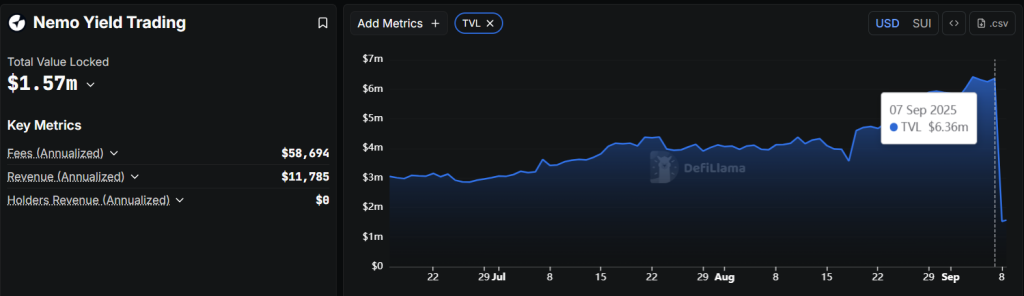
The attack’s impact was immediately felt. According to DeFiLlama data, Nemo’s total value locked (TVL) collapsed to approximately $1.57 million from over $6.3 million before the breach.
Nemo Protocol Loses $2.4M to Hackers on Sui Blockchain Before Planned MaintenanceSource: DefilLama

User withdrawals exceeded $3.8 million worth of USDC and SUI tokens as investors rushed to exit, fearing the exploit’s scope might be more extensive than initially disclosed.

Nemo Protocol Loses $2.4M to Hackers on Sui Blockchain Before Planned MaintenanceSource: DefilLama

The breach specifically targeted Nemo’s yield-trading mechanism, which enables users to divide staked assets into Principal Tokens (PTs) and Yield Tokens (YTs) for yield speculation purposes.

According to blockchain security auditor CertiK, security risks may arise from multiple sources, including coding errors, blockchain network vulnerabilities, and programming language limitations.

Sui Blockchain Security Crisis Contributed to $2.37 Billion DeFi Losses in 2025

Notably, the Nemo security breach marks the third major hack targeting DeFi protocols this month.

Earlier in September, Venus protocol lost $13.5 million to attackers, followed by an $8.4 million theft from the Bunni protocol.

Similarly, in the Sui ecosystem, the Nemo incident follows another significant breach on the Layer-1 network from earlier this year.

On May 22, Cetus Protocol, a prominent decentralized exchange and liquidity provider, suffered a $223 million exploit.

The attacker leveraged an arithmetic overflow flaw in a third-party code library to complete the drain within 15 minutes.

Moreover, these DeFi-focused attacks are on the rise in 2025.

SlowMist’s mid-year analysis revealed that the blockchain sector experienced over $2.37 billion in losses across 121 security incidents during the first half of the year.

Nemo Protocol Loses $2.4M to Hackers on Sui Blockchain Before Planned MaintenanceSource: SlowMist

DeFi protocols alone accounted for 76% of these cases, although centralized exchanges recorded higher individual losses.

A complementary report from Hacken’s 2025 mid-year security assessment estimated total crypto industry losses at over $3.1 billion within the first six months.

Nemo Protocol Loses $2.4M to Hackers on Sui Blockchain Before Planned MaintenanceSource: Hacken

Access control vulnerabilities, including misconfigured wallets and compromised legacy keys, represented 59% of these losses, while DeFi-specific smart contract exploits accounted for $263 million, or roughly 8%.

A recent interview between Cryptonews and Mitchell Amador, founder and CEO of Immunefi, highlighted why conventional security methodologies prove inadequate in Web3’s open-source ecosystem.

Amador explained that “Traditional audits, being static and pre-launch focused, fail to identify post-deployment vulnerabilities present in dynamic DeFi environments.”

He advocated for bug bounty programs as a solution to incentivize ethical hackers, fundamentally restructuring cybersecurity economics to make defensive measures more lucrative than offensive ones.

Sorumluluk Reddi: Bu sitede yeniden yayınlanan makaleler, halka açık platformlardan alınmıştır ve yalnızca bilgilendirme amaçlıdır. MEXC'nin görüşlerini yansıtmayabilir. Tüm hakları telif sahiplerine aittir. Herhangi bir içeriğin üçüncü taraf haklarını ihlal ettiğini düşünüyorsanız, kaldırılması için lütfen service@support.mexc.com ile iletişime geçin. MEXC, içeriğin doğruluğu, eksiksizliği veya güncelliği konusunda hiçbir garanti vermez ve sağlanan bilgilere dayalı olarak alınan herhangi bir eylemden sorumlu değildir. İçerik, finansal, yasal veya diğer profesyonel tavsiye niteliğinde değildir ve MEXC tarafından bir tavsiye veya onay olarak değerlendirilmemelidir.

Ayrıca Şunları da Beğenebilirsiniz

OFAC Designates Two Iranian Finance Facilitators For Crypto Shadow Banking

OFAC Designates Two Iranian Finance Facilitators For Crypto Shadow Banking

The Department of the Treasury’s Office of Foreign Assets Control (OFAC) sanctioned two Iranian financial facilitators for coordinating over $100 million worth of cryptocurrency in oil sales for the Iranian government, a September 16 press release shows. OFAC Sanctions Iranian Nationals According to the Tuesday press release, Iranian nationals Alireza Derakhshan and Arash Estaki Alivand “used a network of front companies in multiple foreign jurisdictions” to transfer the digital assets. OFAC alleges that Alivand and Derakhshan’s transfers also involved the sale of Iranian oil that benefited Iran’s Islamic Revolutionary Guard Corps-Qods Force (IRGC-QF) and the Ministry of Defense and Armed Forces Logistics (MODAFL). IRGC-QF and MODAFL then used the proceeds to support regional proxy terrorist organizations and strengthen their advanced weapons systems, including ballistic missiles. U.S. officials say the move targets shadow banking in the region, where illicit financial actors use overseas money laundering and digital assets to evade sanctions. “Iranian entities rely on shadow banking networks to evade sanctions and move millions through the international financial system,” said Under Secretary of the Treasury for Terrorism and Financial Intelligence John K. Hurley. “Under President Trump’s leadership, we will continue to disrupt these key financial streams that fund Iran’s weapons programs and malign activities in the Middle East and beyond,” he continued. Dozens Designated In Shadow Banking Scandal Both Alivand and Derakhshan have been designated “for having materially assisted, sponsored, or provided financial, material, or technological support for, or goods or services to or in support of the IRGC-QF.” In addition to Alivand and Derakhshan, OFAC has sanctioned more than a dozen Hong Kong and United Arab Emirates-based entities and individuals tied to the network. According to the press release, the sanctioned entities may face civil or criminal penalties imposed as a result
Paylaş
CryptoNews2025/09/18 11:18