

Gold Drops 2% Despite Rising Iran Tensions: Why the Safe Haven Trade Failed
Key Highlights
- Spot gold declined 2% to $4,664 per ounce following Trump’s pledge to strike Iran “extremely hard” within two to three weeks
- The decline ended a four-session rally in gold futures markets
- Crude oil prices jumped to $108 per barrel, increasing inflation fears and bolstering the U.S. dollar
- UBS reduced its 2026 average gold price projection from $5,200 to $5,000, while maintaining its year-end estimate at $5,600
- Silver tumbled more than 4%, and tariffs on metals drove aluminum to nearly four-year peak levels
The precious metal market experienced a significant downturn on April 2 following President Donald Trump’s prime-time announcement threatening military escalation against Iran.
Spot gold retreated 2% to settle at $4,664.39 per ounce, ending four consecutive sessions of gains. Gold futures traded in the United States declined 2.5% to reach $4,691.10 per ounce.
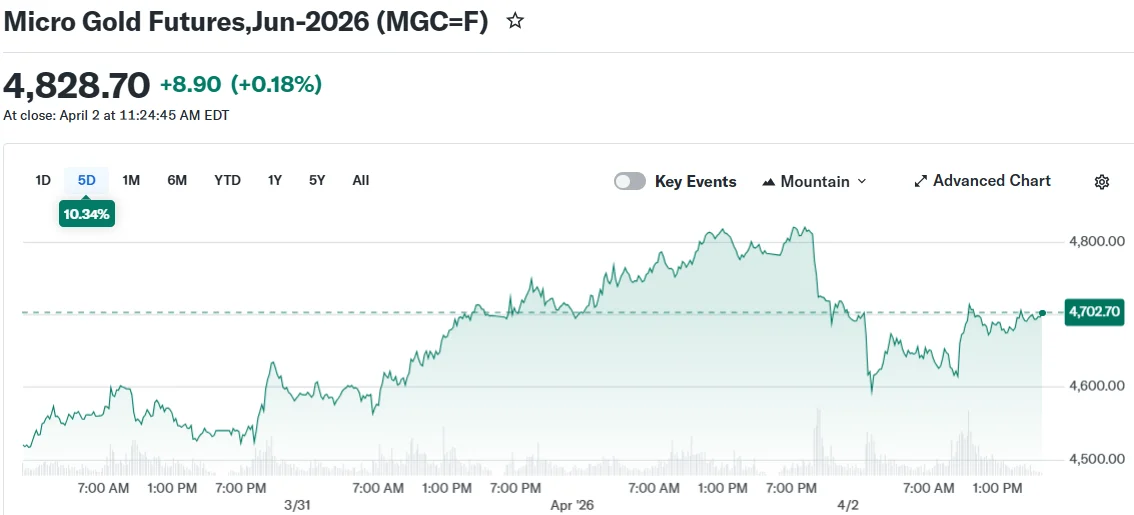 Micro Gold Futures,Jun-2026 (MGC=F)
During his address, Trump announced plans to strike Iran “extremely hard over the next two to three weeks.” His warnings included potential attacks on Iran’s electrical infrastructure and petroleum facilities should negotiations fail.
Investors had anticipated a more measured approach. Gold had been staging a comeback following its steepest monthly decline since October 2008, which occurred in March.
The president’s remarks immediately halted that momentum. Dow futures plummeted over 260 points immediately following Trump’s address. Futures for the S&P 500 declined 0.7%, while Nasdaq 100 futures dropped 0.8%.
The Paradox: Why Gold Retreated Amid Rising Tensions
The market reaction caught many analysts off guard. Typically, heightened geopolitical uncertainty drives capital flows into gold as a protective asset. However, this particular crisis has defied conventional wisdom.
Trump’s bellicose statements triggered a massive rally in energy markets. Brent crude climbed 7.1% to reach $108.29 per barrel. West Texas Intermediate skyrocketed from approximately $97 to exceed $113 within mere hours.
Rising oil prices fuel concerns about accelerating inflation. This dynamic pushes up Treasury bond yields and strengthens the dollar. Since gold generates no income, it becomes less attractive when the greenback appreciates.
Iran’s Foreign Ministry issued a defiant response the following day. “We are absolutely determined and resolute to continue our defense against this aggression,” a ministry representative stated.
Silver plummeted 4.6% to $71.67 per ounce. Platinum shed 2.5% to settle at $1,914.61, while palladium declined 1.4% to $1,451.92.
UBS Revises Gold Price Outlook Downward
UBS adjusted its average gold price projection for 2026 downward to $5,000 from $5,200, reflecting first-quarter market recalibrations.
According to UBS strategist Joni Teves, the upcoming weeks may witness “choppy price action” as financial markets repeatedly reevaluate geopolitical developments.
Despite the revision, Teves maintained the bank’s year-end gold forecast at $5,600.
Regarding industrial metals, Trump issued an executive order implementing a 50% tariff on products constructed entirely from aluminum, steel, or copper. Products substantially composed of these metals will face a 25% duty.
Aluminum values recently approached four-year highs due to supply chain disruptions linked to the Middle East crisis.
Benchmark copper contracts on the London Metal Exchange concluded Thursday’s session 0.8% higher at $12,434.50 per ton.
The post Gold Drops 2% Despite Rising Iran Tensions: Why the Safe Haven Trade Failed appeared first on Blockonomi.


You May Also Like
SEI Price Continues Lower: Can the Giga Upgrade Trigger a Full Reversal?

Bitcoin ETFs Surge with 20,685 BTC Inflows, Marking Strongest Week




