

Brent Crude Surges Past $110 Mark as Trump Issues Iran Ultimatum with Tuesday Cutoff
TLDR
- Crude markets experienced dramatic volatility Monday amid emerging diplomatic discussions between Washington and Tehran
- Brent reached $110 per barrel momentarily before retreating on news of possible 45-day truce negotiations
- President Trump issued a Tuesday ultimatum warning of strikes on Iranian bridges and electrical infrastructure unless the strait reopens
- Tehran’s Revolutionary Guard cautioned it would escalate assaults on American economic targets if civilian sites continue being attacked
- OPEC+ members approved a modest 206,000 barrel daily production boost for May, though delivery remains questionable
Oil prices experienced dramatic swings throughout Monday’s trading session as investors balanced the possibility of renewed American military action against Iran with emerging signals of potential diplomatic resolution.
Brent crude momentarily surged past the $110 threshold before retreating. During Asian morning hours, it stabilized near $109.80, registering a 0.7% gain. Meanwhile, U.S. benchmark crude remained relatively unchanged at $111.62.
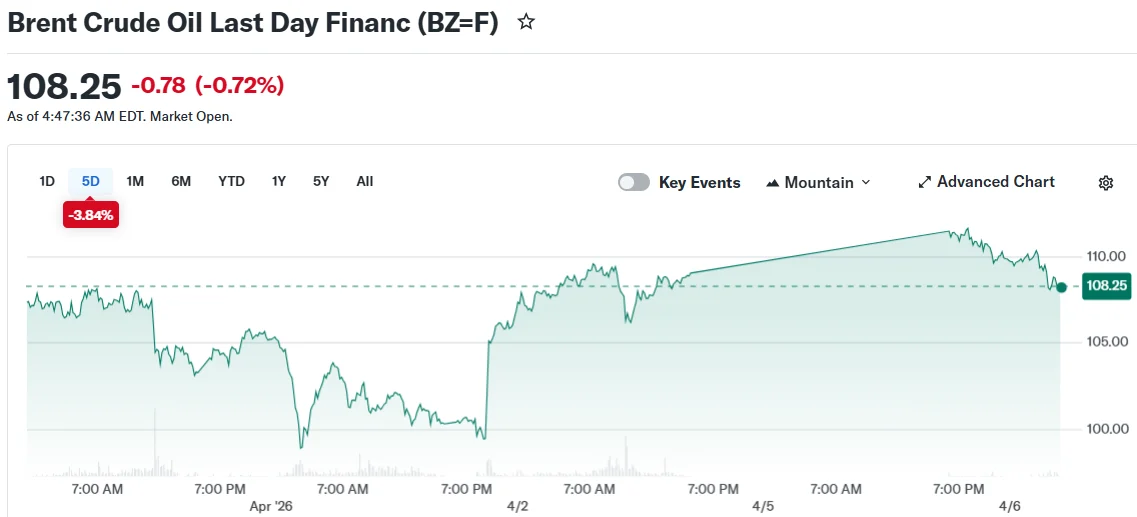 Brent Crude Oil Last Day Financ (BZ=F)
The price volatility demonstrates how closely energy markets are monitoring every development in the escalating U.S.-Iran confrontation, which ignited when American and Israeli military forces conducted strikes against Iranian targets on February 28.
Prior to the conflict’s outbreak, Brent was hovering around $70 per barrel. The benchmark surpassed the $100 mark last week following Trump’s warning that Iran would be bombed “back to the Stone Ages.”
On Sunday evening, Trump published an expletive-laden statement on Truth Social threatening to destroy Iranian electrical facilities and transportation infrastructure unless Tehran reopened the Strait of Hormuz by Tuesday evening U.S. Eastern time.
During a Fox News appearance, Trump indicated there existed a “good chance” an agreement might materialize Monday. He additionally suggested the option of “blowing everything up and taking over the oil” should negotiations collapse.
Ceasefire Talks Emerge
Axios news outlet reported that Washington, Tehran, and regional intermediaries are exploring a potential 45-day cessation of hostilities that might pave the way toward a lasting peace settlement. Reuters similarly confirmed that both nations had been presented with a framework proposal potentially becoming effective as soon as Monday.
The White House declined to provide immediate commentary on the reports. BBC News indicated it had not independently confirmed the Axios reporting.
Tehran maintained its military operations throughout the weekend, accepting responsibility for attacks on petrochemical facilities across Kuwait, Bahrain, and the United Arab Emirates. The Revolutionary Guard additionally cautioned Monday that strikes against American economic interests would intensify should Iranian civilian facilities continue facing bombardment.
OPEC+ Output Hike Falls Short
OPEC+ members reached consensus Sunday to expand crude production by 206,000 barrels daily throughout May. Nonetheless, industry analysts suggest the increase exists primarily on paper. Multiple major producing nations cannot meaningfully boost output due to disruptions stemming from the regional conflict.
The Strait of Hormuz, which typically facilitates approximately twenty percent of global energy transport, has remained obstructed for several weeks. The blockade has elevated energy costs worldwide and sparked inflation worries in nations reliant on Middle Eastern petroleum.
Sushant Gupta from Wood Mackenzie consultancy predicted prices would maintain their volatility, responding to each fresh development emerging from the confrontation.
The post Brent Crude Surges Past $110 Mark as Trump Issues Iran Ultimatum with Tuesday Cutoff appeared first on Blockonomi.


You May Also Like

United Health Products Gains FDA Approval for New Clinical Study Plan to Address Warning Letter

USD/JPY Analysis: Critical Yen Slide and Bank of Japan Policy Risks – BNY Mellon Perspective




