

What Happens to USDC if Polymarket Launches Its Own Stablecoin?
What Will Happen to USDC Now Polymarket Is Launching Its Own Stablecoin?
Polymarket is preparing to swap USDC.e collateral for a new token called Polymarket USD, and the open question is whether that changes USDC’s economic role or only its branding inside the platform. That distinction is why the launch matters to traders watching stablecoin liquidity rather than just prediction-market headlines.
KEY TAKEAWAYS
- Polymarket’s new collateral token is described as backed 1:1 by USDC, so the launch currently looks more like a wrapper than a standalone replacement for Circle’s stablecoin.
- Circle’s February 5, 2026 announcement said native USDC would power settlement on Polymarket, which supports the view that USDC remains embedded in the platform’s plumbing.
- With about $77.83 billion in circulating supply and roughly 24.7% of the USD stablecoin market, USDC is large enough that Polymarket’s change matters strategically before it matters numerically.
What Is Confirmed About Polymarket’s Stablecoin Launch
PYMNTS reported on April 6, 2026 that Polymarket will roll out an exchange-stack upgrade over the next two to three weeks, replacing USDC.e collateral with a new token called Polymarket USD. That lines up with the official Polymarket Developers announcement referenced in the research brief and gives the story a narrower framing than a typical “new stablecoin” headline.
According to the same April 6 reporting, Polymarket USD is backed 1:1 by USDC. That detail is the core reason USDC sits at the center of this story: if the collateral unit is still fully matched to Circle’s token, then Polymarket is changing the user-facing wrapper before it changes the reserve asset.
Circle said on February 5, 2026 that native USDC would power settlement for Polymarket users, which makes the latest launch look consistent with that partnership rather than a sudden divorce from it. For readers tracking the broader market tape, coinlineup’s Top Crypto News for April 7: Bitcoin Briefly Jumps Above $70K is a reminder that infrastructure stories can get buried under price action even when they shape trading venues more durably.
Polymarket also said most users will be wrapped automatically in the frontend, while API-only traders will need to use the Collateral Onramp contract’s wrap() function. During a short maintenance window, all existing order books will be cleared and the exact timing will be announced at least one week in advance, which suggests the bigger operational change is market plumbing rather than a new reserve model.
How a Native Polymarket Stablecoin Could Affect USDC Demand
The market backdrop shows why this is not an immediate existential threat to Circle. On April 7, 2026, USDC was trading near $1.001 with a $77.9 billion market cap and roughly $11.32 billion in 24-hour volume, which is far larger than the footprint of one prediction-market venue.
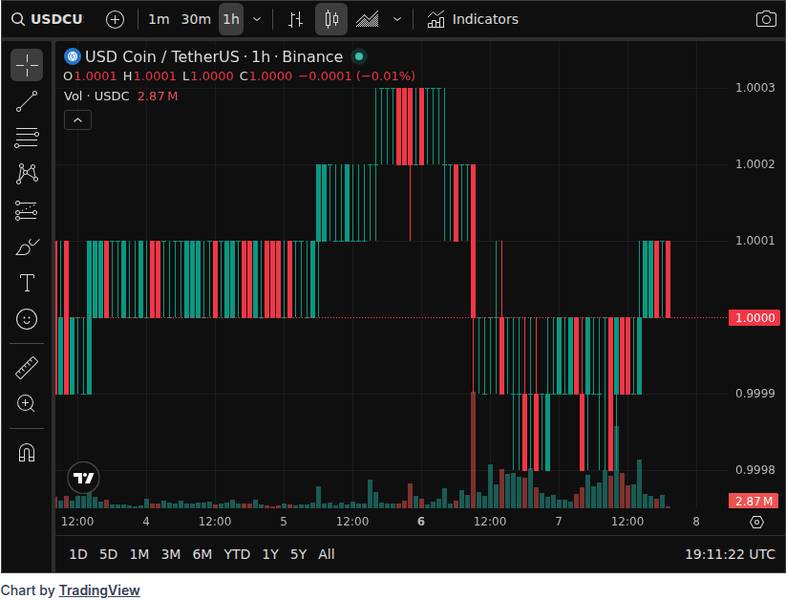 CoinGecko market data view included to frame the latest move in usd-coin.
Against that $77.9 billion market cap and $11.32 billion in 24-hour volume, the bearish case for Circle is mostly about interface control, not solvency. If Polymarket users now deposit into a house-branded token and see balances settled in Polymarket USD, Circle loses some direct brand exposure and some of the user habit that once centered on acquiring USDC.e themselves.
The bullish case follows the documented 1:1 USDC backing. If Polymarket USD only wraps USDC behind the scenes, the platform may still need Circle’s stablecoin for reserves even after it stops showing the USDC ticker to most traders, which means demand is being rerouted rather than destroyed.
DeFiLlama’s stablecoin data showed about $77.83 billion of USDC circulating on April 7, 2026, with Ethereum, Solana, Hyperliquid L1, Base, and Arbitrum as its largest chain venues. In a market where all USD-pegged stablecoins totaled about $315.6 billion, that leaves USDC with roughly 24.7% of the sector, which argues that Polymarket’s move is more meaningful for venue-level liquidity design than for USDC’s macro market share.
Why Polymarket’s Move Matters for Stablecoin Competition
The strategic lesson is that crypto platforms want tighter control over collateral, user balances, and settlement flows even when they still rely on an incumbent asset underneath. In a $315.6 billion stablecoin market where USDC still accounts for about 24.7%, the more realistic threat to Circle is that exchanges and apps keep privatizing the user experience while outsourcing reserve credibility to USDC.
That is why the absence of separate reserve disclosures in the supplied evidence matters. With Circle still presented on February 5, 2026 as Polymarket’s native settlement rail and Polymarket USD described on April 6, 2026 as backed 1:1 by USDC, the current record supports calling this a platform-specific collateral layer, not a fully independent challenger to Circle. The same fight over who controls the crypto stack is visible in coinlineup’s SEC Crypto Fight Could Decide Who Controls Blockchain Stocks, where distribution power matters as much as the underlying asset.
Against USDC’s roughly $77.9 billion market cap and about 24.7% of the USD stablecoin market, Polymarket still faces a real adoption hurdle. A platform-issued dollar token can improve execution and lower user friction, but it also asks traders to trust one more branded unit in a market that already has deep liquidity in USDC. That preference for proven rails over dramatic framing is a useful backdrop to coinlineup’s Bitcoin Quantum Threat: Why Google Can’t Steal Your BTC, which made a similar point about separating scary narratives from the narrower evidence base.
The measured outlook is that USDC probably becomes less visible on Polymarket while remaining economically important to it. If the rollout over the next two to three weeks works smoothly, other crypto venues may study the same model: keep the liquidity and credibility of a large stablecoin, but move the customer relationship into a house token. That would not kill USDC, but it would pressure Circle to defend distribution as aggressively as it defends the peg.
Disclaimer: This article is for informational purposes only and does not constitute investment advice. It is based only on the verified research package supplied for this run and keeps interpretation narrow where direct product documentation was not included.
Disclaimer: This article is for informational purposes only and does not constitute financial or investment advice. Cryptocurrency and digital asset markets carry significant risk. Always do your own research before making decisions.


You May Also Like

Major Trump funder's company now a 'trainwreck'

Trump Says Maintaining CFTC Oversight of Prediction Markets Is ‘Essential’ for US Leadership

Best Mobile User Retention Tools in 2026



