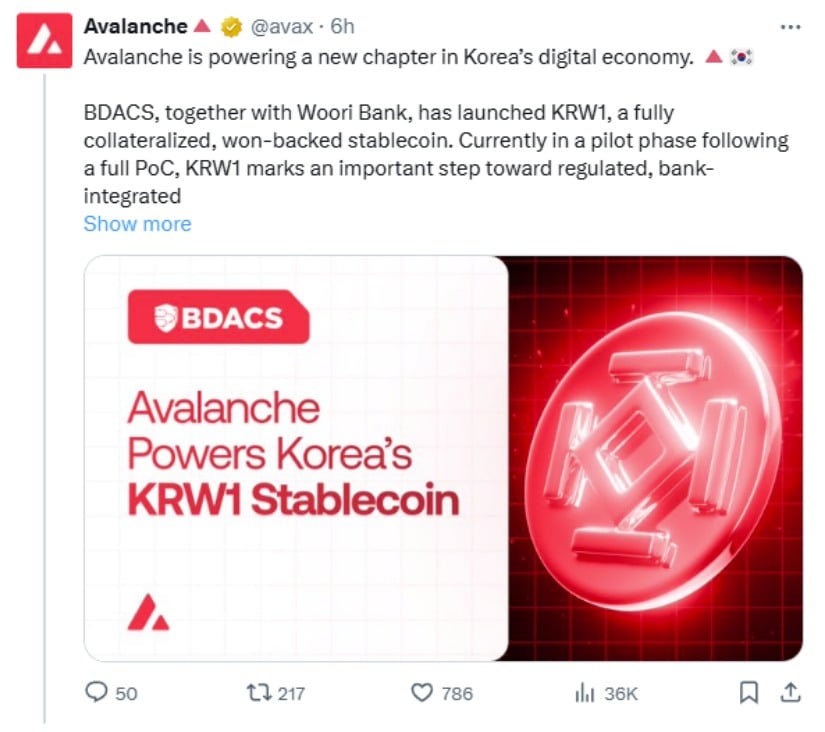
South Korea made history this week by launching its first Korean won-backed stablecoin.South Korea made history this week by launching its first Korean won-backed stablecoin.

South Korea Launches First Won-Backed Stablecoin KRW1 on Avalanche

South Korea Launches First Won-Backed Stablecoin KRW1 on Avalanche

The digital currency, called KRW1, runs on the Avalanche blockchain and marks a major step forward for the country’s digital finance sector.

BDACS, a South Korean crypto custody firm, announced the launch after successfully completing technical testing with Woori Bank, one of the country’s largest financial institutions. Each KRW1 token is backed by actual Korean won held safely at the bank.

The launch comes at a time when South Korea lacks clear rules for stablecoins. However, the government is working on new laws that could change this soon.

What Makes KRW1 Different

KRW1 stands out because it connects traditional banking with modern blockchain technology. Every digital token is backed 1:1 by Korean won stored at Woori Bank. This means users can trust that their digital money has real value behind it.

The stablecoin uses real-time banking connections to prove its reserves exist. This transparency helps build trust between users and the platform. Harry Ryoo, CEO of BDACS, said his company is “building the backbone of the digital asset market, serving corporate, institutional, and public-sector partners.”
@avax

Source: @avax

BDACS chose Avalanche for its speed and security. The Korea Internet & Security Agency has recognized Avalanche as reliable for public sector use. Justin Kim, Head of Asia at Ava Labs, noted that KRW1 shows “the need for a highly-performant and reliable blockchain tailored for a regulatory-compliant stablecoin.”

Government and Public Sector Plans

KRW1 was designed with government use in mind. BDACS plans to offer it as a low-cost payment system for public programs. This could significantly reduce fees when the government distributes emergency relief money or processes other payments.

The company has already built systems for issuing tokens, managing reserves, and verifying transactions. They also created a user app that lets people send money to each other and check transaction details.

Currently, KRW1 operates as a proof-of-concept project. This means it’s not available to the general public yet. This careful approach helps the company avoid breaking any current laws while they wait for new regulations.

Regulatory Landscape Taking Shape

South Korea’s government is moving quickly to create rules for digital currencies. President Lee Jae-myung has promised to support won-backed stablecoins as part of his plan to strengthen the country’s financial independence.

The ruling Democratic Party proposed the Digital Asset Basic Act, which would allow Korean companies to issue stablecoins. Companies would need at least 500 million won (about $368,000) in capital and must keep enough reserves to guarantee refunds.

The Financial Services Commission plans to submit a government bill to lawmakers in October 2025. This new law would create the country’s first official framework for stablecoins.

However, recent political events have slowed progress. The National Assembly postponed discussions about virtual asset rules until at least 2025 following martial law declarations and impeachment proceedings.

Market Competition Heating Up

BDACS isn’t the only company preparing for South Korea’s stablecoin future. At least three major banks – Kakao Bank, Kookmin Bank, and Industrial Bank of Korea – have filed trademark applications for their own Korean won stablecoins.

This competition shows how seriously financial institutions take the stablecoin opportunity. South Korea has one of the world’s most active crypto markets, with over 18 million people – more than one-third of the population – involved in digital assets.

The numbers are impressive. In the first quarter of 2025 alone, USD stablecoin transactions reached 57 trillion won ($42 billion) on South Korean exchanges. This shows there’s strong demand for stable digital currencies.

BDACS believes it has an advantage because KRW1 is already working. The company said that while big tech companies might enter the market later, “KRW1 is already operational with strong institutional backing from Woori Bank and global blockchain partners.”

Global Implications

South Korea’s move could influence other countries considering their own national stablecoins. The combination of blockchain technology with traditional banking oversight creates a model that balances innovation with safety.

BDACS plans to expand KRW1 to other blockchains to improve compatibility. The company is also exploring partnerships with dollar-based stablecoins like USDT and USDC.

The success of KRW1 will be closely watched by regulators and companies worldwide. It could become a template for how other nations create their own digital versions of national currencies.

The Digital Won Revolution

KRW1 represents more than just a new digital currency. It shows how South Korea is positioning itself as a leader in the global shift toward digital finance. By combining the stability of traditional banking with the efficiency of blockchain technology, the country is creating a new model for digital money.

The careful, regulated approach taken by BDACS and Woori Bank could help other countries feel more comfortable about creating their own national stablecoins. As regulations become clearer and more companies enter the market, South Korea’s digital finance sector looks set for significant growth.


Disclaimer: The articles reposted on this site are sourced from public platforms and are provided for informational purposes only. They do not necessarily reflect the views of MEXC. All rights remain with the original authors. If you believe any content infringes on third-party rights, please contact service@support.mexc.com for removal. MEXC makes no guarantees regarding the accuracy, completeness, or timeliness of the content and is not responsible for any actions taken based on the information provided. The content does not constitute financial, legal, or other professional advice, nor should it be considered a recommendation or endorsement by MEXC.

You May Also Like

Unprecedented Surge: Gold Price Hits Astounding New Record High

Unprecedented Surge: Gold Price Hits Astounding New Record High

BitcoinWorld Unprecedented Surge: Gold Price Hits Astounding New Record High While the world often buzzes with the latest movements in Bitcoin and altcoins, a traditional asset has quietly but powerfully commanded attention: gold. This week, the gold price has once again made headlines, touching an astounding new record high of $3,704 per ounce. This significant milestone reminds investors, both traditional and those deep in the crypto space, of gold’s enduring appeal as a store of value and a hedge against uncertainty. What’s Driving the Record Gold Price Surge? The recent ascent of the gold price to unprecedented levels is not a random event. Several powerful macroeconomic forces are converging, creating a perfect storm for the precious metal. Geopolitical Tensions: Escalating conflicts and global instability often drive investors towards safe-haven assets. Gold, with its long history of retaining value during crises, becomes a preferred choice. Inflation Concerns: Persistent inflation in major economies erodes the purchasing power of fiat currencies. Consequently, investors seek assets like gold that historically maintain their value against rising prices. Central Bank Policies: Many central banks globally are accumulating gold at a significant pace. This institutional demand provides a strong underlying support for the gold price. Furthermore, expectations around interest rate cuts in the future also make non-yielding assets like gold more attractive. These factors collectively paint a picture of a cautious market, where investors are looking for stability amidst a turbulent economic landscape. Understanding Gold’s Appeal in Today’s Market For centuries, gold has held a unique position in the financial world. Its latest record-breaking performance reinforces its status as a critical component of a diversified portfolio. Gold offers a tangible asset that is not subject to the same digital vulnerabilities or regulatory shifts that can impact cryptocurrencies. While digital assets offer exciting growth potential, gold provides a foundational stability that appeals to a broad spectrum of investors. Moreover, the finite supply of gold, much like Bitcoin’s capped supply, contributes to its perceived value. The current market environment, characterized by economic uncertainty and fluctuating currency values, only amplifies gold’s intrinsic benefits. It serves as a reliable hedge when other asset classes, including stocks and sometimes even crypto, face downward pressure. How Does This Record Gold Price Impact Investors? A soaring gold price naturally raises questions for investors. For those who already hold gold, this represents a significant validation of their investment strategy. For others, it might spark renewed interest in this ancient asset. Benefits for Investors: Portfolio Diversification: Gold often moves independently of other asset classes, offering crucial diversification benefits. Wealth Preservation: It acts as a robust store of value, protecting wealth against inflation and economic downturns. Liquidity: Gold markets are highly liquid, allowing for relatively easy buying and selling. Challenges and Considerations: Opportunity Cost: Investing in gold means capital is not allocated to potentially higher-growth assets like equities or certain cryptocurrencies. Volatility: While often seen as stable, gold prices can still experience significant fluctuations, as evidenced by its rapid ascent. Considering the current financial climate, understanding gold’s role can help refine your overall investment approach. Looking Ahead: The Future of the Gold Price What does the future hold for the gold price? While no one can predict market movements with absolute certainty, current trends and expert analyses offer some insights. Continued geopolitical instability and persistent inflationary pressures could sustain demand for gold. Furthermore, if global central banks continue their gold acquisition spree, this could provide a floor for prices. However, a significant easing of inflation or a de-escalation of global conflicts might reduce some of the immediate upward pressure. Investors should remain vigilant, observing global economic indicators and geopolitical developments closely. The ongoing dialogue between traditional finance and the emerging digital asset space also plays a role. As more investors become comfortable with both gold and cryptocurrencies, a nuanced understanding of how these assets complement each other will be crucial for navigating future market cycles. The recent surge in the gold price to a new record high of $3,704 per ounce underscores its enduring significance in the global financial landscape. It serves as a powerful reminder of gold’s role as a safe haven asset, a hedge against inflation, and a vital component for portfolio diversification. While digital assets continue to innovate and capture headlines, gold’s consistent performance during times of uncertainty highlights its timeless value. Whether you are a seasoned investor or new to the market, understanding the drivers behind gold’s ascent is crucial for making informed financial decisions in an ever-evolving world. Frequently Asked Questions (FAQs) Q1: What does a record-high gold price signify for the broader economy? A record-high gold price often indicates underlying economic uncertainty, inflation concerns, and geopolitical instability. Investors tend to flock to gold as a safe haven when they lose confidence in traditional currencies or other asset classes. Q2: How does gold compare to cryptocurrencies as a safe-haven asset? Both gold and some cryptocurrencies (like Bitcoin) are often considered safe havens. Gold has a centuries-long history of retaining value during crises, offering tangibility. Cryptocurrencies, while newer, offer decentralization and can be less susceptible to traditional financial system failures, but they also carry higher volatility and regulatory risks. Q3: Should I invest in gold now that its price is at a record high? Investing at a record high requires careful consideration. While the price might continue to climb due to ongoing market conditions, there’s also a risk of a correction. It’s crucial to assess your personal financial goals, risk tolerance, and consider diversifying your portfolio rather than putting all your capital into a single asset. Q4: What are the main factors that influence the gold price? The gold price is primarily influenced by global economic uncertainty, inflation rates, interest rate policies by central banks, the strength of the U.S. dollar, and geopolitical tensions. Demand from jewelers and industrial uses also play a role, but investment and central bank demand are often the biggest drivers. Q5: Is gold still a good hedge against inflation? Historically, gold has proven to be an effective hedge against inflation. When the purchasing power of fiat currencies declines, gold tends to hold its value or even increase, making it an attractive asset for preserving wealth during inflationary periods. To learn more about the latest crypto market trends, explore our article on key developments shaping Bitcoin’s price action. This post Unprecedented Surge: Gold Price Hits Astounding New Record High first appeared on BitcoinWorld.
Share
Coinstats2025/09/18 02:30
USD/CNH stays below 7.0000 – BBH

USD/CNH stays below 7.0000 – BBH

The post USD/CNH stays below 7.0000 – BBH appeared on BitcoinEthereumNews.com. USD/CNH remains under 7.0000 as China’s December inflation data showed headline CPI
Share
BitcoinEthereumNews2026/01/09 22:13
Ethereum Name Service price prediction 2025-2031: Is ENS a good investment?

Ethereum Name Service price prediction 2025-2031: Is ENS a good investment?

Key takeaways: The Ethereum Name Service is a network that enables crypto enthusiasts to rename their cryptocurrency addresses into something simpler, making them easier to remember. Renaming crypto addresses through ENS will enable users to recollect and write them quickly. Even though Ethereum Name Service is based on the Ethereum blockchain, it uses its cryptocurrency, […]
Share
Cryptopolitan2025/09/18 01:38





