

Indium launches The Lifter to Transform Technical Debt into CX Advantage
Indium launches The Lifter: Rewriting Enterprise Modernization Through Software Archaeology
Indium launches The Lifter at a moment when enterprise transformation is being constrained not by intent, but by invisibility. Within the first layer of this shift lies a systemic issue: the “Reverse Engineering Tax,” where engineering teams spend the majority of their time decoding legacy systems instead of building new capabilities. By introducing an agentic AI platform rooted in “software archaeology,” Indium is not just launching a product—it is reframing how enterprises approach modernization, risk, and ultimately, customer experience.
Indium launches The Lifter and the Collapse of the “Build-First” Modernization Model
For decades, modernization has followed a linear assumption: rebuild, refactor, and migrate systems to newer architectures. However, this assumption collapses under the weight of undocumented dependencies, fragmented data flows, and embedded business logic.
At a structural level, enterprises have been modernizing systems they do not fully understand.
This becomes critical when customer expectations demand real-time responsiveness, reliability, and personalization. When systems are opaque, even minor changes introduce cascading risks—delays, outages, and inconsistent experiences.
Indium launches The Lifter into this gap with a clear inversion: “Archaeology before Architecture.”
The deeper implication is profound. Modernization is no longer an engineering execution problem—it is a system comprehension problem. By addressing this root cause, Indium shifts the starting point of transformation from action to understanding.
Why Indium launches The Lifter Signals a Strategic Inflection in Enterprise Capability
Strategically, this launch represents a redefinition of capability ownership within enterprises.
Traditionally, system understanding has been tribal—locked within engineers, documentation fragments, and institutional memory. This creates fragility, dependency risks, and scaling limitations.
With The Lifter, system understanding becomes platformized.
“For 20 years, modernizing legacy systems has been a high-risk guessing game that impacts productivity. We built The Lifter to change that with a ‘read before you write’ philosophy—understanding what you have before you try to change it,” — Ram Khizamboor, COO, Indium
This is where the shift occurs: AI is not just generating code—it is interpreting intent.
The platform’s LLM-agnostic architecture, built with Claude as a foundation, ensures adaptability across enterprise ecosystems. More importantly, the “engineer-in-the-loop” governance model ensures that AI outputs remain auditable, explainable, and enterprise-ready.
Strategically, this positions Indium in a new category—system intelligence platforms—where defensibility is built on depth of understanding rather than speed of execution.
The Competitive Gap: How The Lifter Redefines the Modernization Landscape
The modernization ecosystem today is fragmented across three layers:
- AI-driven code generation tools focusing on speed
- Consulting-led modernization relying on manual discovery
- Observability tools offering partial system visibility
Each solves a part of the problem—but none solve the core issue of holistic system understanding.
Indium launches The Lifter precisely into this gap.
By combining automated code archaeology, data semantic analysis, and AI-driven testing, the platform creates a unified intelligence layer across the enterprise stack.
The implication is competitive asymmetry. Enterprises using such platforms can compress discovery cycles from months to weeks, while competitors remain stuck in manual processes.
This is where the shift occurs: speed is no longer the differentiator—clarity is.
Inside The Lifter: A Unified Intelligence Layer Across Code, Data, and Testing
At an operational level, The Lifter is structured across three interconnected modules:
Legacy Lifter decodes undocumented codebases, maps dependencies, and extracts embedded business logic. This transforms opaque systems into structured, navigable assets.
Data Lifter ensures semantic integrity during migrations. It does not just move data—it preserves meaning, which is critical in sectors like financial services and healthcare.
Test Lifter replaces probabilistic deployment with AI-driven validation, generating tests and assessing impact before changes are pushed to production.
“The platform is built with Claude as its primary foundation, yet it is architected to be LLM-agnostic, ensuring it can seamlessly integrate with any large language model an enterprise prefers,” — Ram Khizamboor, COO, Indium
Operationally, this translates into a continuous intelligence pipeline—where applications, data, and testing are not siloed but deeply interconnected.
The deeper implication is reduced uncertainty. And in enterprise systems, reduced uncertainty directly translates to increased velocity.
From Engineering Clarity to Customer Experience Transformation
From a CX standpoint, the significance of Indium launches The Lifter extends far beyond engineering teams.
Customer experience is increasingly defined by three factors: speed, reliability, and consistency. All three are directly dependent on backend system clarity.
“In industries such as Insurance, Financial Services, Technology, and Healthcare, companies that have been burdened by technical debt are finally achieving value realization and unlocking the full potential of their systems,” — Ritesh Khanna, CRO, Indium
When systems are better understood:
- Features are delivered faster
- Failures are reduced
- Experiences become more predictable
This becomes critical in high-stakes industries where even minor system inconsistencies can lead to significant customer dissatisfaction.
The deeper implication is this: CX excellence is no longer a frontend challenge—it is an architectural outcome.
CX Maturity and the Rise of Predictive System Intelligence
Indium launches The Lifter into enterprises that are transitioning from reactive to predictive CX models.
At a maturity level, this aligns with advanced (Level 4) CX systems—where organizations do not just respond to issues but anticipate them.
The platform’s ability to generate deep system insights before transformation enables:
- Predictive risk identification
- Proactive optimization
- Continuous system learning
However, the gap remains in ecosystem standardization. Enterprises will need to integrate such platforms across diverse architectures and workflows.
This is where the shift occurs: CX maturity is now directly linked to system intelligence maturity.
Decision Intelligence: Navigating Adoption in a Complex Enterprise Landscape
From a decision-making standpoint, Indium launches The Lifter as a high-impact but non-trivial adoption choice.
Build vs Buy vs Partner:
- Buying accelerates time-to-value with proven frameworks
- Partnering ensures integration into complex ecosystems
- Building internally is viable only for highly specialized environments
Risk Assessment:
Moderate—driven by AI trust, change management, and integration complexity
Implementation Complexity:
Medium to high—given the need to integrate across legacy systems, data layers, and testing frameworks
Finally the deeper implication is that enterprises must treat system understanding as a strategic investment, not an operational expense.
Industry-Wide Implications: Talent, Competition, and Ecosystem Shifts
Indium launches The Lifter at a time when the industry is undergoing structural shifts.
Talent:
Engineers will transition from manual reverse engineering to AI-augmented system interpretation roles.
Competition:
Vendors lacking system intelligence capabilities will struggle to remain relevant.
Ecosystem:
A new category of platforms focused on “understand-first” transformation will emerge.
This becomes critical as enterprises move from isolated modernization initiatives to continuous transformation models.
The Future: From Technical Debt to Strategic Asset
Looking ahead, the implications extend beyond immediate efficiency gains.
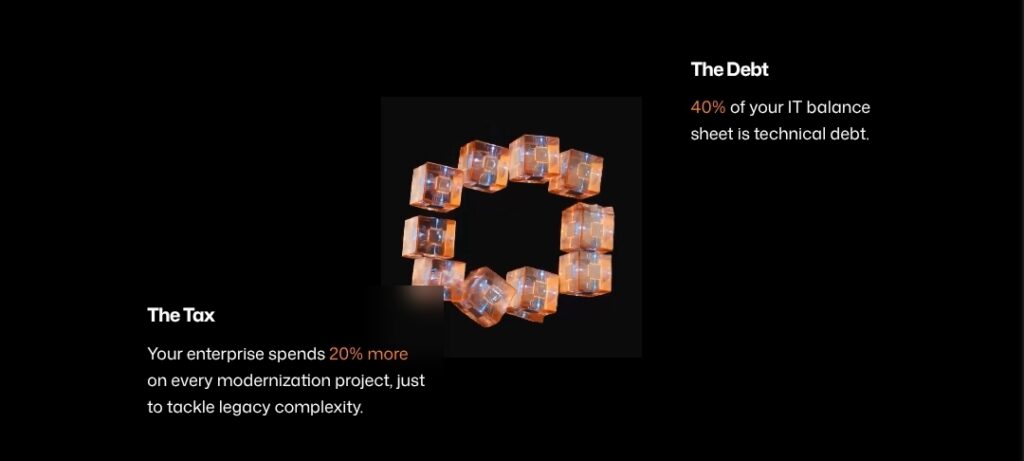
Indium launches The Lifter into a future where technical debt is no longer a liability—but a latent asset.
By decoding legacy systems, enterprises can:
- Extract hidden business logic
- Reuse proven architectures
- Accelerate innovation cycles
This is where the shift occurs: technical debt moves from being a constraint to becoming a foundation for competitive advantage.
Takeaways: The New Logic of Enterprise Modernization
- Technical debt is now a measurable CX risk
- System understanding is emerging as a core enterprise capability
- AI is shifting from generation to interpretation
- “Understand-first” will replace “build-first” modernization
- Platforms like The Lifter will define the next decade of enterprise transformation
Final Word
Indium launches The Lifter not as an incremental innovation, but as a structural reset for enterprise modernization.
The deeper implication is clear: in the next phase of digital transformation, the winners will not be those who build fastest—but those who understand best.
The post Indium launches The Lifter to Transform Technical Debt into CX Advantage appeared first on CX Quest.


You May Also Like
Is Adam Back Satoshi Nakamoto? CEO Responds to New York Times Investigation

Ranking Republican admits to White House reporter he regrets Trump vote: 'Make it stop!'




