

Inside Hack Seasons Conference Cannes: Experts Expose Operational Lessons From Testnet To Mainnet
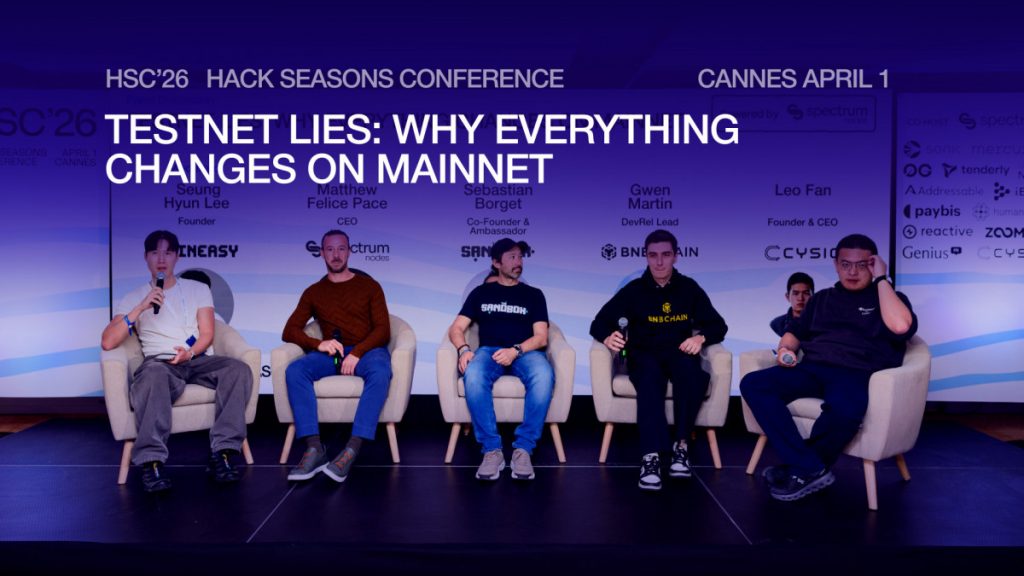
On April 1st, the Hack Seasons Conference in Cannes brought together industry leaders to examine developments and opportunities in institutional digital assets.
One of the key panel discussions, “Testnet Lies: Why Everything Changes on Mainnet,” was focused on the differences between testnets and live blockchain networks. Moderated by Seung Hyun Lee, Founder of CoinEasy, the panel included Matthew Felice Pace, CEO of Spectrum; Sebastian Borget, Co-Founder and Ambassador of The Sandbox; Gwen Martin, DevRel Lead at BNB Chain; and Leo Fan, Founder and CEO of Cysic.
Speakers discussed why projects that perform well in testnets often face challenges on mainnet, citing issues such as scalability, security assumptions, and unexpected user behavior. They highlighted the limitations of testnet incentives and emphasized the need for monitoring, redundancy, and strong operational processes to handle real-world conditions.
The discussion provided a practical perspective on mainnet launches, showing that success in a controlled environment does not guarantee stability or adoption in production.
The panel opened with a core idea: testnets are valuable, but they can also create a dangerous illusion of readiness. The speakers agreed that testnets often look healthier than they really are. Matthew said testnets can be filled with bots and airdrop hunters, making teams believe they have real users when they do not. Sebastian added that testnets are often used as marketing tools, not just engineering environments, which can blur the line between product validation and community farming. Gwen echoed that point, noting that testnets should be treated as a developer playground, not production-ready infrastructure.
Neil brought in another perspective: testnet behavior can create false confidence around security, usability, and scale. In his view, the shift to mainnet exposes weaknesses that testnets simply cannot simulate.
The panel then switched to the realities of launching on mainnet. Once real value is involved, users become adversarial, attackers appear, and systems are pushed far beyond expected limits. The speakers shared examples ranging from RPC failures and blockchain slowdowns to a massive transaction bundle that crashed a sequencer.
A recurring theme was redundancy. The panel stressed that teams need backup RPCs, multiple validators, alternative bridges, strong monitoring, and around-the-clock escalation processes. They also warned that relying too heavily on a single cloud provider or a single infrastructure vendor can become a serious risk.
From Onboarding To Security: Key Operational Lessons For Mainnet Success
Another major topic was user experience. The panel agreed that mainnet users are often not crypto-native, which means onboarding must be much simpler than many blockchain teams assume. Gas fees, wallet setup, and token acquisition can all become blockers. For institutions and Web2 users especially, the speakers said, the burden is on chains to make blockchain invisible, not complicated.
Security was another major concern. The speakers emphasized that audits are helpful but not enough, and that internal security teams, live monitoring, and rapid response plans are essential.
The panel closed with a practical message: launching a chain is not a marketing stunt. It requires real operations, deep technical discipline, and preparation for failure. In the end, the discussion offered a candid look at what happens after the excitement of testnet fades — and why watching the full panel is worth it for anyone building in Web3.
The post Inside Hack Seasons Conference Cannes: Experts Expose Operational Lessons From Testnet To Mainnet appeared first on Metaverse Post.


You May Also Like

Why Stablecoins Don’t Work Without Boring Infrastructure

Reagan adviser: Trump's 'shambolic' admin threatens the republic




