

How to Buy S&P 500 from India — ETF, SIP & Futures Guide
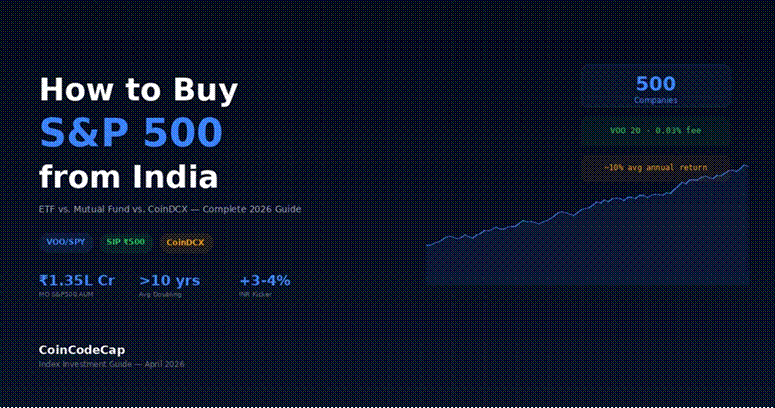
Here’s a number I think about a lot: $10,000 invested in the S&P 500 in 1990 became $150,000 by 2024. No stock picking. No timing. No genius. Just buying an index and waiting.
In rupee terms, the returns are even better because the rupee depreciated from ₹17/dollar in 1990 to ₹85+ in 2026. That $150,000 is roughly ₹1.28 crore — from ₹1.7 lakh. A 75x return.
I came to S&P 500 investing embarrassingly late. I spent years picking Nifty stocks, tracking quarterly results — and my 5-year CAGR was 11%. The S&P 500 did 12.2% in dollars in the same period, before adding the 3-4% annual rupee depreciation kicker. My years of “active” stock picking produced less than a mindless SIP into an index fund I could have set up on Groww in four minutes.
Full trading guide: How to Trade US Stock Futures from India
What the S&P 500 actually is
The S&P 500 is not “the 500 biggest US companies.” It’s 500 companies selected by the S&P Index Committee based on profitability, liquidity, and public float.
Top 10: Apple (~7%), Microsoft (~6.5%), NVIDIA (~6%), Amazon (~3.8%), Google (~3.5%), Meta (~2.8%), Broadcom (~2.2%), Tesla (~1.8%), Berkshire (~1.7%), Eli Lilly (~1.4%). The Magnificent Seven alone account for ~33%.
CoinDCX doesn’t offer the S&P 500 index directly, but lists most stocks that drive it: Apple, NVIDIA, Tesla, Google, Amazon, Meta, Microsoft. Plus the NSDQ100 index (90%+ correlated with S&P 500).
Route 1: Indian Mutual Funds — the ₹500/month SIP
| Fund | Type | Expense Ratio | Min SIP | AUM |
|---|---|---|---|---|
| Motilal Oswal S&P 500 Index Fund | Index Fund | ~0.5% | ₹500 | ₹1.35L Cr |
| Mirae Asset S&P 500 Top 50 ETF | ETF (top 50) | ~0.3% | 1 unit | Smaller |
| ICICI Pru S&P 500 Index Fund | Index Fund | ~0.4% | ₹500 | Growing |
Motilal Oswal S&P 500 Index Fund is the clear leader — ₹1.35 lakh crore AUM. Available on Groww, Zerodha Coin, Kuvera. SIP from ₹500/month. Setup takes three minutes.
I’ve been running ₹5,000/month SIP since mid-2024. Auto-debit, set and forget.
Hidden cost: tracking error. Indian funds deviate from the actual S&P 500 by 0.5-1.5% annually. Over 10 years, that compounds to ~10% less than actual index returns.
Tax treatment: Indian mutual funds investing in foreign securities = debt funds. ALL gains taxed at slab rate. No 12.5% LTCG. No indexation. At 30% bracket, you pay 30% on gains. Significantly worse than owning VOO directly (20% LTCG with indexation after 24 months).
Who should use this: anyone investing ₹500-₹10,000/month who wants zero hassle.
Route 2: US-listed ETFs via Vested or INDmoney
Vanguard S&P 500 ETF (VOO): $620/share, fractional from $1. Expense ratio: 0.03%. That’s ₹30/year per ₹1 lakh invested — vs ₹500/year on Motilal Oswal.
iShares Core (IVV): identical 0.03%. SPDR (SPY): 0.09%, most liquid, preferred by traders.
The expense gap: 0.03% vs 0.5% saves ₹470 per lakh per year. On ₹10 lakh, that’s ₹4,700/year. Add the 20% LTCG tax advantage and VOO wins for investments above ₹10,000/month.
Catch: Forex conversion costs 0.5-1.5% each way. Breakeven: ~₹10,000/month. Below that, use Indian fund. Above that, buy VOO.
Comparisons: CoinDCX vs. Vested | CoinDCX vs. INDmoney
Route 3: CoinDCX — trading the stocks that drive the S&P 500
✍️ WORDPRESS HTML — CoinDCX S&P 500 Coverage
CoinDCX covers stocks representing ~32% of S&P 500 weight, plus NSDQ100 (90%+ correlated). When the S&P 500 drops 7% like it did in March 2026, going long NSDQ100 on CoinDCX with 3x leverage captures the bounce in ways a SIP never can.
More on the index: How to Buy NASDAQ 100 from India
The real cost comparison
| ₹1 Lakh S&P 500 Position | Indian MF SIP | VOO on Vested | CoinDCX (NSDQ100) |
|---|---|---|---|
| Annual expense | ₹500 (0.5%) | ₹30 (0.03%) | ₹4,000-8,000 (funding) |
| Forex cost | ₹0 (handled by fund) | ~₹1,000-1,500 per leg | ₹0 |
| Tax on gains | Slab rate (all gains) | 20% LTCG w/ indexation | Slab rate (speculative) |
| Leverage? | No | No | Up to 20x |
| Short selling? | No | No | Yes |
| Best for | ₹500-10K/month SIP | ₹10K+/month hold | Active trading |
✍️ WORDPRESS HTML — Key Takeaway — Decision Tree
Investing ₹10,000+/month or lump sums? → Buy VOO on Vested or INDmoney. Lower expenses, better tax treatment.
Want to actively trade the index? → NSDQ100 on CoinDCX. Leverage, short selling, 24/7 access.
Want all three? → That’s what I do. SIP for compounding, VOO for core position, CoinDCX for tactical trades.
My actual S&P 500 strategy from India
Layer 1 — Motilal Oswal SIP (₹5,000/month): Auto-debit. Never touch. In 20 years, should compound to ₹40-50 lakh at historical returns plus rupee depreciation.
Layer 2 — VOO on Vested (quarterly lump sums): Bigger ticket justifies forex cost. SIPC protection. Hold for a decade.
Layer 3 — CoinDCX (tactical): When S&P 500 drops 5%+, go long NSDQ100 with 2-3x. When it rallies on euphoria, short for a scalp. CoinDCX profits fund additional Vested purchases.
Related: How to Buy US Tech Stocks Using ₹500 | How to Profit from US Market Crashes
The S&P 500 in 2026 — what’s happening
Down ~4% YTD. Oil prices past $100/barrel amid Iran conflict. AI spending concerns weighing on megacap tech. Tech concentration risk (Mag 7 = 33% of index) amplifying selloffs.
For SIP investors: dips mean lower NAVs and more units per rupee. For CoinDCX traders: volatility creates tradeable moves. Both perspectives are valid.
✍️ WORDPRESS HTML — Risk Warning
FAQs
How can I buy S&P 500 from India?
Three ways: (1) Motilal Oswal S&P 500 Index Fund — SIP from ₹500/month on Groww/Zerodha. (2) Buy VOO on Vested/INDmoney — fractional from $1. (3) Trade NSDQ100 on CoinDCX with leverage.
What is the minimum amount?
₹500/month via Indian mutual fund SIP. $1 (~₹85) for fractional VOO. ₹100 on CoinDCX for NSDQ100 futures.
S&P 500 mutual fund or VOO ETF — which is better?
Under ₹10K/month: Indian mutual fund (no forex, auto-debit). Above ₹10K/month: VOO on Vested (0.03% vs 0.5% expense, better tax). Active trading: CoinDCX NSDQ100.
How is S&P 500 taxed in India?
Indian funds: slab rate on all gains (debt fund classification). Direct VOO: 20% LTCG with indexation after 24 months. CoinDCX: speculative income at slab rate.
Best S&P 500 fund in India?
Motilal Oswal S&P 500 Index Fund — ₹1.35 lakh crore AUM, SIP from ₹500/month.
✍️ WORDPRESS HTML — CTA Banner
Bottom line
The S&P 500 is the most important investment vehicle for Indian investors wanting long-term US exposure. ₹500/month on Groww gets you started. VOO on Vested gets you lowest cost. CoinDCX gets you tactical flexibility. Use all three.
Start the SIP today. It takes four minutes.
Read More in the Series
- CoinDCX US Futures Review: User’s Perspective
- CoinDCX US Futures vs INDmoney Full Comparison
- CoinDCX US Futures vs Vested Finance Full Comparison
- How to Trade US Stock Futures from India
- Funding Rate in US Stock Futures on CoinDCX — What It Costs to Hold a Position
- CoinDCX US Futures vs Angel One
For on-demand analysis of any cryptocurrency, join our Telegram channel.


You May Also Like

Hut 8 AI landlord data center strategy turns Bitcoin collateral into bridge capital

Is Pepecoin (PEPE) Era Ending? 19K Investors Watch This New Cheap Altcoin

Hyperliquid Enters Top 10 Crypto With New ATH, But How High Will It Be If It Overtakes Ethereum?



