Oil Prices Fall as U.S. Blockade of Strait of Hormuz Triggers International Backlash
TLDR
- Brent crude fell 0.3% to $99.04 and WTI dropped 1.6% to $97.47 on Tuesday
- China called the U.S. naval blockade of Iranian ports “dangerous and irresponsible”
- Saudi Arabia warned the blockade could push Iran to escalate the conflict
- A second round of U.S.-Iran talks may happen in Islamabad before the ceasefire ends
- The IEA says global oil supply has dropped by 10.1 million barrels per day since the war began
Oil prices fell on Tuesday as international criticism of the U.S. naval blockade of Iranian ports grew, while markets watched for signs of progress toward a peace deal between Washington and Tehran.
Brent crude futures dropped 0.3% to $99.04 a barrel. West Texas Intermediate fell 1.6% to $97.47 a barrel.
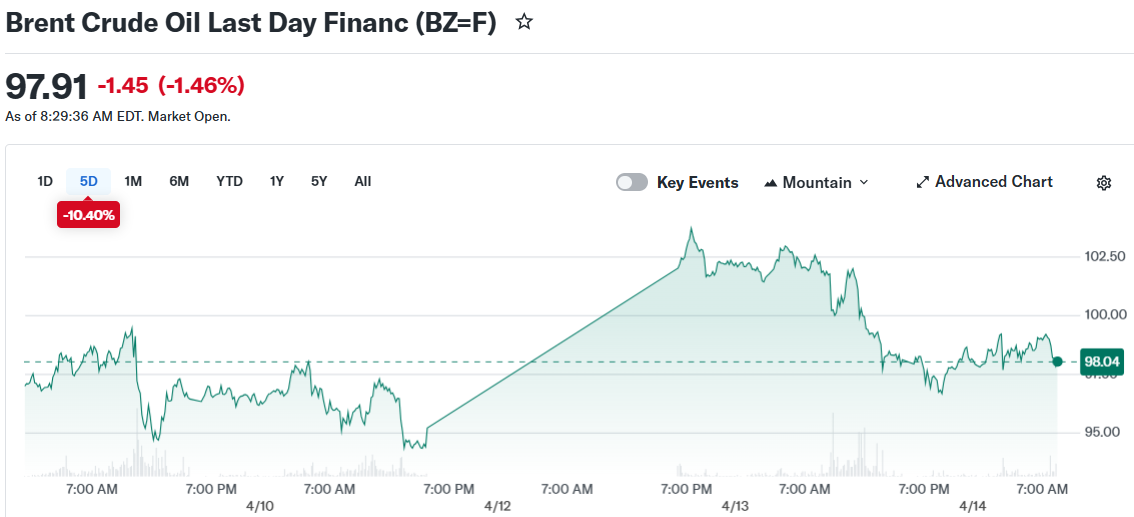 Brent Crude Oil Last Day Financ (BZ=F)
The U.S. blockade began on Monday. President Trump said it was designed to pressure Iran into a lasting peace agreement. The blockade covers Iranian ports as well as parts of the Persian Gulf, Gulf of Oman, and sections of the Arabian Sea.
China pushed back on the move Tuesday. A foreign ministry spokesperson called the blockade “dangerous and irresponsible,” according to the South China Morning Post.
Saudi Arabia also raised concerns. Arab officials told the Wall Street Journal that Riyadh is urging the U.S. to lift the blockade, fearing it could push Iran to escalate the conflict.
China’s President Xi Jinping laid out a four-point peace plan after meeting with the Crown Prince of Abu Dhabi, adding to the international push for de-escalation.
Despite the diplomatic noise, Trump said Monday that the “right people” in Iran still want to make a deal. He confirmed Iranian officials had contacted the White House expressing interest in talks.
Washington’s key demands include a full reopening of the Strait of Hormuz and Iran agreeing to stop uranium enrichment for 20 years.
Vice President JD Vance, who led the U.S. delegation at last weekend’s talks in Islamabad, said the discussions were not a failure. He told Fox News there were “good conversations” and that the “ball is in Iran’s court.”
Pakistan has offered to host a second round of talks before the current two-week ceasefire expires. Both Pakistani and Iranian officials confirmed this to Reuters.
The Market Impact
WTI futures closed below Brent crude on Tuesday for the second consecutive day. The last time this happened before April 2 was nearly four years ago. Analysts see this as a sign that markets are pricing in some optimism over a peace deal.
The International Energy Agency warned that prices may not yet reflect the full extent of the supply shock.
The Supply Picture
The IEA reported that global oil supply fell by 10.1 million barrels per day in March, down to 97 million barrels per day. It called the disruption the largest in history.
Oil demand is also expected to contract by 80,000 barrels per day this year.
The U.S. has deployed 16 warships to the Middle East, though none are currently inside the Persian Gulf.
Israel and Lebanon were set to begin direct peace talks in Washington on Tuesday, with Secretary of State Marco Rubio taking part in the discussions.
The post Oil Prices Fall as U.S. Blockade of Strait of Hormuz Triggers International Backlash appeared first on CoinCentral.


You May Also Like

JPMorgan CFO Flags Regulatory Arbitrage Risks From Stablecoins

Chainlink Whale Activity Rises While Price Bleeds for 7 Straight Months