

Gold Price Warning: Rejection at $4,800 Signals Possible Crash to $4,100
Gold is in a nervous spot. The metal is moving through a sideways phase with choppy price action. This comes after one of its biggest one-day drops in more than ten years, down nearly 6%. The gold price is trading at $4709.
Gold briefly fell below $4,660 on Friday but bounced back fast, holding above $4,700. That steadiness comes from geopolitical trouble in the Middle East. That uncertainty keeps pushing people toward safe-haven assets, even as broader economic pressure builds.
What’s Driving Gold Price Right Now
The conflict between the United States and Iran is still a big driver, especially around the Strait of Hormuz. About 20% of the world’s oil flows through that waterway. Any disruption there sends inflation worries higher. The price of oil is holding above $98 per barrel, thus pushing the markets to reconsider the path interest rates will follow.
The USD index was trading at a level of 98 with rapid climbs whenever there is uncertainty in the energy market and geopolitics becomes tense. Even modest moves of 0.2% to 0.3% in the dollar have pressured gold, as a stronger dollar raises costs for international buyers.
Expectations for Federal Reserve rate cuts have also faded. Markets now expect a pause instead of easing. That keeps a lid on the gold price for now. Key economic events are set for April 29–30, with the Federal Reserve decision followed by Q1 GDP and PCE inflation data, and these releases will likely drive the gold’s price next move.
On the flow side, the data shows clear profit-taking. Gold ETFs recorded about $12 billion in outflows in March 2026, marking the largest monthly exit on record. In shorter windows, SPDR Gold Shares saw more than $4.5 billion withdrawn within a single week, with another $2.9 billion leaving in a single session.
These figures point to large players locking in gains after gold’s strong rally earlier this year. Even with that, central banks continue to accumulate, with projections near 850 tonnes of purchases in 2026, which supports the broader outlook.
Here’s What The Gold Price Chart Is Showing
The setup aligns with analysis shared by market analyst Elena Ben, who identified a rejection zone between $4,780 and $4,800. Price has tested this range multiple times and failed to break through, forming lower highs along the way. That structure points to weakening buying strength in the short term.
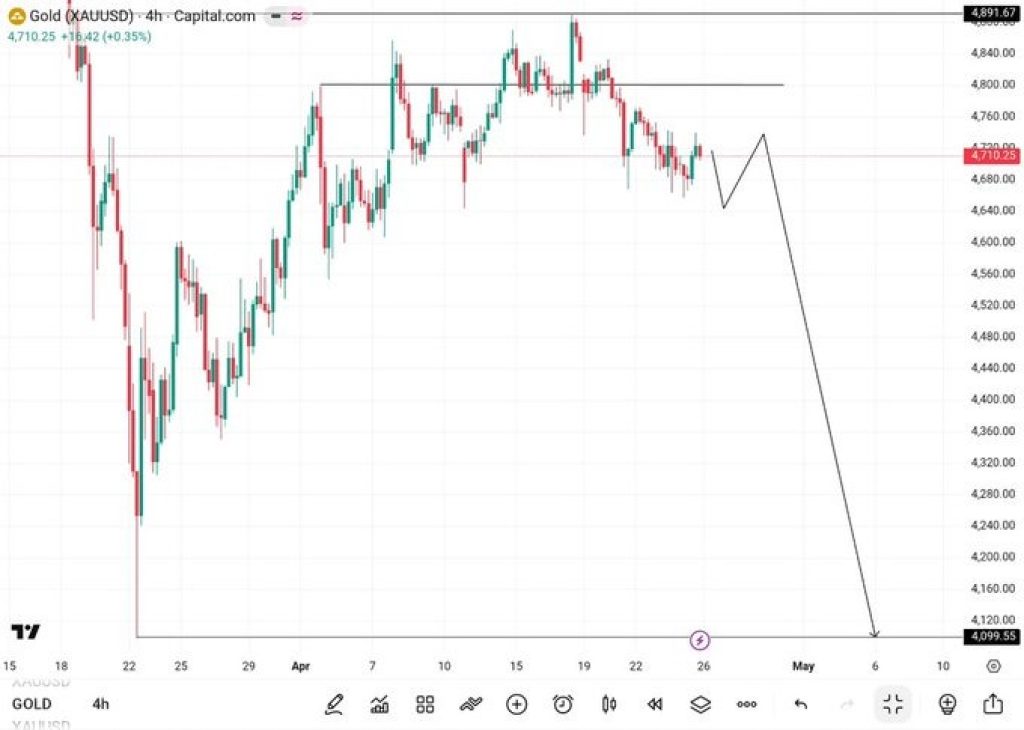 Source: X/ElenaBen
A recovery toward the $4,730 to $4,750 region is still possible. But the key condition remains clear. As long as the $4,800 zone caps price, sellers remain in control.
Also, the $4,650 level has become critical. A confirmed break below this support could accelerate downside pressure and open the path toward deeper levels.
Read Also: Here’s Where Kaspa (KAS) Price Could Be Headed This New Week
Why Is $4,100 Now in Focus For Gold?
The $4,100 level stands out as a major downside target. It aligns with a strong support zone from earlier consolidation phases and would mark a full reset after gold’s rally of more than 70% earlier in 2026.
This does not invalidate the broader bullish outlook. Many institutions still expect gold to test the $5,000 to $6,000 range before the year ends. But in the short run, the market is taking a breather after a long run upward.
The Gold price is stuck between two forces: people buying because of world tension, and pressure from the economy. In case the Middle East situation deteriorates further, buying interest can emerge. In case of persistent inflation and an unchanged aggressive stance by the Fed, gold risks further losses.
For now, the key levels are clear. Resistance stands at $4,800, and support sits at $4,650. A break on either side will likely define the gold’s price next major move, with $4,100 in focus if support fails.
Frequently Asked Questions

Gold is priced in dollars, so when the U.S. dollar strengthens, it becomes more expensive for international buyers to purchase gold. This often reduces demand and can push gold prices lower.
A move toward $4,100 is possible if the gold price loses the $4,650 support level. That level acts as a key floor, and a breakdown could trigger further selling, especially if macro conditions like high interest rates and weaker demand continue.
Higher interest rates make yield-bearing assets like bonds more attractive, reducing demand for gold. When rate cuts are expected, gold often performs better.
Subscribe to our YouTube channel for daily crypto updates, market insights, and expert analysis.
The post Gold Price Warning: Rejection at $4,800 Signals Possible Crash to $4,100 appeared first on CaptainAltcoin.


You May Also Like

turnaround drags, China sales slump

Israel orders evacuations in Lebanon, military activity surges




