

Must Read
A screenshot from Kalikasan's presentation on rare earths and minerals in the Philippines that could be extracted under Pax SilicaA screenshot from Kalikasan's presentation on rare earths and minerals in the Philippines that could be extracted under Pax Silica
Sci-tech coalition opposes Pax Silica over ‘resource plunder,’ env’t harms
For feedback or concerns regarding this content, please contact us at crypto.news@mexc.com
MANILA, Philippines – The Philippines is among the most mineralized countries in the world — a status that has transformed the nation into a strategic “jackpot” for foreign interests, says Ana Celestial, programs officer at the Kalikasan People’s Network for the Environment (Kalikasan PNE).
The country ranks third in gold, fourth in copper, fifth in nickel, and sixth in chromite deposits around the world.
The mineral riches of the country, particularly in terms of rare earth metals needed in high-tech manufacturing, have brought it into a deal with the US called Pax Silica.
While several experts have commended Pax Silica as a way to strengthen the country’s strategic geopolitical alignments through economic partnerships, with implications to national security, and its job-creation potential, Kalikasan PNE and other science- and tech-based groups have expressed vehement opposition towards it.
Defense Secretary Gilberto Teodoro Jr. said Pax Silica is a “complement to our defense relations.”
Kalikasan PNE, AGHAM (AGHAM Advocates of Science and Technology for the People) and CPU (Computer Professionals Union) form part of a newly relaunched STOP US War (Scientists and Technologists Oppose the US War) coalition — originally formed in the 2000s — that oppose an “imperial US,” and the wars it plays a part in.
While groups such as the Kilusang Magbubukid ng Pilipinas and the left-leaning Makabayan bloc of Congress have earlier voiced their issues with Pax Silica, the new coalition held a forum, Tuesday, April 28, where Kalikasan’s Celestial spoke in more detail about the alleged harms that Pax Silica will bring, particularly with regards to mineral extraction.
Celestial said the country holds an estimated $170 billion in nickel deposits, ranks fourth globally in copper reserves, with four types of rare earth metals that are valuable to the US, including scandium, neodymium, cerium, and lanthanum, which have been surveyed in Palawan, Samar, Surigao, and Zambales.
These rare earth metals, she said, are the essential raw materials that become vital components for high-tech electronics, semiconductors, other equipment, and data centers.
Scandium forms durable, lightweight alloys fit for aerospace structure such as aircraft fuselage and fuel tanks. A large majority of so-called “permanent magnets” are made out of neodymium that can be used in wind turbines, electric vehicles, earphones, hard drives, and the vibrating mechanism of phones. Cerium is used in “polishing glass screens, camera lenses, and silicon wafers,” and also made into aerospace alloys. Lanthanum can be used as a component in camera lenses, and as a component in rechargeable batteries for hybrid engines.
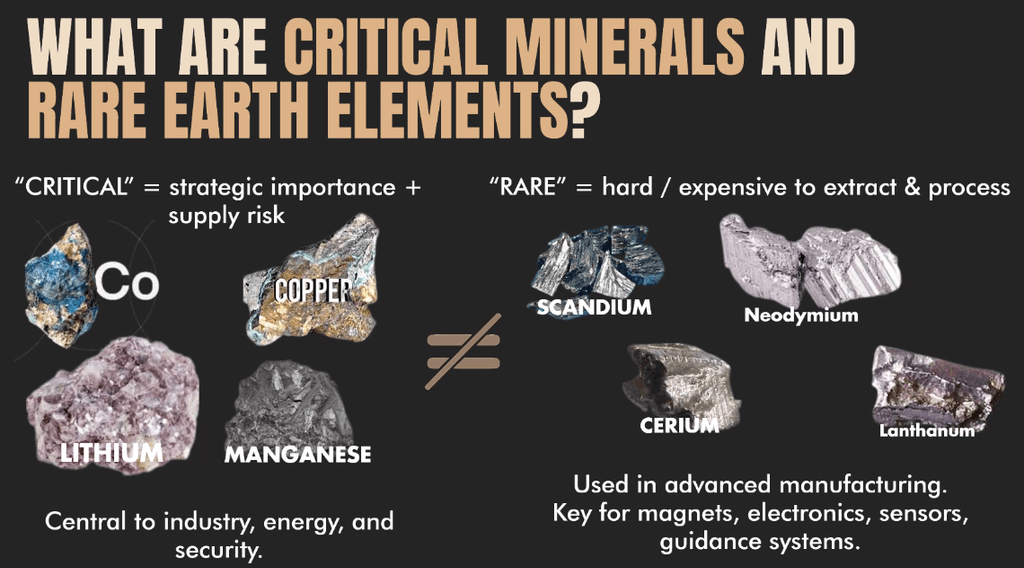 A screenshot from Kalikasan’s presentation on rare earths and minerals in the Philippines that could be extracted under Pax Silica
Yet, Celestial said there is a deep “hypocrisy of the US government” as while these rare earth metals have been publicized as important to high-tech electronics, and green technologies, these can be “dual use,” and could be used in “war machines” such as F-35 jets, navy destroyer ships, and laser-guided missile systems.
Celestial called Pax Silica a form of “neo-colonization” and continued US imperialism.
Similar to earlier criticism by Kilusang Magbubukid ng Pilipinas and Makabayan bloc, the group doubts that the new deal will have the Philippines moving up the value chain as far as mining and mineral processing is concerned.
She claimed that despite decades of the Philippine Mining Act, enacted in 1995, the promised transfer of technology and local capacity building has never materialized. Major foreign corporations, she claimed, extract ore without sharing advanced processes or teaching Filipinos how to build heavy machinery.
Celestial noted, “Tinuturo ba yun sa mga local mining engineers natin? Yung mga engineers ba natin nakadevelop ng capacity para dito? Hindi naman.” (Do they teach our local engineers? Are our engineers able to build up our own capacity for this? No.)
Instead, the mining industry remains merely “export-oriented” shipping out raw or simply processed minerals while keeping the local economy dependent on foreign corporations.
The extraction of these resources is not a path to national industrialization, she said, and rather, it is a system where “extraction and processing are reorganized around foreign demand” and the “environmental cost is left behind while value moves outward.”
The social cost of Pax Silica will also fall heavy on the indigenous population, she warns. Approximately, in 2024, “72 to 75% ng applications ng mining permits ay nasa ancestral domains ng mga katutubo,” leading to mass displacement and the militarization of indigenous lands. (About 72 to 75% of mining permit applications are within the ancestral domains of indigenous people.)
When mountains are “hollowed out” for minerals, watersheds are destroyed, and the Philippines’ natural geography is turned potentially into a site of man-made disasters. An increased and more pointed demand for mining, as a result of Pax Silica, may put the indigenous people further at risk, she warned.
Celestial also raised questions about the “military nature” of the deal, through the development of a 4,000-acre Economic Security Zone (ESZ) in New Clark City. Located near former US military bases, this area is being built up with ammunition hubs, while the Balikatan military drills continue. The group foresees the industrial hub as playing a part in the US’ overall military programs. (READ: What is Pax Silica? What are its goals, and what concerns does it raise?)
As an ESZ, the hub will operate under US common law and will be granted diplomatic immunity, and Celestial questioned as well whether labor protections for Filipino workers would be upheld. – Rappler.com


Disclaimer: The articles reposted on this site are sourced from public platforms and are provided for informational purposes only. They do not necessarily reflect the views of MEXC. All rights remain with the original authors. If you believe any content infringes on third-party rights, please contact crypto.news@mexc.com for removal. MEXC makes no guarantees regarding the accuracy, completeness, or timeliness of the content and is not responsible for any actions taken based on the information provided. The content does not constitute financial, legal, or other professional advice, nor should it be considered a recommendation or endorsement by MEXC.
You May Also Like

‘A huge disservice’ – White House warns ICBA as CLARITY Act risks delay
The post ‘A huge disservice’ – White House warns ICBA as CLARITY Act risks delay appeared on BitcoinEthereumNews.com. The momentum for the crypto market structure
Share
BitcoinEthereumNews2026/04/29 18:06

Visa (V) Stock Surges Over 5% on Record-Breaking Q2 Results
Visa (V) stock soared 5% following exceptional Q2 results: $3.31 EPS, $11.2B revenue, and 17% YoY growth—the best performance since 2022. The post Visa (V) Stock
Share
Blockonomi2026/04/29 17:59

WTI Price Forecast: Inches closer to $100 amid fears of US blockade extension on Iran
The post WTI Price Forecast: Inches closer to $100 amid fears of US blockade extension on Iran appeared on BitcoinEthereumNews.com. West Texas Intermediate (WTI
Share
BitcoinEthereumNews2026/04/29 18:08



