

Gold Prices Fall as US-Iran Tensions Escalate Over Strait of Hormuz
TLDR
- Gold dropped as much as 1.9%, trading at around $4,562–$4,571 per ounce on Monday
- Trump announced “Project Freedom” to guide ships through the Strait of Hormuz
- Iran’s navy claimed it turned away US warships and warned against unauthorized movement through the strait
- A stronger dollar and oil-driven inflation are pushing central banks toward higher interest rates, which hurts gold
- Central banks added gold at the fastest pace in over a year in Q1, showing long-term demand remains strong
Gold fell sharply on Monday as traders kept a close eye on rising tensions between the US and Iran over the Strait of Hormuz, one of the world’s most important shipping routes.
Spot gold dropped as much as 1.9% before settling down around 1.1%, trading at $4,562–$4,571 an ounce in London trading. Gold futures also fell 1.5% to $4,573.94.
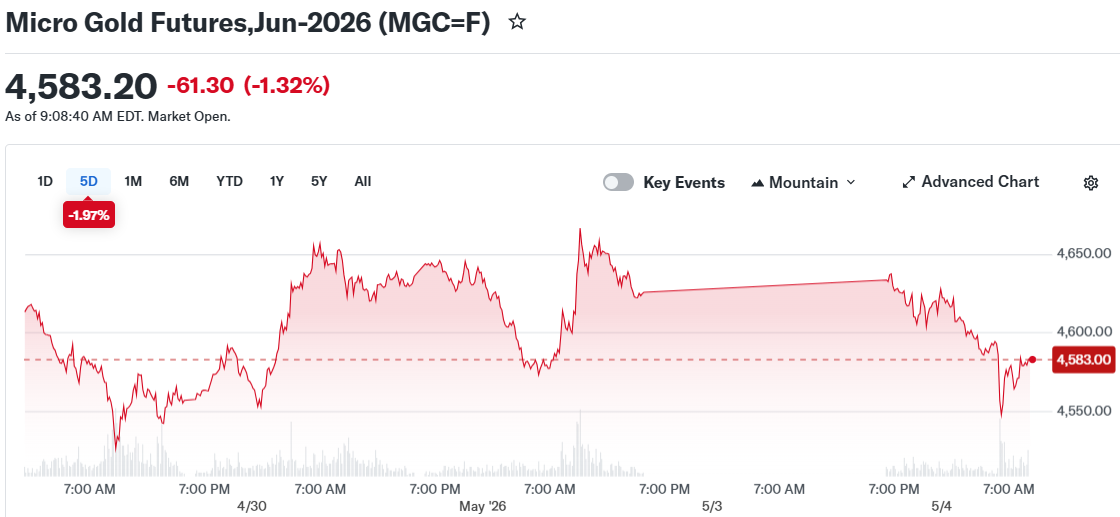 Micro Gold Futures,Jun-2026 (MGC=F)
The drop came after President Donald Trump announced “Project Freedom” over the weekend. The plan aims to help reopen shipping traffic through the Strait of Hormuz, which handles about a fifth of the world’s oil supply.
Trump said the US would begin guiding ships not involved in the Iran conflict through the strait starting Monday. He gave few details on how the plan would work.
An unnamed Iranian source told state media that Tehran “will not be bullied” and had prepared other scenarios ready to activate if needed. Iran’s military also warned that no commercial vessels should move through the strait without approval from its armed forces.
The Associated Press reported that the US-led Joint Maritime Information Center set up an “enhanced security area” south of traditional shipping lanes. The center said typical routes through the strait were “extremely hazardous” due to naval mines that have not been fully cleared.
Oil and Inflation Pressure Gold
Brent crude futures jumped back above $110 a barrel on Monday. Oil has stayed well above pre-war levels since the conflict began in late February, raising inflation concerns worldwide.
Higher oil prices are pushing central banks toward tighter monetary policy. Gold is a non-yielding asset, meaning it tends to do worse when interest rates rise.
The US dollar also firmed on Monday, adding more pressure on gold. A stronger dollar makes gold more expensive for buyers in other currencies, which can reduce demand.
Manav Modi, a commodities analyst at Motilal Oswal Financial Services, said a stronger dollar and oil-driven inflation fears are prompting hawkish signals from major central banks.
Gold has now lost around 12% since the war began at the end of February.
Long-Term Demand Still Solid
Despite the recent declines, some market watchers remain positive on gold’s longer-term outlook.
The World Gold Council reported that central banks added to their gold holdings at the fastest pace in more than a year during the first quarter.
Tether Holdings also extended a buying streak that has made it the largest known non-bank, non-government holder of gold in the world.
Traders this week will watch the US Treasury’s borrowing plans, Federal Reserve speakers, and the monthly jobs report for clues on the direction of interest rates.
The post Gold Prices Fall as US-Iran Tensions Escalate Over Strait of Hormuz appeared first on CoinCentral.


You May Also Like

Not a loophole: Singapore AI export controls let China tap US AI legally

Exclusive interview with Smokey The Bera, co-founder of Berachain: How the innovative PoL public chain solves the liquidity problem and may be launched in a few months

Iran’s army chief warns of ‘total destruction’ for ground invasion



